Fine wine occupies a singular position in the world of alternative assets. Unlike equities or property, a great bottle of Burgundy or a case of first-growth Bordeaux carries with it centuries of tradition, a living provenance, and a capacity to appreciate in ways that defy conventional financial logic. For collectors and investors across Australia and the APAC region, understanding the mechanics of this market is not merely academic. It is the difference between building a collection of genuine, lasting worth and accumulating expensive bottles that underperform or, worse, diminish in value through mismanagement or misinformation. This guide offers the clarity and rigour that discerning buyers deserve.
Table of Contents
- What makes fine wine a unique market?
- How the fine wine market works: Participants, channels, and buying modes
- Valuing fine wine: Factors, models, and expert frameworks
- Strategic management: Maximising value and avoiding pitfalls
- Why the real value of fine wine is in the details most investors miss
- Expert support for your fine wine journey
- Frequently asked questions
Key Takeaways
| Point | Details |
|---|---|
| Fine wine is an asset | The fine wine market operates with its own rules, risks, and rewards distinct from traditional assets. |
| Provenance is crucial | A single gap in a wine’s chain of custody can erase much of its market value. |
| Storage protects returns | Maintaining proper temperature and humidity is non-negotiable for safeguarding investments. |
| Expert advice saves money | Leveraging professional appraisals and management helps avoid costly mistakes and optimises outcomes. |
What makes fine wine a unique market?
Fine wine is not simply expensive wine. It is defined by a precise constellation of qualities: recognised brand or domaine, proven longevity in the bottle, documented provenance, and a price point that reflects genuine scarcity and demand. A 1996 Krug Clos du Mesnil or a 2010 Pétrus is not valued primarily for what is in the glass today, but for what it represents across time, geography, and culture.
The participants who shape this market are equally distinct. Auction houses such as Christie's, Sotheby's, and Hart Davis Hart set public price benchmarks through competitive bidding. Specialist brokers facilitate private trades, often at negotiated premiums. Merchant houses and négociants source and distribute across global networks. Each channel carries its own fee structures, risks, and advantages, and understanding these layers is foundational for any serious collector.
Provenance is, in many respects, the soul of fine wine value. A bottle with an unbroken chain of custody from the château to a temperature-controlled cellar commands significantly more than an identical bottle with gaps in its history. As the Wine Investment Guide by the International Wine Authority notes, poor provenance can nullify value entirely, and counterfeits remain a persistent risk across the market.
The fine wine market also exhibits what economists call the Veblen effect: at the ultra-premium tier, rising prices can actually increase demand rather than suppress it, because exclusivity itself becomes the commodity. This dynamic rewards patience and discernment in equal measure.
Key characteristics that set fine wine apart as an asset class include:
- Illiquidity: There are no instant sales. Exit requires planning, timing, and access to the right channels.
- Low correlation: Fine wine's performance tends to move independently of equities and bonds, offering genuine portfolio diversification.
- Volatility: Returns can be higher than traditional assets, but so can the swings, particularly for emerging regions or lesser-known producers.
- Optimal hold period: The ideal holding window is broadly 8 to 15 years, aligning with peak drinking windows and auction demand cycles.
- Counterfeit risk: Sophisticated forgeries exist at every price point, making authentication non-negotiable.
For collectors seeking bespoke wine buying or those considering selling your collection, understanding these fundamentals is the first and most important step. The Bordeaux market in Australia offers a compelling case study in how global demand intersects with local appetite for fine wine investment.
"The fine wine market rewards those who treat it with the same rigour they would apply to any serious asset class: with research, patience, and an unflinching eye for detail."
How the fine wine market works: Participants, channels, and buying modes
With an understanding of the market's defining traits, let's turn to the practical side: how collectors interact with it and what options they have.
The primary routes to market are well established, though each carries distinct trade-offs. Physical ownership remains the most common mode, acquired through auction, broker, or merchant. En primeur, or buying wine as futures before it is bottled, offers access to sought-after allocations at pre-release prices, though it demands patience and confidence in the producer.
Primary buying channels compared:
| Channel | Access | Cost | Liquidity | Risk |
|---|---|---|---|---|
| Auction (Christie's, Sotheby's) | Broad | Buyer's premium 20-25% | Quarterly | Moderate |
| Specialist broker | Curated | Negotiated | Variable | Lower |
| En primeur | Early allocation | Pre-release pricing | Lowest | Higher |
| Online platform | Wide | Variable fees | Moderate | Higher |
| Merchant/négociant | Broad | Retail margin | Low | Moderate |
Storage is not a peripheral concern. It is a core determinant of value. Proper cellaring requires a consistent temperature of around 13°C (55°F) and relative humidity of 60 to 70 per cent. Deviation from these parameters, even briefly, can accelerate oxidation, compromise corks, and render a bottle unsaleable. The International Wine Authority confirms that storage at 55°F and 60 to 70 per cent relative humidity is critical, with liquidity best achieved through quarterly auction cycles.
The steps to entering the market with confidence are:
- Define your objectives. Are you collecting for pleasure, investment, or both? Your answer shapes every subsequent decision.
- Select your channel. Auction suits buyers who want price transparency; brokers suit those who value curation and relationship.
- Establish provenance. Insist on documentation for every acquisition, regardless of the seller's reputation.
- Arrange professional storage. Never compromise on cellaring conditions. A professional facility is worth every dollar.
- Plan your exit. Know before you buy how and when you intend to sell.
Pro Tip: Attend reputable wine events and tastings to build relationships with brokers and auctioneers. Access to the finest allocations is often relationship-driven, not simply transactional.
For collectors exploring investment channels, the landscape rewards those who invest time in understanding the market's rhythms before committing capital.
Valuing fine wine: Factors, models, and expert frameworks
With market access mapped out, understanding valuation frameworks is essential for protecting and growing your investment.
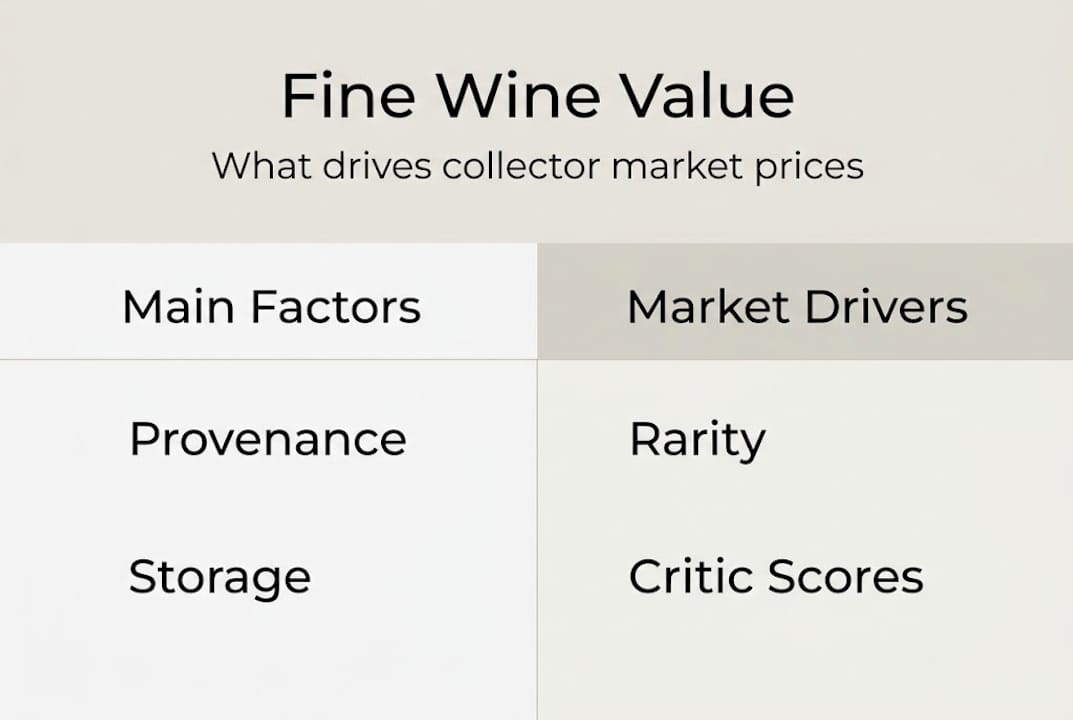
Fine wine valuation is both science and art. It draws on quantifiable data, auction records, critic scores, and market trends, while also requiring the kind of nuanced judgement that only comes from deep experience. The key drivers of value are:
- Provenance: An unbroken, documented chain of custody from producer to current owner. A single gap can reduce value materially.
- Vintage quality: Exceptional years command premiums that persist for decades. The 2010 Bordeaux vintage, for example, continues to appreciate as bottles enter their drinking window.
- Critic scores: Ratings from Robert Parker, Jancis Robinson, and the Wine Advocate carry significant market weight, particularly for Bordeaux and Burgundy.
- Rarity: Limited production, single-vineyard designations, and library releases create scarcity that underpins price.
- Storage history: Bottles from impeccably maintained cellars attract premiums at auction; those with uncertain histories are discounted or passed over entirely.
The most commonly used valuation models include:
| Model | Method | Best for |
|---|---|---|
| Auction record analysis | Recent hammer prices for identical bottles | Benchmark pricing |
| Comparative market analysis | Similar vintages, producers, and formats | Relative value |
| Trend forecasting | Price trajectory over 5 to 10 years | Long-term planning |
| Expert appraisal | Independent assessment by a specialist | Insurance, probate, sale |
The International Wine Authority is clear that counterfeits are common, and that the optimal holding period of 8 to 15 years aligns with peak auction demand. This makes independent wine appraisals not a luxury but a necessity for any serious collector.
Pro Tip: Commission professional valuations at least every three years, or whenever a significant market event occurs, such as a producer's death, a landmark auction result, or a major critic reassessment. Values shift, and your records should reflect current market reality.
For estates and families navigating inheritance, probate wine values require particular rigour. Courts expect independent, market-led assessments, not sentimental or speculative figures.
Common valuation pitfalls to avoid:
- Relying on purchase price as a proxy for current value
- Accepting verbal provenance assurances without written documentation
- Ignoring the impact of label condition, fill level, and capsule integrity on auction estimates
- Assuming all vintages from a great producer carry equal investment merit
Strategic management: Maximising value and avoiding pitfalls
Armed with valuation know-how, effective management ensures your fine wine holdings deliver over the long term.
The finest collection in the world can be undone by poor stewardship. Temperature fluctuations, inadequate humidity, vibration, and light exposure are the silent destroyers of fine wine value. Best-practice cellaring conditions are non-negotiable:
- Temperature: Maintain a consistent 12 to 14°C. Fluctuations, even within this range, accelerate ageing unpredictably.
- Humidity: Target 65 to 70 per cent relative humidity to preserve cork integrity and prevent label deterioration.
- Darkness: UV light degrades wine rapidly. Professional facilities use UV-filtered lighting as standard.
- Vibration control: Even low-level vibration from nearby machinery or traffic can disturb sediment and disrupt the ageing process.
- Security: High-value collections require monitored, access-controlled environments. Insurance underwriters increasingly require this as a condition of coverage.
Insurance and documentation are the twin pillars of portfolio protection. Every bottle should be catalogued with purchase records, provenance documentation, storage history, and current valuations. A collection without proper records is, in the eyes of insurers and courts, a collection without proven value.
"The discipline of meticulous record-keeping is, in many ways, the most unglamorous and most important act a collector can perform. It is the foundation upon which all other value rests."
The optimal holding period of 8 to 15 years is not arbitrary. It reflects the convergence of peak drinking windows, auction demand cycles, and the time required for market sentiment to fully price in a wine's quality and rarity. Selling too early forfeits appreciation; selling too late risks missing the window of peak liquidity.
A structured approach to cellar management includes regular portfolio reviews, ideally annually, to assess which bottles are approaching their optimal window, which require revaluation, and which might be candidates for sale or consumption. Exit planning should begin at least two years before intended sale, allowing time for valuation, consignment, and auction scheduling.
Pro Tip: Rotate your review calendar to align with major auction seasons, typically March to May and September to November in the Southern Hemisphere. This maximises your exposure to peak buyer demand and competitive bidding.
Why the real value of fine wine is in the details most investors miss
Step back from the headline numbers and the celebrated labels, and a more instructive picture emerges. The collectors who consistently outperform are not those who chase the most famous names or the highest Parker scores. They are those who master the details that most investors dismiss as peripheral.
A single provenance slip, an undocumented period in a private cellar, a humidity reading that drifted below 55 per cent for one summer, can erase years of appreciation in a single auction room. We have seen impeccably credentialed bottles pass unsold because the documentation was incomplete. The market is unforgiving in this regard, and rightly so.
The Veblen effect is equally treacherous for the status-driven buyer. Purchasing ultra-premium wine because it is expensive and prestigious, rather than because it represents genuine value at that price, distorts strategy and inflates risk. The most rewarding collections are built on knowledge, not on the desire to impress.
Patience, too, is undervalued. Unlike equities, where liquidity provides a psychological safety net, fine wine demands forward planning and genuine conviction. The collectors who thrive are those who approach each acquisition as a long-term commitment, not a short-term trade.
Expert support for your fine wine journey
Building and managing a fine wine collection of genuine worth requires more than enthusiasm. It demands expertise, access, and the kind of independent, market-led guidance that only a specialist can provide.
At Cellared Fine Wine, we work with collectors, investors, and estates across Australia and the APAC region to ensure every decision is informed, every valuation is rigorous, and every acquisition is purposeful. Whether you need independent appraisal services for insurance or probate, or bespoke cellar management solutions to protect and grow your holdings, our team brings deep market knowledge and a highly personal approach to every engagement. Fine wine rewards those who take it seriously. We help you do exactly that.
Frequently asked questions
What factors most determine a fine wine's market value?
Provenance, critic scores, vintage quality, rarity, and storage history are the primary drivers, with poor provenance capable of nullifying value entirely regardless of the wine's pedigree.
How long should I hold fine wine for the best investment results?
The optimal holding period is broadly 8 to 15 years, aligning with peak drinking windows and the auction demand cycles that generate the strongest competitive bidding.
Can poor storage reduce my collection's value?
Absolutely. Storage at 55°F and 60 to 70 per cent relative humidity is considered critical; deviations can accelerate deterioration and render bottles unsaleable at auction.
Is the fine wine market liquid if I need to sell quickly?
The fine wine market is considered illiquid by nature, with most sales occurring through scheduled quarterly auctions and specialist brokers rather than instant or on-demand transactions.
Recommended
- Wine Appraisals & Valuations | Cellared | Bespoke Wine Buying, Valuation & Cellar Management
- Sell Your Wine Collection | Cellared | Bespoke Wine Buying, Valuation & Cellar Management
- Wine & Spirits Valuations | Family Law, Probate & SMSF | Cellared | Bespoke Wine Buying, Valuation & Cellar Management
- Bespoke Fine Wine Buying | Cellared | Bespoke Wine Buying, Valuation & Cellar Management
- Wine Vintage Basics: What It Means and Why It Matters