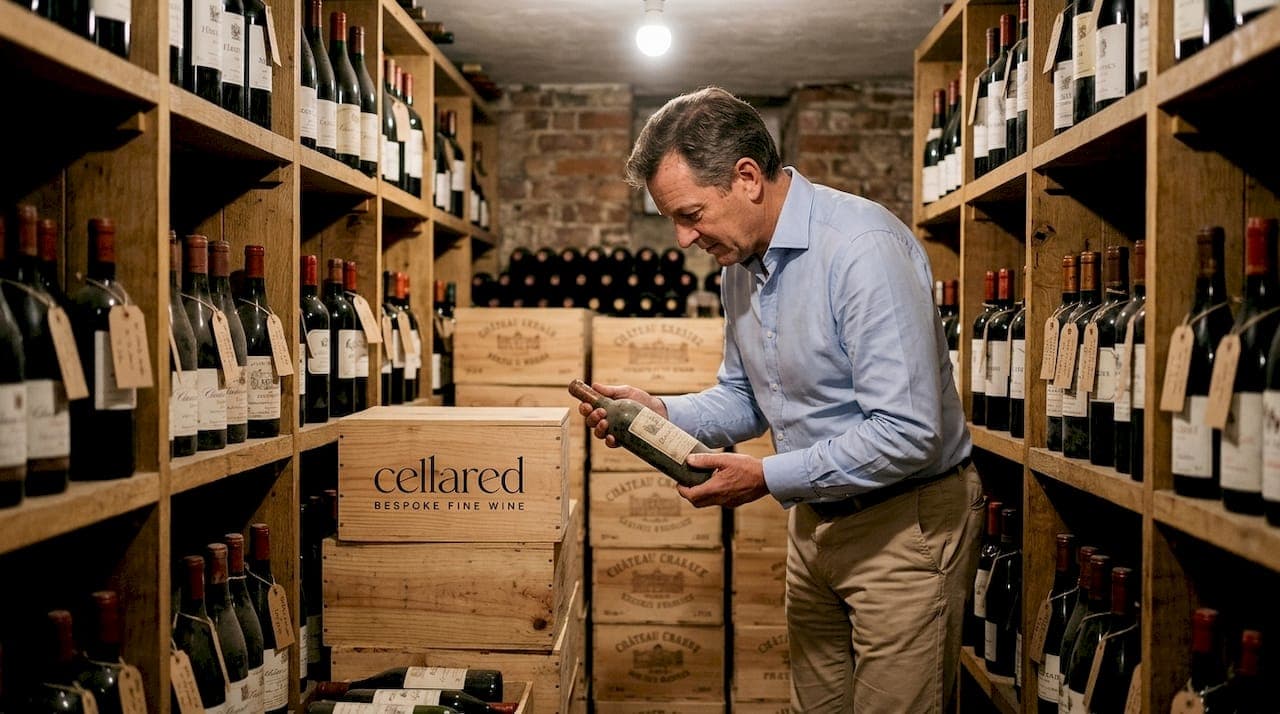
Not every exceptional bottle is an investment-grade wine, and for collectors in Australia and across the APAC region, this distinction carries genuine financial weight. The fine wine market rewards precision: a Penfolds Grange from a celebrated vintage may appreciate dramatically over a decade, while a similarly priced release from a lesser year quietly flatters only the palate. Understanding how to separate the truly remarkable from the merely outstanding requires a disciplined eye, market literacy, and a structured approach to evaluation. This guide walks through the essential criteria, practical tools, and regional considerations that every serious collector needs to navigate this rewarding but nuanced market.
Table of Contents
- What makes a wine investment-grade?
- Key evaluation criteria for investment-grade wines
- Methodologies: Tools and strategies for identifying investment-grade wine
- Risks, common mistakes, and Australian nuances
- The real-world challenge: Why the market moves, and what most guides miss
- Explore professional wine identification and valuation services
- Frequently asked questions
Key Takeaways
| Point | Details |
|---|---|
| Prestigious regions matter | Investment-grade wines usually come from renowned wine areas with strong track records. |
| Evaluation is multi-factor | Assessing investment potential relies on critic scores, provenance, condition, and market liquidity. |
| Professional storage is crucial | Proper cellar management and bonded storage maximise both authenticity and long-term value. |
| Beware of risks | Investors must watch out for fakes, illiquidity, and market corrections to protect their assets. |
| Australian blue-chips excel | Certain Australian bottles, like Rockford and Wendouree, offer strong investment potential at release. |
What makes a wine investment-grade?
Investment-grade wine is not simply expensive wine. It is wine that carries the structural, historical, and market characteristics to appreciate in value over time, perform consistently at auction, and attract sophisticated buyers when you choose to sell. The distinction matters enormously, particularly for collectors building portfolios with both passion and purpose.
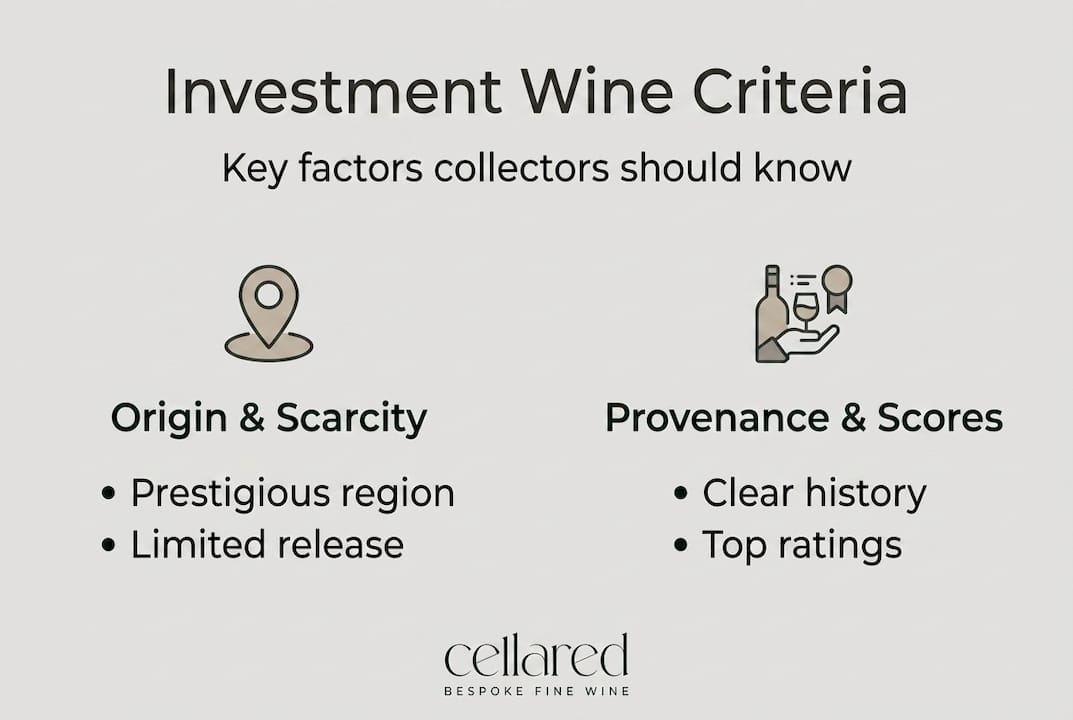
At the heart of this category sit the world's most celebrated regions. Investment-grade wines are typically sourced from prestigious appellations such as Bordeaux, Burgundy, Tuscany, and Napa Valley, produced by wineries with long-standing reputations for consistency and craftsmanship. Strong vintages, shaped by exceptional growing seasons and meticulous winemaking, are equally critical. Ageing potential over decades rather than years further separates these bottles from their more approachable counterparts, as does genuine rarity rooted in limited production volumes.
Australia offers its own remarkable candidates for this category. Producers such as Rockford and Wendouree from the Barossa and Clare Valleys respectively command serious attention at auction. Their releases are produced in tiny quantities, often allocated through mailing lists, and carry a depth of regional character that speaks directly to discerning collectors. Exploring the top wine regions for investment potential is a meaningful first step for any collector entering this space.
Primary traits that signal investment potential:
- Historic winery with a proven record across multiple vintages
- Limited annual production creating genuine scarcity
- Critical acclaim from respected international publications
- Demonstrated auction performance over at least ten years
- Ageing potential of fifteen or more years in ideal conditions
- Identifiable terroir that cannot be replicated elsewhere
- Consistent demand from international collectors and trade buyers
"The finest investment-grade wines are not born in cellars alone. They are born in the landscape, shaped by weather, and confirmed by time."
| Feature | Investment-grade wine | Standard collectible wine |
|---|---|---|
| Production volume | Highly limited, often allocated | Moderate to broad distribution |
| Ageing potential | 15 to 50+ years | 5 to 15 years |
| Auction track record | Consistent, sustained growth | Inconsistent or limited data |
| Regional pedigree | Premier cru, Grand cru, DOCG equivalent | Regional appellation |
| Critical acclaim | 95+ points regularly | Occasional high scores |
| Provenance documentation | Full chain of custody | Partial or informal |
Pro Tip: For Australian collectors entering the market, blue-chip domestic releases from producers like Rockford Basket Press Shiraz or Wendouree Shiraz offer compelling value at release prices, with auction histories that reward patience and careful cellaring.
The concept of ageing potential deserves particular emphasis. A wine built for longevity possesses structural elements, firm acidity, concentrated tannins, and layered complexity, that allow it to evolve gracefully across decades. This evolution is not incidental. It is the engine of value appreciation.
Key evaluation criteria for investment-grade wines
Once you understand what defines this category, the next discipline is knowing precisely how to evaluate individual bottles and producers. This is where the systematic collector separates themselves from the enthusiastic but uninformed buyer.
Critic scores from publications such as Decanter and Wine Spectator remain essential benchmarks. Evaluation criteria include provenance and condition indicators such as fill level, label integrity, capsule condition, and documented storage history, alongside liquidity tracked through platforms like Liv-ex indices. A score of 95 points or above from a respected critic signals not only quality but commercial credibility in secondary markets globally.

Provenance is the backbone of wine investment. A bottle without a verifiable chain of custody, from production through transportation to storage, carries a risk premium that no score can fully offset. Buyers at the serious end of the market want documentation, ideally records showing the wine was stored professionally in temperature-controlled conditions throughout its life. Partnering with experienced professionals who offer wine appraisals ensures that provenance is assessed with rigour, not assumption.
Physical condition is equally non-negotiable. The fill level (called ullage) should sit high in the neck for young wines. Labels must be clean, with no significant staining or tearing. Capsules should be intact and free of corrosion. These physical markers speak directly to storage conditions and dramatically influence resale value.
Checklist for evaluating a bottle:
- Confirm critic score of 95 points or higher from at least two respected publications
- Verify fill level sits at or above the base of the neck
- Inspect label condition for staining, tearing, or fading
- Check capsule for corrosion or damage
- Obtain documented storage history, preferably from bonded warehouse records
- Research auction results for the specific wine and vintage over multiple years
- Assess the liquidity of the producer and appellation through Liv-ex data
| Evaluation factor | Why it matters | Where to verify |
|---|---|---|
| Critic score | Drives international demand and pricing | Decanter, Wine Spectator, Wine Advocate |
| Provenance | Confirms authenticity and storage integrity | Merchant records, auction house certificates |
| Bottle condition | Directly affects resale value | Physical inspection, professional appraisal |
| Market liquidity | Indicates ease of eventual sale | Liv-ex, auction house results |
| Vintage quality | Underpins long-term appreciation potential | Vintage charts, regional reports |
The Liv-ex Fine Wine 1000, which tracks the performance of the 1,000 most actively traded fine wines globally, is an invaluable resource for assessing market movement. Tracking this index alongside specific producer data reveals not just performance but the rhythm of the broader market. Professional cellar management services also use such data to advise collectors on when to hold and when to consider releasing bottles to market.
Pro Tip: Rather than attempting to cover every major wine region at once, specialise in two or three that you understand deeply. Targeted expertise in, say, Burgundy and the Barossa Valley will serve you far better than a scattered approach across a dozen appellations.
Methodologies: Tools and strategies for identifying investment-grade wine
Understanding criteria is one thing. Putting a repeatable, strategic methodology into practice is quite another. The collectors who build genuinely rewarding portfolios over time do so by combining rigorous research, disciplined buying, and professional infrastructure.
Tracking Liv-ex indices, monitoring auction results, diversifying across regions and vintages, using professional bonded storage, buying cases rather than single bottles, pursuing education through programmes such as WSET, and using pricing platforms to establish fair value are all methodologies that experienced collectors rely upon. Each of these habits compounds over time.
A structured approach to building your methodology:
- Research the market systematically. Subscribe to Liv-ex data, follow major auction houses such as Langton's, Christie's, and Hart Davis Hart, and read vintage reports from credible critics before committing capital.
- Buy en primeur where appropriate. Purchasing wine before it is bottled, typically in Bordeaux or Burgundy, can secure allocation at lower prices, though it requires patience and trust in your source.
- Verify provenance before every purchase. Never accept provenance claims without documentation. Request storage records, original purchase invoices, and transport history where possible.
- Invest in education. The Wine & Spirit Education Trust (WSET) Diploma and equivalent qualifications build the foundational knowledge that makes every buying decision more confident and more informed.
- Diversify strategically. A portfolio weighted entirely in Burgundy, however compelling, carries concentration risk. Balance it across regions and vintage years.
- Use professional services for bespoke buying strategies. Specialist advisers with deep market relationships can access allocations and information that are simply unavailable to private buyers acting alone.
| Buying approach | Advantages | Considerations |
|---|---|---|
| Full case purchase | Stronger provenance, greater resale appeal, better price per bottle | Higher upfront capital requirement |
| Single bottle purchase | Lower entry cost, flexibility | Reduced liquidity, harder to prove unbroken case integrity |
| En primeur | Potential discount, early allocation access | Long wait, capital tied up, quality uncertainty |
Advantages of using professional services:
- Access to rare allocations not available through standard retail channels
- Independent valuation that reflects real market conditions, not optimistic guesswork
- Professional storage that satisfies insurance and provenance requirements
- Market intelligence informed by active participation in auctions and trade
- Ongoing cellar review to identify when bottles are approaching optimal drinking or selling windows
Pro Tip: Bonded warehouse storage, where wine is held under customs bond and its provenance is formally documented by a licensed facility, is the gold standard for serious investment collections. It preserves authenticity and dramatically simplifies the sales process by providing buyers with confidence in the wine's history. Consider professional storage from the outset rather than retrospectively.
Risks, common mistakes, and Australian nuances
Every sophisticated market carries risks, and fine wine investment is no exception. The collectors who navigate it successfully are those who approach risk with the same intelligence they bring to selection.
Counterfeiting remains a genuine concern in the fine wine market, particularly for prestigious Burgundy and older Bordeaux vintages. Avoiding fakes requires checking label paper quality, bottle shape, reflective label features, and cork markings. Illiquidity is another real risk: fine wine is not a liquid asset in the traditional sense, and converting bottles to cash can take months through auction channels. Storage and insurance costs must also be factored into any honest return calculation, as they compound meaningfully over a long holding period.
"In Australia, auction data from Langton's tells a more honest story about what a wine is worth than any international critic's score ever could. The market here knows what it values, and it prices accordingly."
Market corrections in recent years have reinforced that even established categories are not immune to volatility. Top-end Tuscan wines such as Sassicaia and Masseto have shown resilience, as has Burgundy over a five-year view, but short-term declines remind collectors that patience is not merely a virtue in this market. It is a prerequisite.
For Australian collectors, Langton's Classification of Australian Wine provides an invaluable local framework, ranking wines by their auction performance over time rather than critic scores alone. This approach reflects real demand and real liquidity in the domestic market. Wines like Rockford Basket Press Shiraz, Wendouree Shiraz, and Clarendon Hills Astralis appear consistently because buyers return to them across vintages, a behaviour that underpins value far more reliably than a single exceptional review.
Common mistakes and how to avoid them:
- Buying without verifiable provenance. Always request documentation and verify provenance independently where possible.
- Over-concentrating in a single region or producer. Diversify thoughtfully across geographies and styles.
- Ignoring carrying costs. Storage, insurance, and auction fees can significantly erode returns if not modelled into your expectations from the outset.
- Chasing scores without market context. A 100-point wine from an illiquid producer is harder to sell than a 95-point wine with deep auction history.
- Neglecting Australian market data. International indices tell part of the story; Bordeaux in Australia trades differently than it does in London or Hong Kong.
Pro Tip: Limit fine wine to between 5 and 10 per cent of your total investment portfolio. This allocation provides meaningful exposure to a rewarding alternative asset class without creating undue concentration risk in an illiquid category.
The real-world challenge: Why the market moves, and what most guides miss
Most guides to wine investment read as though the market behaves predictably, rewarding quality with appreciation in a tidy, linear fashion. The reality, as anyone with genuine experience in this space knows, is considerably more nuanced.
The Liv-ex 1000 has delivered approximately 10.6 per cent annualised returns over fifteen years, and the Burgundy 150 index rose by around 20 per cent over five years. Yet the same market has seen declines of roughly 12 per cent over more recent periods, reminding collectors that even the most celebrated categories are subject to broader economic forces, currency shifts, and changes in collector appetite.
What separates the collectors who navigate these cycles successfully from those who don't is not simply the quality of the wines they buy. It is their understanding of liquidity, their willingness to hold through corrections without panic selling, and their discipline in focusing on established names with deep buyer pools rather than speculative bets on emerging producers. The textbook criteria, scores, provenance, ageing potential, are necessary but not sufficient. The collector who thrives over twenty years is also the one who understands that timing, patience, and market relationships are the true differentiators. Fine wine rewards those who treat it with the same reverence they extend to the wine itself.
Explore professional wine identification and valuation services
Ready to move beyond theory and into a properly managed, confidently built collection? Cellared Fine Wine works with Australian collectors, investors, and private clients to bring precision and expertise to every stage of this process.
Whether you require independent expert wine appraisals for insurance or advisory purposes, or are looking for structured cellar management services to protect and optimise your existing collection, Cellared's team brings deep market knowledge and a genuinely personal approach to every engagement. We help collectors buy well, value accurately, and hold with confidence, because the finest wines deserve the finest care at every stage of their journey from release to cellar to the moment they are opened.
Frequently asked questions
What regions produce the most sought-after investment-grade wines?
Investment-grade wines are primarily sourced from Bordeaux, Burgundy, Tuscany, and Napa Valley, with Australian regions such as the Barossa Valley and Clare Valley producing their own sought-after collector bottles.
How can I tell if a wine will appreciate in value?
Assess critic scores, provenance documentation, bottle condition, verified storage history, rarity, and market liquidity data through indices like Liv-ex to form a well-rounded view of appreciation potential.
What are the main risks of investing in wine?
Key risks include purchasing counterfeit bottles, illiquidity when attempting to sell, ongoing storage and insurance costs, and the possibility of broader market corrections affecting even established producers.
Is it better to buy cases or single bottles for investment?
Buying full cases is strongly preferred because intact cases carry stronger provenance, attract a wider pool of serious buyers at auction, and typically achieve better per-bottle prices than broken case stock.
Recommended
- Sell Your Wine Collection | Cellared | Bespoke Wine Buying, Valuation & Cellar Management
- Wine Appraisals & Valuations | Cellared | Bespoke Wine Buying, Valuation & Cellar Management
- Wine Cellar Management | Cellared | Bespoke Wine Buying, Valuation & Cellar Management
- Bespoke Fine Wine Buying | Cellared | Bespoke Wine Buying, Valuation & Cellar Management