
Fine wine occupies a singular position among alternative assets: it is at once deeply personal and demonstrably profitable. For decades, the assumption has been that building a serious collection is a labour of love, a pursuit driven purely by taste and tradition. Yet the numbers challenge that narrative rather forcefully. The fine wine storage market is valued at USD 3.8 billion in 2024, with APAC emerging as the fastest-growing region. Across Australia and the broader Asia-Pacific, a new generation of collectors is approaching wine not merely as a pleasure but as a structured, market-led strategy. This guide explains what private client wine services offer, why they matter in today's APAC landscape, and how you can access their full advantages.
Table of Contents
- What are private client wine services?
- Investment potential of fine wine: Returns, risks and benchmarks
- How private client wine services add value: Advisory, storage, and liquidity
- Choosing the right provider: What to look for in Australia and APAC
- Why most collectors underestimate the power of expert wine management
- Explore your private wine service options with Cellared
- Frequently asked questions
Key Takeaways
| Point | Details |
|---|---|
| Bespoke management advantage | Expert, personalised wine services boost both enjoyment and investment outcomes for private clients. |
| Strong investment case | Fine wine offers 8–12% annual returns and portfolio diversification, especially in APAC growth markets. |
| Provider selection matters | The right adviser ensures security, authenticity, and access to exclusive wine opportunities. |
| Unlock new liquidity | Wine-backed loans and valuations create flexible options for high value collectors. |
What are private client wine services?
At their core, private client wine services represent a bespoke, end-to-end approach to the acquisition, management, valuation, and eventual realisation of a fine wine collection. Unlike transactional retail or auction models, these services are built around the individual collector's goals, whether that means building a legacy cellar, diversifying an investment portfolio, or securing rare and sought-after bottles that simply cannot be found on open markets.
Demand for these services has grown considerably, and it is no coincidence that private collectors dominate the global wine storage market. High net worth individuals are drawn to fine wine for several converging reasons: it offers genuine portfolio diversification, it carries intrinsic cultural and social prestige, and it lends itself to generational legacy planning in a way that equities or property seldom do.
The scope of private client wine services typically spans:
- Bespoke acquisition: Sourcing rare, allocated, and off-market bottles tailored to your collection strategy
- Cellar management: Professional wine cellar management, including condition monitoring, rotation, and insurance-ready documentation
- Investment advisory: Market-led guidance on which regions, producers, and vintages represent the most compelling opportunities
- Independent valuation: Court-ready appraisals for insurance, probate, family law, and private advisory purposes
- Event and community access: Exclusive tastings, producer visits, and collector networks unavailable to the general public
The bespoke wine buying process is particularly valued by serious collectors, as it removes the friction of navigating allocation lists and auction bidding wars. A skilled adviser brings relationships, foresight, and market intelligence that no catalogue or online marketplace can replicate.
"Wine is the most civilised thing in the world." Ernest Hemingway. For today's APAC collector, it is also among the most astute.
The benefits of cellaring wine extend well beyond flavour transformation: proper provenance, meticulous storage records, and expert guidance collectively preserve and enhance asset value in ways that casual collecting cannot match.
Investment potential of fine wine: Returns, risks and benchmarks
The investment case for fine wine is built on a compelling combination of historical returns, low correlation to traditional asset classes, and a finite supply of the world's most sought-after bottles. The evidence is structured and increasingly difficult to ignore.
Over the past five years, the Liv-ex Fine Wine 1000 index returned 14.10%, with Champagne and Burgundy outperforming the broader index. That figure compares favourably against many mainstream asset classes and, crucially, it was achieved with relatively low volatility and minimal correlation to equity markets.
| Index / Region | 5-year return | Notable drivers |
|---|---|---|
| Liv-ex Fine Wine 1000 | +14.10% | Broad fine wine benchmark |
| Burgundy | Outperformed | Scarcity, global demand |
| Champagne | Outperformed | Prestige cuvées, APAC appetite |
| Bordeaux | Steady | Volume, liquidity, Bordeaux benchmarks |
Fine wine's appeal as a portfolio component rests on more than raw returns. Its low correlation with equities means it typically holds value during periods of market stress, functioning as a genuine diversifier rather than simply another risk asset. For collectors managing substantial wealth across multiple asset classes, this characteristic is significant.
That said, the market is not without its cycles. Bordeaux experienced a notable correction between 2012 and 2016 after a decade of sharp appreciation, and more recently, broader fine wine indices have seen modest pullbacks following the post-pandemic surge. Regional differences are pronounced: Burgundy and Champagne have demonstrated remarkable resilience, while some secondary regions carry greater price risk.
Fine wine rewards patience. Like the Nebbiolo grape at its finest, the most compelling returns often emerge only after years of careful stewardship.
Pro Tip: When assessing a wine's investment potential, prioritise producers with consistent critical acclaim and documented provenance. Market cycles are inevitable, but blue-chip producers from established appellations have historically recovered and surpassed prior peaks.
What collectors should watch closely: market cycles tied to global economic sentiment, the reputation and allocation status of key producers, appropriate temperature-controlled storage, and the costs associated with insurance and management. Each of these factors shapes the net return on a fine wine portfolio in ways that are not always apparent at the point of purchase.
How private client wine services add value: Advisory, storage, and liquidity
A self-managed collection and a professionally managed portfolio may contain identical bottles, yet they can diverge dramatically in outcome. The difference lies not in the wine itself but in the infrastructure, intelligence, and relationships brought to bear by specialist advisers.
Personal advisory is the foundation. An experienced adviser understands market timing, producer reputations, and the nuances of regional pricing in ways that take years to develop. They can identify when to acquire, when to hold, and when to realise, and they do so with access to off-market opportunities that are invisible to the independent collector.
Secure, professional storage is equally critical. Fine wine ageing is unforgiving: temperature fluctuations, humidity variations, and improper handling can permanently compromise both quality and value. Top-tier providers maintain bonded, climate-controlled facilities with full audit trails, the kind of provenance documentation that commands premium prices at resale and satisfies the requirements of insurers and legal proceedings alike.
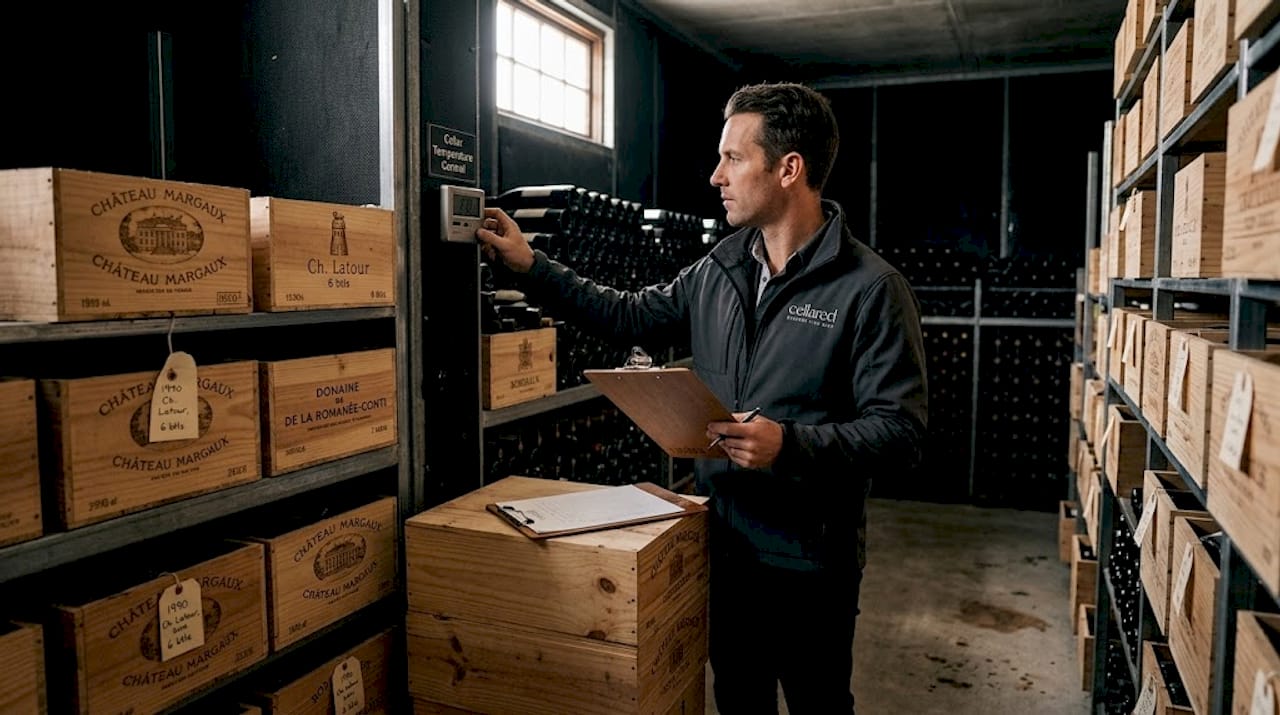
Liquidity is an area where private client services offer a distinct structural advantage. Beyond auction access, sophisticated providers can facilitate wine-backed financing, a mechanism that allows collectors to leverage their holdings without selling. Wine-backed loans typically offer 50 to 60% of appraised value, starting from £250,000, and require blue-chip wines stored in bonded warehouses. This creates genuine optionality: a collector can access capital for other opportunities while retaining ownership of appreciating assets.
| Feature | Private client service | Traditional auction or retail |
|---|---|---|
| Sourcing access | Off-market, allocated, rare | Open market only |
| Storage | Bonded, audited, insured | Self-managed or generic |
| Valuation | Independent, court-ready professional wine valuations | Auction estimate only |
| Liquidity options | Wine-backed loans, private sale | Auction timelines |
| Advisory | Tailored, ongoing | Transaction-based |
The journey from intake to exit strategy typically follows a clear sequence:
- Collection audit and valuation: Establishing what you hold, its condition, and its current market value
- Strategy development: Aligning the collection with your investment, lifestyle, and legacy goals
- Active management: Sourcing additions, managing storage, and monitoring market movements
- Realisation planning: Identifying optimal timing and channels for sale, whether private, auction, or estate
Pro Tip: Never allow your collection to go unvalued for more than two years. Market movements can shift asset values significantly, and an outdated valuation leaves you exposed on both insurance and estate planning fronts.
Choosing the right provider: What to look for in Australia and APAC
Selecting a private client wine service is itself a considered exercise. The provider you choose will handle assets of considerable financial and personal significance, so the evaluation process deserves the same rigour you would apply to selecting a fund manager or legal adviser.
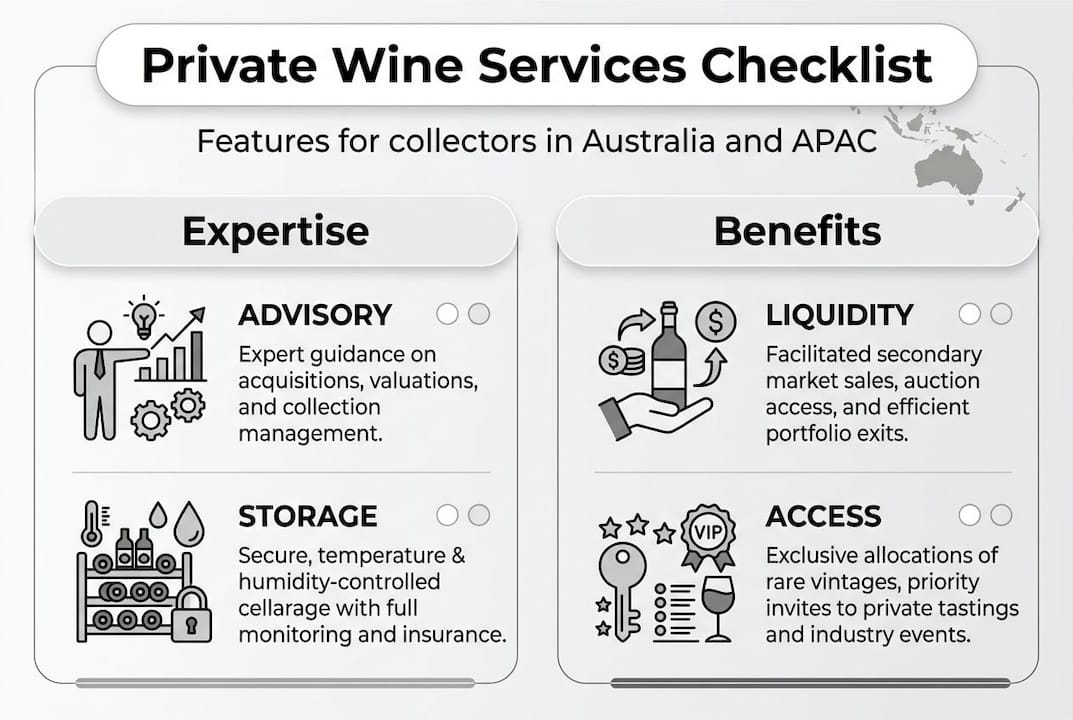
APAC is the fastest-growing region for fine wine services, with Australia's strong domestic base and cities such as Singapore and Hong Kong serving as regional hubs. This growth is driven by rising populations of high net worth individuals across China, India, and Southeast Asia, creating both opportunity and complexity for collectors operating across borders.
Essential criteria when evaluating a provider:
- Credentials and independence: Look for advisers with verifiable market expertise and no conflicts of interest in their recommendations
- Security and provenance: Confirm that storage facilities meet bonded warehouse standards, with full chain-of-custody documentation
- Market access and network: A strong provider has relationships with négociants, auction houses, and private sellers that translate into genuine sourcing advantages
- Tailored advice: Avoid providers with a one-size-fits-all approach; your goals, tax position, and risk appetite are unique
- Regulatory awareness: APAC cross-border acquisitions involve customs, duties, and compliance considerations that require specialist knowledge
- Communication and reporting: Regular market updates, portfolio reviews, and transparent fee structures are non-negotiable
Questions worth asking a prospective provider: How do you source allocations? What storage facilities do you use and are they independently audited? Can you provide court-ready valuations? How do you handle cross-border logistics for APAC clients?
Access to exclusive wine events is a telling indicator of a provider's network depth. Invitations to private producer tastings, en primeur releases, and collector dinners signal genuine industry relationships, not simply a retail licence.
Pro Tip: Ask your prospective provider to walk you through a recent off-market acquisition they facilitated for a client. The specificity and confidence of that answer will tell you more than any brochure, and it will quickly distinguish genuine specialists from generalists. Reviewing a provider's regional wine expertise is equally instructive, as deep regional knowledge underpins credible sourcing and advisory work.
Why most collectors underestimate the power of expert wine management
There is a particular kind of collector, sophisticated in many things, who believes that passion and a good memory for vintages are sufficient tools for managing a serious collection. This is, respectfully, a costly misconception.
What professional advisers bring to the table is not merely knowledge, it is access. Off-market deals, early allocation opportunities, and connections to estates that simply do not sell through public channels represent a category of advantage that no amount of personal research can replicate. The collector who manages independently is, by definition, working only with what is publicly available.
The risks of solo management are structural, not just occasional. Insurance gaps arise from outdated valuations. Undervalued assets appear in estate proceedings. Bottles are sold at inopportune moments because the collector lacks the market context to wait. These are not hypothetical scenarios; they are the recurring outcomes we observe when collections change hands without proper stewardship.
APAC trends are amplifying this gap. As regional demand grows and cross-border complexity increases, the advantage held by providers with genuine international networks compounds year on year. Expert cellar management is not a luxury service for the exceptionally wealthy. For any collector with a portfolio worth protecting, it is simply the rational choice.
Explore your private wine service options with Cellared
Cellared Fine Wine works with collectors, investors, estates, and private clients across Australia and APAC to deliver exactly the kind of meticulous, market-led service that transforms a wine collection into a well-managed asset. Whether you are seeking an independent appraisal, sourcing a rare bottle, or building a long-term cellar strategy, the expertise and personal commitment of the Cellared team is at your disposal.

From court-ready valuations for insurance and estate purposes to bespoke buying solutions that access allocations and off-market opportunities, Cellared brings deep market knowledge and a highly personal approach to every engagement. If you are ready to manage your collection with greater clarity, confidence, and ambition, we invite you to connect with the Cellared team and discover what truly bespoke wine services can achieve for you.
Frequently asked questions
What is a private client wine service?
It is a bespoke, end-to-end suite of collection management, investment advisory, and acquisition services tailored for high net worth individuals, where private collectors dominate the global wine storage market.
Are fine wines really a good investment in Australia?
Fine wine has demonstrated compelling returns, with the Liv-ex Fine Wine 1000 returning 14.10% over five years, and APAC and Australian collector demand continuing to strengthen the market's foundations.
How secure are wine-backed loans?
Wine-backed loans typically offer 50 to 60% of appraised value, with blue-chip bottles required to be held in audited, bonded warehouses as security.
What makes a top-tier private wine management provider?
The strongest providers combine Australian and APAC market expertise, bonded storage, independent valuation capability, and a genuine network for exclusive off-market access that retail and auction channels cannot offer.
Recommended
- Wine Appraisals & Valuations | Cellared | Bespoke Wine Buying, Valuation & Cellar Management
- Test Conversion | Cellared | Bespoke Wine Buying, Valuation & Cellar Management
- Wine Cellar Management | Cellared | Bespoke Wine Buying, Valuation & Cellar Management
- Cellared Fine Wine | Bespoke Wine Buying, Valuation & Cellar Management
- Wine Basics