
Managing a private wine cellar is both an art and a science, demanding meticulous planning, structured discipline, and a genuine passion for exceptional wine. For Australian collectors, the challenge is amplified by the country's variable climate, which can wreak havoc on even the most carefully assembled collection if storage conditions are neglected. Whether your cellar is a considered investment vehicle, a source of personal pleasure, or both, the principles of sound management remain consistent: protect provenance, maintain optimal conditions, and track performance with rigour. Professional bonded storage is essential for investment-grade cellars, while home cellars require climate control systems suited to Australia's demanding conditions.
Table of Contents
- Plan your cellar for both investment and pleasure
- Choose optimal storage solutions for the Australian climate
- Insure your collection and protect its value
- Track cellar performance and make informed decisions
- Why truly successful cellars blend investment discipline with personal flair
- Ready to elevate your cellar management?
- Frequently asked questions
Key Takeaways
| Point | Details |
|---|---|
| Professional storage | Bonded warehouses offer security and duty-free benefits for investment wine collections. |
| Climate control | Stable temperature and humidity are essential for preserving wine quality in Australian home cellars. |
| Specialty insurance | Insure your cellar against loss, with coverage matching market value and annual appraisals. |
| Track value | Monitor cellar performance using global wine indices and digital tools to inform decisions. |
| Expert support | Leverage professional services for cellar valuation, management, and buying to maximise enjoyment and investment return. |
Plan your cellar for both investment and pleasure
A well-conceived cellar plan is the foundation upon which all great collections are built. Before a single bottle is purchased, it is worth asking a fundamental question: is this cellar primarily an investment, a personal pleasure, or a sophisticated blend of both? The answer shapes every decision that follows, from the wines you acquire to the infrastructure you install.
Investment-focused cellars demand a different discipline from entertainment-focused ones. An investment cellar prioritises wines with proven ageing potential, strong secondary market demand, and impeccable provenance. Think First Growth Bordeaux, Grand Cru Burgundy, and prestigious Australian icons like Penfolds Grange. An entertainment cellar, by contrast, might hold a broader range of styles and regions, curated for the pleasure of sharing exceptional bottles with discerning guests.
Many collectors find the most rewarding approach lies in a thoughtful combination of both. Allocate a portion of your cellar to long-term investment wines, stored with absolute precision, and a separate section for wines you intend to enjoy over the coming years. This dual-purpose approach ensures your cellar delivers both financial returns and genuine pleasure.
Storage infrastructure is equally critical. Bonded warehouses suit investment wines, offering security, provenance documentation, and duty-free benefits that protect resale value. Home cellars, however, require purpose-built climate control systems capable of managing Australia's temperature extremes, particularly in cities like Brisbane, Perth, and Adelaide where summer heat can be relentless.
For cellar management tips that translate planning into practice, the layout of your cellar matters as much as its contents. Organise your racking to ensure older vintages are accessible without disturbing younger bottles. Visibility and logical sequencing reduce the risk of accidentally opening a wine before its time.
- Separate investment wines from drinking wines with clearly labelled zones
- Prioritise accessibility for frequently enjoyed bottles
- Allow space for future acquisitions without a full reorganisation
- Maintain a detailed inventory from day one
Pro Tip: Invest in modular, versatile racking systems from the outset. As your collection grows, adaptable infrastructure saves considerable time and expense compared to fixed shelving that cannot accommodate evolving needs.
Choose optimal storage solutions for the Australian climate
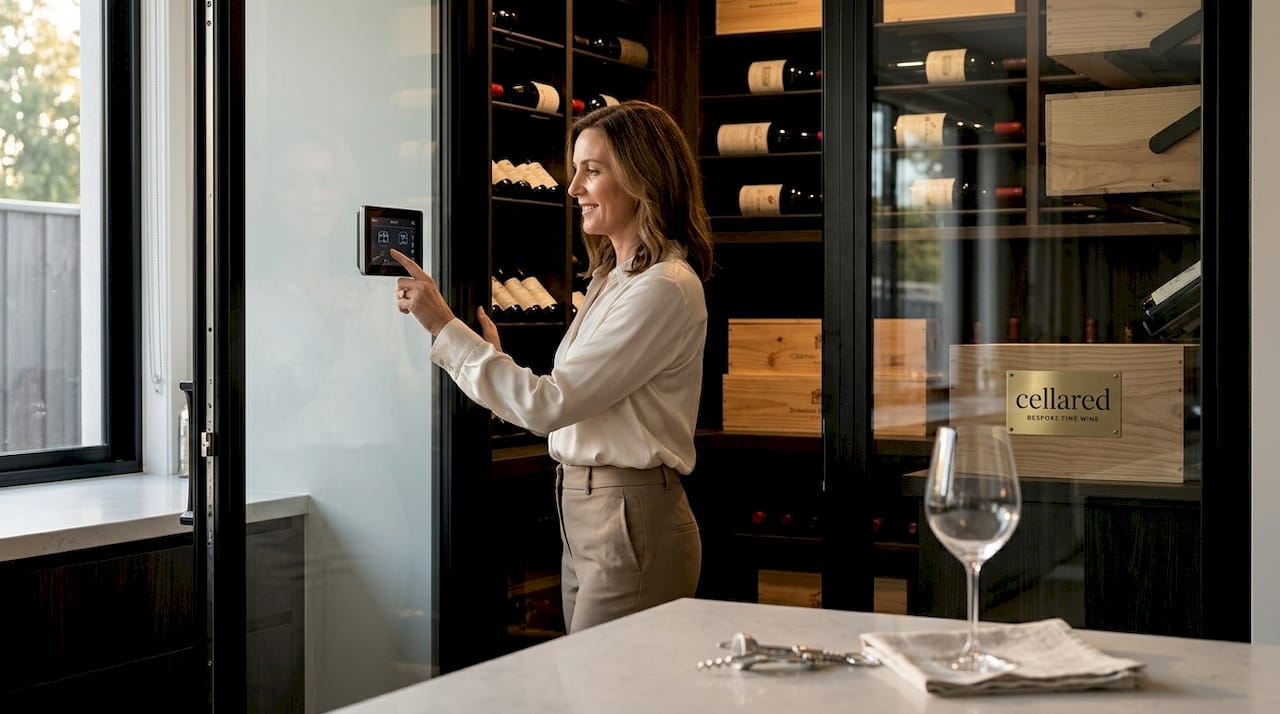
With your cellar plan in place, choosing the right storage solution is crucial, especially given Australia's climate extremes. The ideal storage environment for fine wine is remarkably specific: a consistent temperature between 12°C and 14°C, relative humidity between 60% and 75%, minimal vibration, and protection from ultraviolet light. Achieving this in an Australian home requires deliberate investment.
"Professional bonded storage offers security and provenance proof; climate control is non-negotiable for home cellars in Australia's variable conditions."
| Feature | Professional storage | Home cellar |
|---|---|---|
| Temperature stability | Guaranteed year-round | Requires dedicated system |
| Humidity control | Managed professionally | Requires monitoring equipment |
| Provenance documentation | Comprehensive | Owner-managed |
| Security | Commercial grade | Dependent on installation |
| Insurance | Often included | Separate policy required |
| Accessibility | Scheduled visits | Immediate |
| Cost | Per-bottle fee | Upfront capital investment |
For collectors who prefer home storage, the following steps establish a robust foundation:
- Install a purpose-built wine cellar climate control system, not a standard air conditioning unit, which cycles too aggressively and introduces harmful temperature fluctuations.
- Insulate walls, ceiling, and floor with materials rated for thermal performance, ensuring the cellar is properly sealed against external heat.
- Install a hygrometer (a device that measures humidity) and monitor readings weekly, adjusting with a humidifier or dehumidifier as conditions demand.
- Fit UV-filtering glass or eliminate natural light entirely from the cellar space.
- Schedule annual wine valuations to confirm your collection's condition and current market value remain aligned.
The investment in professional home cellar infrastructure is substantial, but it is far less costly than the irreversible damage caused by a single season of inadequate temperature management. A wine stored at 25°C for even a few weeks can age years prematurely, stripping it of the very complexity that made it worth acquiring.
Insure your collection and protect its value
Once storage is sorted, protecting your investment with the right insurance and regular valuations becomes paramount. A private wine collection of meaningful value is an asset that deserves the same rigorous protection as fine art or jewellery, yet insurance is an area where many collectors remain dangerously underprotected.
Specialty wine insurance policies are distinct from standard home contents cover. They are designed specifically to address the risks inherent in fine wine ownership, including market value fluctuations, temperature damage, accidental breakage, and theft. Standard home contents policies rarely provide adequate cover for collections valued above a modest threshold.
Key features to seek in a wine insurance guide include:
- Market value cover: Ensures replacement at current market price, not original purchase price
- Environmental damage: Covers losses from temperature fluctuations, humidity failure, or power outages
- Theft and accidental breakage: Comprehensive physical protection for the collection
- Transit cover: Essential if wines are regularly moved between storage locations
- Agreed value policies: Particularly valuable for rare or trophy bottles where market comparables are limited
The cost of specialty cover is surprisingly accessible. Insurance fees typically range from $1 to $3 per $1,000 of collection value annually, meaning a collection worth $200,000 might cost between $200 and $600 per year to insure comprehensively.
| Collection value | Annual insurance cost (low) | Annual insurance cost (high) |
|---|---|---|
| $50,000 | $50 | $150 |
| $100,000 | $100 | $300 |
| $200,000 | $200 | $600 |
| $500,000 | $500 | $1,500 |
Annual appraisals are the essential companion to insurance. Valuation services from independent specialists ensure your policy reflects current market realities, not outdated purchase prices. Markets for fine wine shift considerably over time, and a collection insured at 2019 values in 2026 may be significantly underprotected. Engaging professional wine valuations on a regular cycle also provides critical documentation for estate planning, family law proceedings, and private advisory purposes. Pair this with annual cellar appraisals to maintain a clear, defensible picture of your collection's worth.
Track cellar performance and make informed decisions
With insurance in place, tracking performance helps inform investment decisions and maximises cellar enjoyment. A cellar that is not actively monitored is, in many respects, a cellar that is not being managed at all. Performance tracking transforms a passive collection into a dynamic asset.
Global fine wine indices, most notably the Liv-ex Fine Wine 1000, provide the most reliable benchmarks for assessing collection performance. While no empirical benchmarks exist specifically for Australian private cellars, these global indices reveal strong historical returns for investment-grade wines, with professional storage typically costing $1 to $2 per bottle annually. Understanding how your holdings track against these indices helps identify which wines are appreciating, which are plateauing, and which may be approaching their optimal drinking window.
A structured approach to performance tracking involves the following steps:
- Build a detailed digital inventory that records producer, appellation, vintage, quantity, purchase price, current estimated value, and optimal drinking window for every bottle.
- Update valuations annually, cross-referencing against current auction results and market data from sources such as Bordeaux market insights to ensure accuracy.
- Identify wines approaching peak maturity and plan consumption or sale accordingly, avoiding the common mistake of holding bottles past their optimal window.
- Review your cellar's composition annually to assess whether it remains aligned with your investment objectives and personal preferences.
- Consult a specialist adviser before making significant buying or selling wine collection decisions, particularly in volatile market conditions.
Pro Tip: Digital inventory platforms purpose-built for wine collectors, such as CellarTracker or Vivino's collection tools, allow you to log tasting notes, monitor market prices, and generate portfolio reports with minimal effort. The discipline of maintaining an accurate digital record pays dividends when it comes time to sell, insure, or bequeath your collection.
Regular performance reviews also reveal the emotional dimension of cellar ownership. Noticing that a particular producer's wines have consistently outperformed expectations, or that a region you once favoured has plateaued, sharpens your palate as a buyer and deepens your appreciation as a collector.
Why truly successful cellars blend investment discipline with personal flair
After exploring the mechanics of cellar management, it is worth reflecting on the philosophy that sustains the most exceptional private collections. Conventional wisdom in wine investment tends to emphasise discipline: buy proven producers, store impeccably, track indices, and sell at the right moment. This is sound advice, but it misses something essential.
The collectors whose cellars endure across generations are those who never lose sight of the personal dimension of ownership. A cellar managed purely as a financial instrument becomes sterile. It loses the narrative thread that makes fine wine so compelling: the story of a particular vintage, the memory of a remarkable meal, the anticipation of a bottle that has been patiently waiting for its moment.
True success in cellar management comes from holding both impulses simultaneously. The discipline of expert cellar management ensures the collection grows in value and condition. The personal flair, expressed through the wines you choose, the occasions you create, and the people you share them with, ensures the cellar remains a living, breathing source of joy rather than a mere ledger entry. A well-managed cellar, tended with both rigour and passion, becomes something far more valuable than an asset. It becomes a legacy.
Ready to elevate your cellar management?
Managing a private wine cellar to its full potential requires expertise that goes well beyond temperature gauges and insurance policies. It demands market knowledge, independent judgement, and a deeply personal understanding of what your collection means to you.

At Cellared Fine Wine, we offer wine appraisals services, bespoke acquisition strategies, and ongoing cellar management experts support tailored to the needs of serious Australian collectors. Whether you are building a collection from scratch, seeking an independent valuation, or exploring bespoke wine buying opportunities, our team brings the market knowledge and personal service your cellar deserves. Reach out to discover how we can help you buy well, value accurately, and enjoy with confidence.
Frequently asked questions
What is the best way to store wine for investment purposes in Australia?
Professional bonded storage offers security, provenance documentation, and duty-free benefits that make it the preferred choice for investment-grade collections in Australia. Home cellars can be suitable for personal collections provided robust climate control systems are installed and maintained.
How much does it cost to insure a private wine collection?
Specialty wine insurance typically costs $1 to $3 per $1,000 of collection value annually, covering replacement value, temperature damage, and theft. This makes comprehensive cover surprisingly accessible relative to the value being protected.
What climate control features are essential for a home cellar in Australia?
Stable temperature between 12°C and 14°C, humidity between 60% and 75%, UV protection, and purpose-built cooling systems are all essential for home cellars in Australia's variable climate. Standard air conditioning units are not adequate substitutes for dedicated wine cellar systems.
How do I get an annual valuation for my cellar and why is it important?
Annual appraisals from independent wine specialists confirm current market value and provide essential documentation for insurance, estate planning, and investment decisions. Without regular revaluation, your insurance cover may significantly underrepresent your collection's true worth.
Recommended
- Wine Cellar Management | Cellared | Bespoke Wine Buying, Valuation & Cellar Management
- Wine Appraisals & Valuations | Cellared | Bespoke Wine Buying, Valuation & Cellar Management
- Test Conversion | Cellared | Bespoke Wine Buying, Valuation & Cellar Management
- Bespoke Fine Wine Buying | Cellared | Bespoke Wine Buying, Valuation & Cellar Management