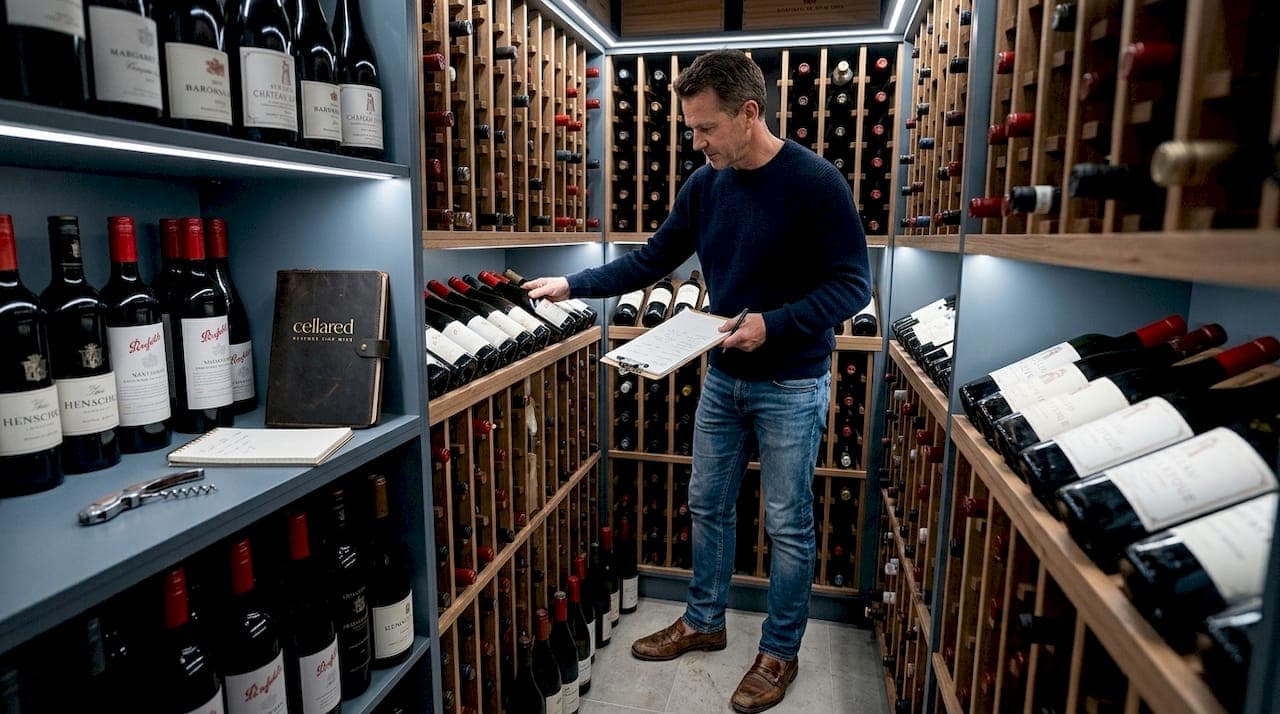
Fine wine liquidation is frequently misunderstood as a last resort for troubled collectors, yet nothing could be further from the truth. For serious collectors and investors across Australia and the Asia-Pacific region, wine liquidation refers to the deliberate, strategic conversion of a fine wine collection into cash through auctions, private sales, brokers, or specialist merchants, all with the singular purpose of achieving optimal market value. It is a considered process, not a distress signal. This article clarifies what wine liquidation truly means, surveys the principal pathways available in Australia, compares their merits, and illuminates the risks that can quietly erode the value of even the finest cellar.
Table of Contents
- What is wine liquidation for collectors?
- Australian wine liquidation pathways: Auctions, private sales, brokers
- Comparing auctions and private sales: Which suits your collection?
- Risks, storage, and provenance: Protecting value during liquidation
- The expert perspective: Overlooked nuances in wine liquidation
- Maximise your wine liquidation outcome with professional support
- Frequently asked questions
Key Takeaways
| Point | Details |
|---|---|
| Wine liquidation defined | Liquidation involves strategically converting a fine wine collection into cash for optimal value, not just urgent or surplus sales. |
| Australian liquidation channels | Specialist auctions and private sales are the main pathways for collectors in Australia, each suiting different wine types and goals. |
| Channel comparison | Auctions suit rare bottles, while private sales offer higher net results for bulk or less rare collections if you have networks. |
| Risk management | Professional storage, provenance documentation, and avoiding En Primeur pitfalls are essential for protecting wine value. |
| Expert advice | Matching your collection type to the right channel and prioritising robust storage will help you achieve the best market outcome. |
What is wine liquidation for collectors?
At its core, wine liquidation is the process of converting fine wine assets into capital, typically when a collector wishes to rebalance a portfolio, settle an estate, fund a new acquisition strategy, or simply crystallise gains built over years of patient accumulation. It is a financial and logistical exercise that demands as much care as the original act of buying.
The term "liquidation" carries unfortunate baggage from the world of corporate insolvency, but in the fine wine context it simply means realising value. Wine liquidation is not simply surplus wine selling or a distress sale; it involves optimising value for fine wine assets that often represent significant financial and cultural worth. A collector selling a vertically assembled Penfolds Grange library, for instance, is not in distress. They are exercising sophisticated market timing.
Several characteristics distinguish fine wine liquidation from ordinary wine sales:
- Investment grade stock: The wines involved are typically classified, critically acclaimed, or produced in limited quantities, commanding premiums that reward patience.
- Provenance documentation: Original receipts, chain-of-custody records, and professional storage histories are not optional extras; they are value multipliers.
- Channel selection: The choice of auction house, private buyer, or specialist broker directly affects the final realisation.
- Condition and presentation: Fill levels, label integrity, capsule condition, and original timber cases all influence buyer confidence and bid levels.
Provenance is the silent currency of the fine wine market. A bottle with an impeccable paper trail will nearly always outperform an identical bottle of uncertain history.
Understanding these distinctions allows collectors to approach wine liquidation methods with the strategic clarity they deserve, rather than treating the exercise as an afterthought.
Australian wine liquidation pathways: Auctions, private sales, brokers
Australia's fine wine market has matured considerably, and collectors today enjoy a range of sophisticated liquidation pathways. Each channel offers distinct advantages depending on the character and composition of the collection in question.
Specialist auction houses like Langtons, Abbeys Auctions, and Liquid Assets are the most prominent platforms in Australia, with Langtons handling major estate collections including that of the legendary James Halliday. Auction environments create competitive tension among buyers, which can drive prices well beyond reserve, particularly for signed bottles, rare parcels, and vertically assembled collections.
Private sales, by contrast, operate through direct negotiation between seller and buyer, often facilitated by a specialist broker or wine merchant. These arrangements can move swiftly and discreetly, making them attractive for collectors who value confidentiality or who hold wines that might not perform optimally in a public bidding room.
Brokers and specialist merchants occupy a valuable middle ground. They bring established buyer networks, market intelligence, and transactional experience, reducing the logistical burden on the seller while maintaining strong price discipline.

| Channel | Best suited for | Key advantage | Typical cost |
|---|---|---|---|
| Auction house | Rare, signed, or trophy wines | Competitive bidding drives premiums | 15 to 25% seller commission |
| Private sale | Bulk collections, less-rare labels | Lower fees, speed, discretion | Negotiable; often 5 to 10% |
| Specialist broker | Mixed or complex portfolios | Network access, expert guidance | Variable; often percentage-based |
For Australian wine auction options, the following wines consistently perform strongly:
- Penfolds Grange (all vintages, particularly pre-2000)
- Henschke Hill of Grace
- Burgundy premiers and grands crus
- First-growth Bordeaux in original cases
- Rare Italian producers: Giacomo Conterno, Bruno Giacosa
For Australian liquidation strategies, the key is matching wine type to channel, rather than defaulting to auction because it feels prestigious.
Comparing auctions and private sales: Which suits your collection?
With the main channels now mapped, the practical question becomes: which approach is right for your specific collection? The answer is rarely one or the other. Most sophisticated collectors use a blend of both.
Auctions drive competition for rare and high-value wines, often exceeding pre-sale estimates, but they involve commissions and buyer premiums; private sales can avoid those costs and net higher returns but require substantial effort and established networks.
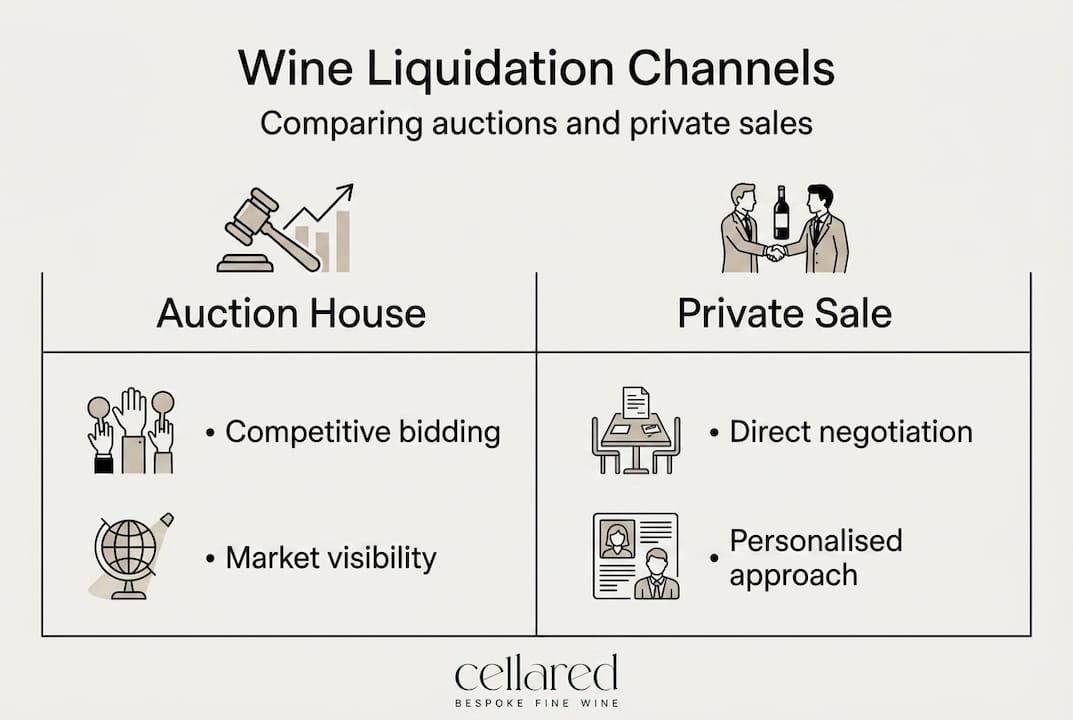
| Factor | Auction | Private sale |
|---|---|---|
| Price ceiling | High, driven by competition | Negotiated, typically fixed |
| Seller commission | 15 to 25% | 5 to 10% or less |
| Buyer premium | 18 to 25% paid by buyer | None or minimal |
| Timeline | Set by auction calendar | Flexible |
| Reach | Broad, national or international | Targeted, relationship-based |
| Best for | Trophy, signed, rare parcels | Bulk, mid-tier, or portfolio sales |
To navigate this decision methodically, consider the following steps:
- Audit your collection: Separate trophy and rare bottles from bulk or everyday-drinking stock.
- Assess provenance documentation: Well-documented wines are auction-ready; undocumented stock may perform better through private channels.
- Obtain a professional valuation: Market-led appraisal benchmarks your realistic expectations before approaching any channel.
- Engage specialist advice: Brokers and merchants with deep market knowledge can advise on timing, reserve pricing, and channel fit.
- Consider staging: Release rare parcels to auction first; follow with private sales for remaining stock.
Pro Tip: Never set your reserve based on sentimental or purchase-price logic. Market value is determined by current demand, recent comparable sales, and vintage condition, not by what you paid years ago.
For collectors holding exceptional individual bottles, exploring approaches for rare wines through a specialist bespoke buying service can unlock a buyer pool that auction rooms simply cannot reach.
Risks, storage, and provenance: Protecting value during liquidation
The greatest threat to a wine liquidation outcome is not a slow market. It is insufficient preparation. Whether you pursue auction or private sale, the value of your collection is only as strong as its documentation, condition, and storage history.
Provenance and storage are critical for retaining value; collectors with bulk or undocumented storage risk significant losses in insolvencies and en primeur situations. This is not a theoretical risk. It plays out in real collections, real estates, and real disputes every year.
Key risks to address before commencing any liquidation process:
- En Primeur exposure: Wines purchased as futures (before bottling) may be held by the merchant, not you. Until physical delivery, you are typically an unsecured creditor.
- Insolvency of a storage provider: If your wine is stored communally rather than in segregated, bonded storage, it may be treated as a general asset in the event of provider insolvency.
- Undocumented chain of custody: Any gap in provenance, such as a period of home storage without temperature records, creates doubt in the buyer's mind and suppresses bids.
- Physical condition deterioration: Improper cellaring for preservation can compromise fill levels, corks, and flavour integrity, all of which are observable and assessable at the point of sale.
Professional cellar management addresses the majority of these risks by ensuring wines are held in bonded, temperature-controlled, segregated facilities with meticulous condition records.
Pro Tip: Before liquidating, commission professional wine valuations from an independent specialist. A court-ready appraisal not only benchmarks realistic expectations but also provides formal documentation that strengthens buyer confidence and may be essential for estate, insurance, or legal purposes.
The difference between a well-managed collection and a poorly documented one is not merely aesthetic. It can represent tens of thousands of dollars in final realisation.
The expert perspective: Overlooked nuances in wine liquidation
At Cellared Fine Wine, we consistently observe the same pattern: collectors invest extraordinary care in acquiring fine wine, then approach liquidation as an afterthought. This asymmetry is the single greatest driver of suboptimal outcomes.
The conventional wisdom that "just put it in auction" suits all collections is simply wrong. Auctions excel for signed or rare bottles but can be a blunt instrument for portfolios of mixed provenance or mid-tier stock where competitive tension rarely materialises.
What most collectors overlook is timing. The wine market, like any asset class, has cycles. Releasing a vertically assembled Burgundy collection during a buyer's market yields fundamentally different results than timing the sale to coincide with heightened demand from Asian collectors or a strong vintage anniversary.
Documentation is the other great oversight. Receipts, appraisals, storage records, and even tasting notes from credible critics form a dossier that commands buyer confidence. We routinely see collections with identical bottles achieve markedly different prices based solely on the quality of their documentation.
Finally, cellar management strategies matter before, during, and after a decision to sell. Collections that have been professionally managed throughout their life require significantly less remediation before going to market.
Maximise your wine liquidation outcome with professional support
Understanding the theory of wine liquidation is one thing; executing it with precision is another. The difference between a good outcome and an exceptional one often lies in the quality of professional support engaged at each stage of the process.
At Cellared Fine Wine, we offer independent, market-led get wine valuations that are court-ready and suitable for probate, insurance, family law, and private advisory contexts. Our professional cellar management service ensures your collection is preserved, documented, and presented to its fullest potential before going to market. When the time comes to act, our bespoke approach to sell your wine collection connects you with the right buyers through the right channels, maximising every aspect of your liquidation outcome.
Frequently asked questions
Is wine liquidation only for distressed, surplus, or unwanted wine?
No. Wine liquidation refers to the strategic conversion of fine wine into cash through optimal channels, and it is regularly undertaken by sophisticated collectors pursuing portfolio rebalancing, estate planning, or well-timed capital realisation.
Which method offers the best results: auction or private sale?
Auctions drive competitive pricing for rare and high-value wines, often exceeding pre-sale estimates, while private sales can deliver higher net returns for bulk or less-rare bottles when the seller has access to strong buyer networks.
Why is professional storage important when liquidating wine?
Provenance and storage are critical determinants of value; professionally managed, segregated, and bonded storage protects against insolvency risk, preserves condition, and gives buyers the confidence to bid strongly.
Are there risks with liquidating En Primeur wine positions?
Yes. En Primeur buyers are unsecured creditors until physical delivery of the wine; in the event of a merchant's insolvency before delivery, the primary recourse is typically a refund claim rather than recovery of the physical stock.
Recommended
- Sell Your Wine Collection | Cellared | Bespoke Wine Buying, Valuation & Cellar Management
- Wine Appraisals & Valuations | Cellared | Bespoke Wine Buying, Valuation & Cellar Management
- Wine Cellar Management | Cellared | Bespoke Wine Buying, Valuation & Cellar Management
- Test Conversion | Cellared | Bespoke Wine Buying, Valuation & Cellar Management
- Wine corking explained: Why it matters for preservation & taste