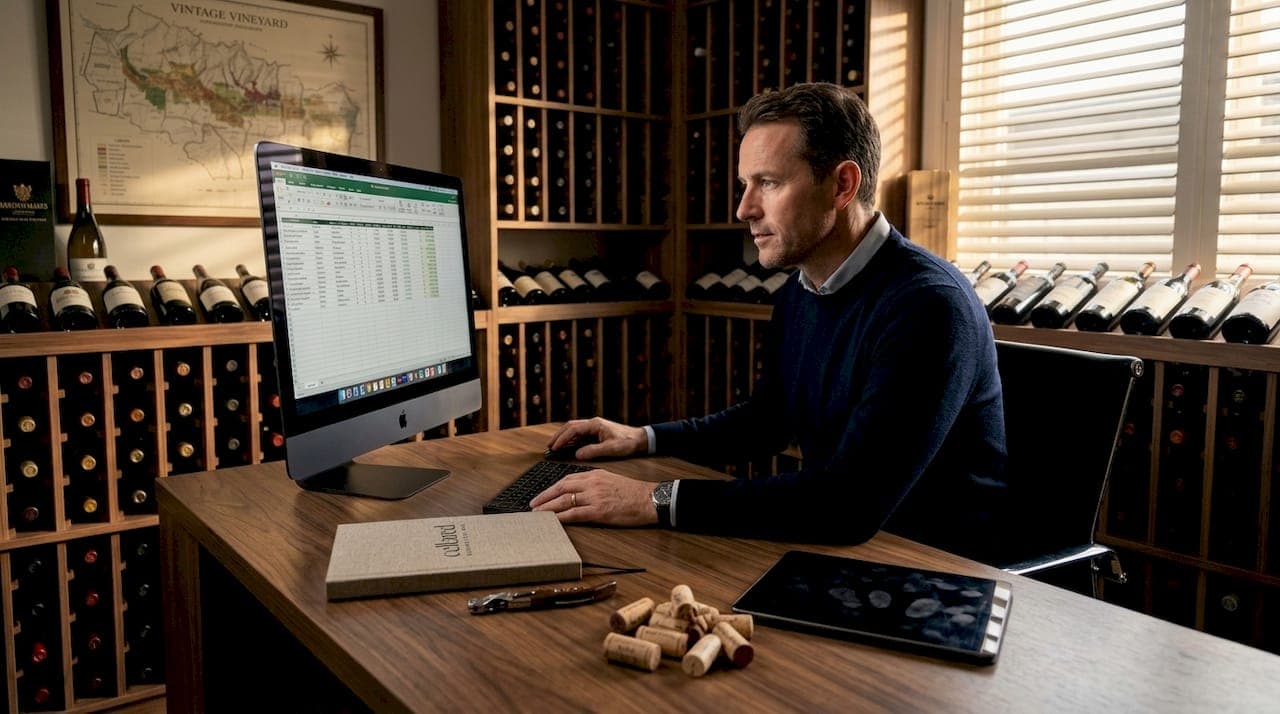
Despite whispers of sweeping regulatory change and the rising influence of ESG (environmental, social and governance) considerations in fine wine markets, the core standards governing wine valuations have remained remarkably stable heading into 2026. The market is stabilising post-correction, with Burgundy and Italian wines leading the recovery, yet the fundamental mechanics of how a bottle's worth is determined remain grounded in time-tested principles. For collectors and investors across Australia and APAC, understanding these standards is not merely academic. It is the difference between safeguarding a significant asset and making costly, irreversible errors in valuation, insurance, and estate planning.
Table of Contents
- What are wine valuation standards in 2026?
- Critical factors influencing wine value
- Market dynamics and regional trends in 2026
- Best practices for securing expert valuations
- The uncomfortable truth: Why most "standard" valuations miss crucial details
- Connect with Cellared for expert wine valuations and portfolio advice
- Frequently asked questions
Key Takeaways
| Point | Details |
|---|---|
| Stable standards in 2026 | No major changes to core wine valuation methods—market-driven criteria still prevail. |
| Provenance and condition matter | Authenticity, label integrity, and storage history strongly affect valuations for high-value bottles. |
| Regional performance guides investment | Burgundy and Italian wines are leading returns in a stabilising 2026 market. |
| Expert valuations protect portfolios | Professional, documented appraisals and rigorous checks safeguard against costly errors and fraud. |
What are wine valuation standards in 2026?
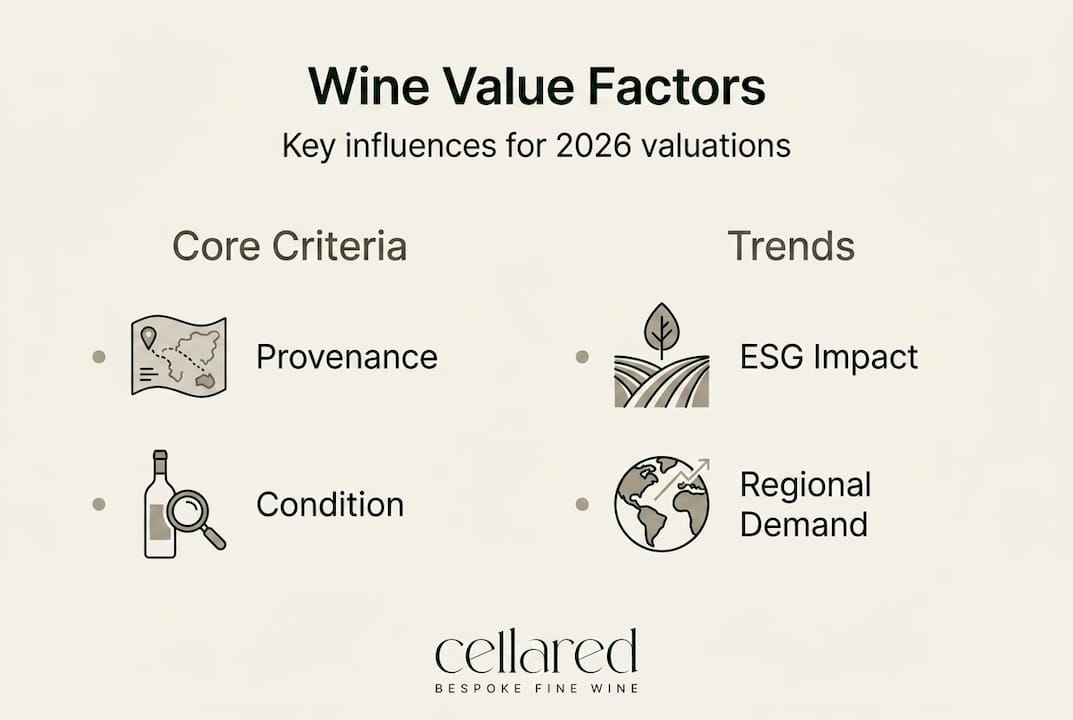
For those who follow fine wine markets closely, the absence of a dramatic overhaul in 2026 valuation standards may feel counterintuitive. Markets have shifted, sustainability rhetoric has grown louder, and digital tools have multiplied. Yet the bedrock criteria used by credentialed valuers remain consistent, structured around four primary pillars: provenance, market comparables, critical ratings, and physical condition.
Provenance refers to a wine's documented history, from the producer's cellar to its current owner. A bottle with an unbroken chain of custody commands considerably more confidence, and typically more value, than one with gaps in its journey. Market comparables draw on recent auction results, exchange data, and private sales to establish where a wine sits in the current marketplace. Critical ratings, particularly those from internationally recognised authorities, continue to influence buyer sentiment and therefore price. A 2026 wine scoring guide remains essential reading for understanding how scores translate to market value.
Physical condition encompasses everything from label integrity and fill level (known as ullage) to cork quality and storage history. Even minor imperfections can trigger meaningful value discounts on investment-grade bottles.
What is genuinely new in 2026 is the growing conversation around ESG and sustainability credentials. Wealth managers note that no major standard changes have been formalised, but sustainability factors are increasingly discussed in valuations for institutional clients. For now, they remain supplementary rather than determinative.
| Valuation criterion | Weight in standard assessments | Emerging considerations |
|---|---|---|
| Provenance documentation | Very high | Chain of custody digitalisation |
| Market comparables | High | Expanded exchange data sources |
| Critical ratings | Moderate to high | Regional critic influence growing |
| Physical condition | High | Automated condition imaging |
| ESG and sustainability | Low to moderate | Not yet standardised |
Key criteria applied in professional wine valuations include:
- Verified provenance and chain of custody
- Recent comparable sales from reputable auction houses and exchanges
- Critical scores from recognised international authorities
- Detailed physical inspection for condition and storage integrity
- Regional market context and vintage-specific performance data
One telling statistic: fine wine as an asset class has attracted record institutional interest in 2026, with wealth managers citing its low correlation to equities as a compelling diversification argument. The stability of valuation standards is precisely what gives this asset class its credibility.
Critical factors influencing wine value
Valuation is, at its finest, a precise art. The criteria may be consistent, but their application to individual bottles demands experience, judgement, and a willingness to investigate what others might overlook.
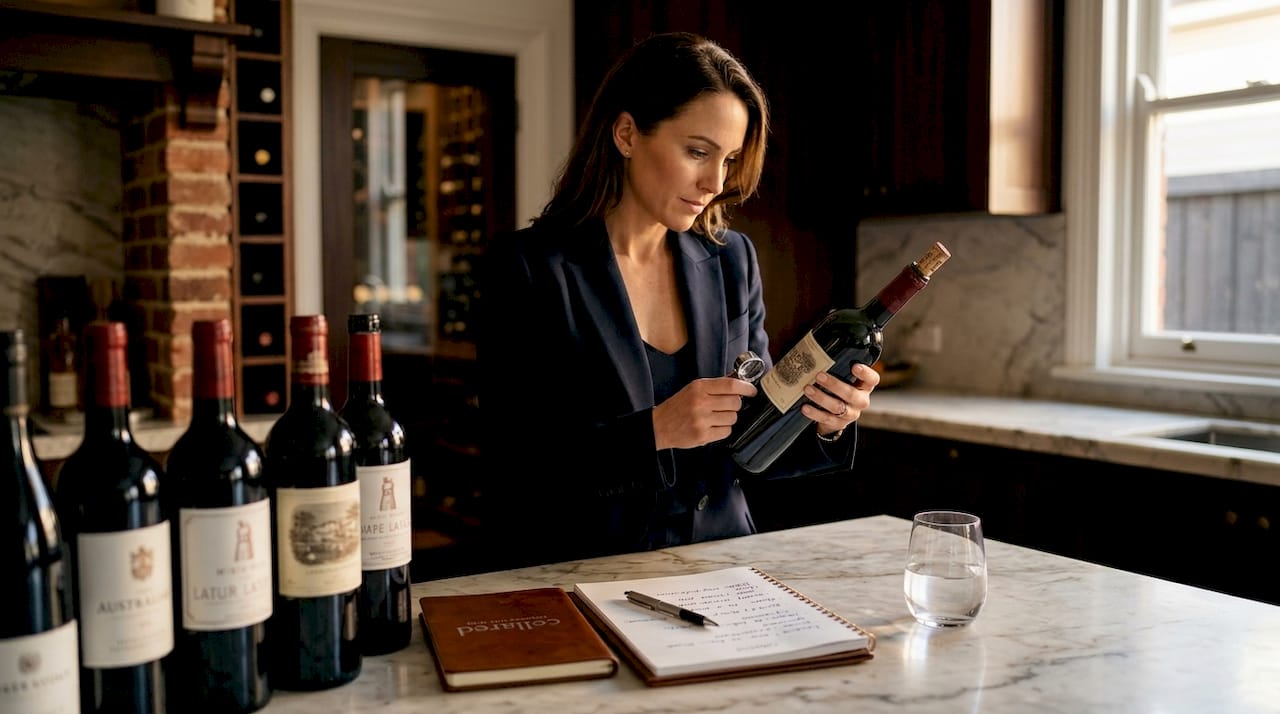
Provenance sits at the heart of any serious assessment. A magnum of 1982 Pétrus is only worth what the market believes it to be, and that belief is anchored entirely in the bottle's documented history. Counterfeiting risk is particularly acute for prestigious older vintages, where the rewards for fraud are highest and authentication is most challenging. Certificates, original wooden cases, retailer receipts, and auction house records all contribute to a provenance file that a skilled valuer will scrutinise carefully.
Condition is equally telling. The state of a label, capsule, and fill level can shift a valuation meaningfully. A bottle with a heavily soiled or torn label may be penalised even if the wine inside is perfect, because condition affects both desirability and resale. Understanding how wine label condition is assessed professionally can help collectors make informed storage and handling decisions.
Vintage matters in ways that go beyond simple age. Certain years produce wines with exceptional ageing potential, elevating their value on a curve that experienced valuers understand intimately. A wine vintage basics overview illustrates why not all old wine is good wine, and not all recent releases are modest in ambition.
For collectors approaching wine appraisals and valuations for insurance or estate purposes, the numbered steps below provide a practical framework:
- Compile all provenance documentation before the valuer arrives
- Photograph labels, capsules, and fill levels under consistent lighting
- Confirm storage conditions and temperature history where possible
- Request written condition notes for each bottle assessed
- Cross-reference the valuer's comparable sales data independently
For those managing estates, probate wine valuations require an additional layer of rigour, as the figures produced carry legal weight and may be scrutinised in court.
"A wine collection is only as valuable as the documentation that supports it. In the absence of proof, even the finest bottles are reduced to speculation."
Pro Tip: Never accept a valuation that does not include a condition report and specific comparable sales references. Any credible professional will provide both without hesitation.
Market dynamics and regional trends in 2026
Zooming out from individual bottles, the broader market context of 2026 offers both reassurance and nuance for collectors. The post-correction stabilisation that characterised late 2024 and 2025 has continued, with select regions demonstrating remarkable resilience.
Liv-ex indices show annualised returns of 6 to 10 per cent across established fine wine indices, with Burgundy and Italy emerging as the standout performers. This outperformance is not accidental. Both regions offer a combination of limited production, strong critical advocacy, and deeply loyal collector bases that insulate them from broader market volatility.
| Region | 2026 market trend | Key drivers |
|---|---|---|
| Burgundy | Outperforming | Scarcity, critical acclaim, collector loyalty |
| Italy (Barolo/Barbaresco) | Outperforming | Global recognition, ageing potential |
| Bordeaux | Stabilising | En primeur recalibration, value seeking |
| Australia and APAC | Recovering | Domestic demand, export growth |
For collectors with Australian and APAC holdings, the recovery trajectory is encouraging. Domestic demand for premium Australian labels has strengthened, while cross-border appetite from Singapore, Hong Kong, and Japan continues to underpin prices for globally recognised bottles.
Regional insights for collectors include:
- Barbaresco wine insights reveal a market that rewards patience and provenance equally
- Barolo market trends reflect growing international demand, particularly from APAC buyers
- Bordeaux outlook signals selective opportunity amid broader recalibration
Effective cellar management strategies are increasingly important in this environment, as the gap between well-managed and poorly managed collections widens in valuation terms. Temperature fluctuations, excessive light exposure, and improper humidity all erode value over time in ways that only become apparent at the point of appraisal.
A broader survey of wine regions overview reveals that regional diversification remains a sound strategy for collectors seeking both growth and stability in 2026.
Best practices for securing expert valuations
Knowing how valuations are shaped is only half the equation. The other half is ensuring that the valuation you commission is genuinely rigorous, independent, and fit for purpose, whether for insurance, estate planning, family law proceedings, or private sale.
Identifying credible professionals requires scrutiny. Look for valuers with demonstrable market experience, not just theoretical knowledge. Court-ready valuation reports, which must withstand legal examination, are the gold standard and a reliable indicator of professional rigour. A valuer who hesitates to provide a court-ready report is one who may not wish their methodology to be tested.
The following steps outline a sound approach to commissioning and verifying a valuation:
- Confirm the valuer's independence from buyers, sellers, and auction houses
- Request examples of previous valuation reports and assess their depth
- Ensure the valuer conducts a physical inspection, not merely a desktop review
- Ask for explicit comparable sales references with dates and prices
- Obtain written confirmation of storage conditions and any condition discounts applied
For trusted wine appraisals, the documentation surrounding each bottle should be treated with the same seriousness as a title deed on a property. Counterfeiting risk remains high for prestigious older vintages, and even well-intentioned vendors may be unaware that a bottle in their possession has been tampered with or mislabelled.
Pro Tip: Always request detailed inspection reports with photographs for every bottle valued above a material threshold. A credible valuer will welcome the request; an under-qualified one will resist it.
Collectors considering selling their wine collection should commission an independent valuation before approaching any buyer or auction house. A wine corking guide is also useful for understanding how cork integrity affects both condition assessments and final sale value. Going in with an independent figure protects against undervaluation and provides a credible benchmark in any negotiation.
The uncomfortable truth: Why most "standard" valuations miss crucial details
Here is what the industry rarely admits openly: a significant proportion of wine valuations produced each year are insufficiently rigorous. They rely on software-generated comparables, cursory physical inspections, and standardised condition notes that fail to capture the genuine nuances of a bottle's history and current state.
For collectors with significant holdings, this is not a minor inconvenience. It is a material risk. A valuation that overlooks a provenance gap, misses a subtle label imperfection, or fails to account for regional market shifts can misrepresent a collection's true worth by tens of thousands of dollars.
At Cellared, we have observed this pattern repeatedly across Australian and APAC markets. The most consequential errors rarely arise from deliberate negligence. They stem from over-reliance on automated tools and a reluctance to invest the time that genuinely complex collections demand. Detailed wine valuations that withstand scrutiny require experience, market intelligence, and a commitment to investigating every relevant detail. In 2026, discerning collectors should accept nothing less.
Connect with Cellared for expert wine valuations and portfolio advice
Understanding the standards is the first step. Applying them with precision to your own collection is where Cellared excels.
Cellared Fine Wine offers independent, court-ready appraisals for insurance, probate, family law, and private advisory purposes, grounded in genuine market knowledge and meticulous physical assessment. Our cellar management expertise ensures your collection is stored, catalogued, and valued with the rigour it deserves. Whether you hold Burgundy, Italian icons, or exceptional Australian labels, our regional insights bring depth and context to every assessment. Speak with Cellared today and experience the difference that truly expert valuation makes.
Frequently asked questions
Have there been major changes to wine valuation standards in 2026?
No significant changes have been formalised in 2026; ESG considerations are growing in relevance but remain supplementary, and the core mechanics of market-driven valuation are unchanged.
What's the biggest risk when valuing old vintages?
Counterfeiting and provenance gaps are the foremost risks; always insist on thorough documentation and professional authentication before accepting or assigning a value to older bottles.
How are regional wine markets performing in 2026?
Burgundy and Italy are outperforming, with Liv-ex indices reflecting annualised returns of 6 to 10 per cent, while Australian and APAC markets continue a steady recovery.
What's the best way to ensure my valuation is accurate?
Engage credentialled, independent valuers who conduct physical inspections and provide full documentation; provenance is critical for high-value bottles and must be verified rather than assumed.
Recommended
- Wine Appraisals & Valuations | Cellared | Bespoke Wine Buying, Valuation & Cellar Management
- Wine & Spirits Valuations | Family Law, Probate & SMSF | Cellared | Bespoke Wine Buying, Valuation & Cellar Management
- Probate Wine Valuations | Deceased Estate & Date of Death Reports | Cellared | Bespoke Wine Buying, Valuation & Cellar Management
- Wine Cellar Management | Cellared | Bespoke Wine Buying, Valuation & Cellar Management
- Wine scoring guide: make smarter choices in 2026