
When a fine wine collection enters legal proceedings, the stakes extend well beyond aesthetics. Understanding what is a court ready wine valuation separates those who protect their assets from those who watch them undervalued, disputed, or dismissed by a judge. Unlike a casual cellar appraisal or insurance estimate, a court ready valuation must satisfy rigorous legal standards, demonstrate absolute neutrality, and withstand scrutiny from opposing experts. Probate disputes, divorce settlements, and estate divisions all hinge on this distinction. This article explains precisely what sets court ready valuations apart and what you need to know before entering any legal process involving fine wine.
Table of Contents
- Key takeaways
- What defines a court ready wine valuation
- The wine valuation process for court use
- Common pitfalls in court wine valuations
- How court ready valuations support legal outcomes
- My perspective on what truly matters in court valuations
- How Cellared can assist with expert wine valuations
- FAQ
Key takeaways
| Point | Details |
|---|---|
| Not all appraisals qualify | A general wine appraisal lacks the legal standards and documentation a court will accept as admissible evidence. |
| Neutrality is non-negotiable | Courts require absolute independence from the valuer; any hint of advocacy can render a valuation inadmissible. |
| Valuation date is a legal decision | The chosen date determines which market data applies and can materially shift the outcome of a settlement. |
| Provenance documentation is critical | Chain of custody and storage records are as legally significant as the market figures themselves. |
| Early engagement changes outcomes | Integrating valuation into legal strategy from the outset, rather than treating it as a compliance step, protects your position. |
What defines a court ready wine valuation
A court ready wine valuation is a formally structured, professionally documented appraisal of a wine collection prepared to meet the evidentiary standards required by Australian courts and legal proceedings. This is not simply a question of finding an expert who knows their Burgundy from their Barossa. The report must comply with recognised professional standards, whether that is USPAP, AICPA guidance, or the relevant Australian legal framework applicable to the proceeding in question.
Courts scrutinise methodology with particular attention to normalisation adjustments and the distinctions made between different classes of value. A court ready valuation must define clearly:
- The standard of value being applied. Fair Market Value and Fair Value are not interchangeable, and courts reject reports that conflate them or fail to declare which applies.
- The valuation date, which determines what market data and condition records are relevant. An unclear or strategically misapplied date is one of the most common reasons a valuation is rejected.
- The interest being valued, meaning whether the assessment covers the entire collection, specific parcels, or an individual's share within a jointly held estate.
- Provenance and chain of custody, documented with precision. Storage conditions and uninterrupted provenance are legally significant because lapses in custody can reduce a wine's value to near zero in the eyes of a buyer or court.
- Normalisation adjustments, such as accounting for abnormal storage costs, one-off acquisition expenses, or any personal goodwill attached to the collector rather than the collection itself.
The valuer must remain a neutral, independent expert rather than an advocate for one party's preferred outcome. Courts and judges require absolute neutrality and transparency, not opinions shaped to serve a litigation strategy. This distinction matters enormously. A collector's personal wine consultant, however knowledgeable, rarely qualifies as an independent expert in a contested legal context.
Pro Tip: Request your valuer's curriculum vitae and prior court or tribunal experience before engagement. A specialist who has provided expert witness testimony before is a different proposition to one who has only ever produced insurance appraisals.
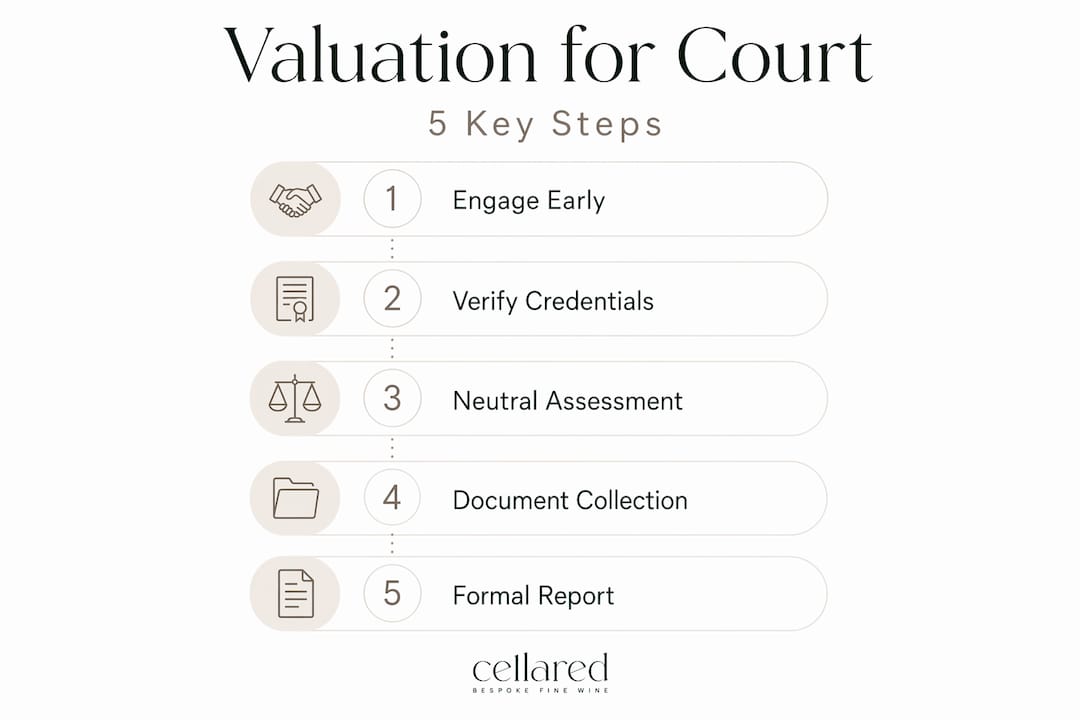
The wine valuation process for court use
Understanding how to value wine for court purposes requires clarity about each stage of the process. The steps below reflect what a properly conducted court approved wine appraisal looks like in practice.
-
Engagement and legal assignment definition. The valuer receives a formal brief outlining the legal context, the parties involved, the purpose of the valuation, and the standard of value required. This brief shapes every subsequent decision.
-
Wine asset identification and verification. Each bottle or parcel within the collection is physically inspected or verified through reliable documentation. Lot numbers, labels, fill levels, capsule condition, and provenance records are assessed and catalogued with meticulous care.
-
Market data gathering and analysis. The valuer draws on current auction results, dealer price lists, secondary market data, and comparable sales. Industry multiples and market data shift materially over time, which is why outdated data leads directly to inadmissible or disputed reports.
-
Condition and provenance adjustments. Market prices are adjusted based on storage history, temperature and humidity records, and the completeness of the chain of custody. Wine held at 13°C and 60 to 70% humidity with unbroken documentation commands a fundamentally different value to wine with unexplained custody gaps.
-
Valuation date determination. The valuation date is a legal strategy decision affecting what data applies. If not specified by court order, it must be selected with careful attention to the case narrative and applicable law.
-
Report preparation. The final report presents methodology, data sources, assumptions, adjustments, and conclusions in a structured format that opposing experts and the court can interrogate. Clarity and transparency throughout are not optional qualities.
-
Expert witness readiness. A court ready valuer must be prepared to defend their opinion under cross-examination. This requires not only sound methodology but the ability to articulate and justify every assumption made.
Pro Tip: Engage your wine valuation specialist early in the legal process, ideally before proceedings are formally commenced. The chosen valuation date can be a strategic consideration, and locking in the wrong date before taking advice can cost you significantly.
Common pitfalls in court wine valuations
The wine appraisal for legal purposes fails far more often through foundational errors than through complex technical mistakes. Most valuation failures stem from the wrong valuation date or undefined legal standards rather than flawed market analysis. Knowing where others go wrong is the clearest guide to getting it right.
-
Failing to define the standard of value. A report that does not clearly state whether it applies Fair Market Value or Fair Value gives opposing counsel straightforward grounds for challenge. Courts require clarity on what interest is valued, under what standard, and on what assumptions.
-
Inadequate provenance documentation. Provenance is not merely a desirable detail. Proper chain of custody documentation is as critical as financial data because uncertainty about a wine's custody history can devastate its legally recognised value.
-
Using outdated market data. Fine wine markets move. Deal multiples and secondary market prices shift with economic conditions and consumer demand. A valuation based on 2021 auction results applied to a 2026 settlement is a vulnerable document.
-
Conflating personal goodwill with collection value. Where a collection has been curated around a known collector's reputation, the valuer must separate the intrinsic asset value from any premium attached to the individual's personal relationships or standing in the wine community.
-
Where winery assets are involved, failing to separate vineyard land from the business. Vineyard land is a separate, stable asset requiring its own independent appraisal. Bundling it carelessly with a winery business valuation produces a figure that misrepresents both.
-
Allowing the report to read as advocacy. Courts expect valuers to start with the legal assignment and proceed methodically to a conclusion. A report that appears to back-calculate toward a client's preferred figure is one that experienced judges identify and reject.
A court will not rescue a poorly constructed valuation on the basis of an expert's credentials alone. The report must stand on its own. Neutrality, transparency, and documented methodology are the three pillars that determine whether a wine valuation survives legal scrutiny.
How court ready valuations support legal outcomes
The practical importance of court ready wine valuations becomes most vivid when you consider the legal contexts where they are applied. Each proceeding carries different stakes, different timelines, and different standards for how assets are allocated.
| Legal context | Role of court ready valuation | Key consideration |
|---|---|---|
| Probate and estate administration | Establishes fair asset value for distribution among beneficiaries | Valuation date typically at date of death |
| Family law and divorce | Supports equitable division of jointly held or disputed wine assets | Neutrality and independence are paramount |
| Shareholder or business disputes | Values wine inventory or cellar assets within a company or SMSF | Separation of asset classes is critical |
| Tax and estate planning | Provides defensible figures for duty and CGT calculations | Early integration prevents regulatory scrutiny |
In probate proceedings, a court ready valuation provides the executor and beneficiaries with a defensible, legally recognised figure for every bottle in the collection. Without it, disputes between beneficiaries over perceived value are almost inevitable, and those disputes consume time and legal fees that erode the estate's worth.
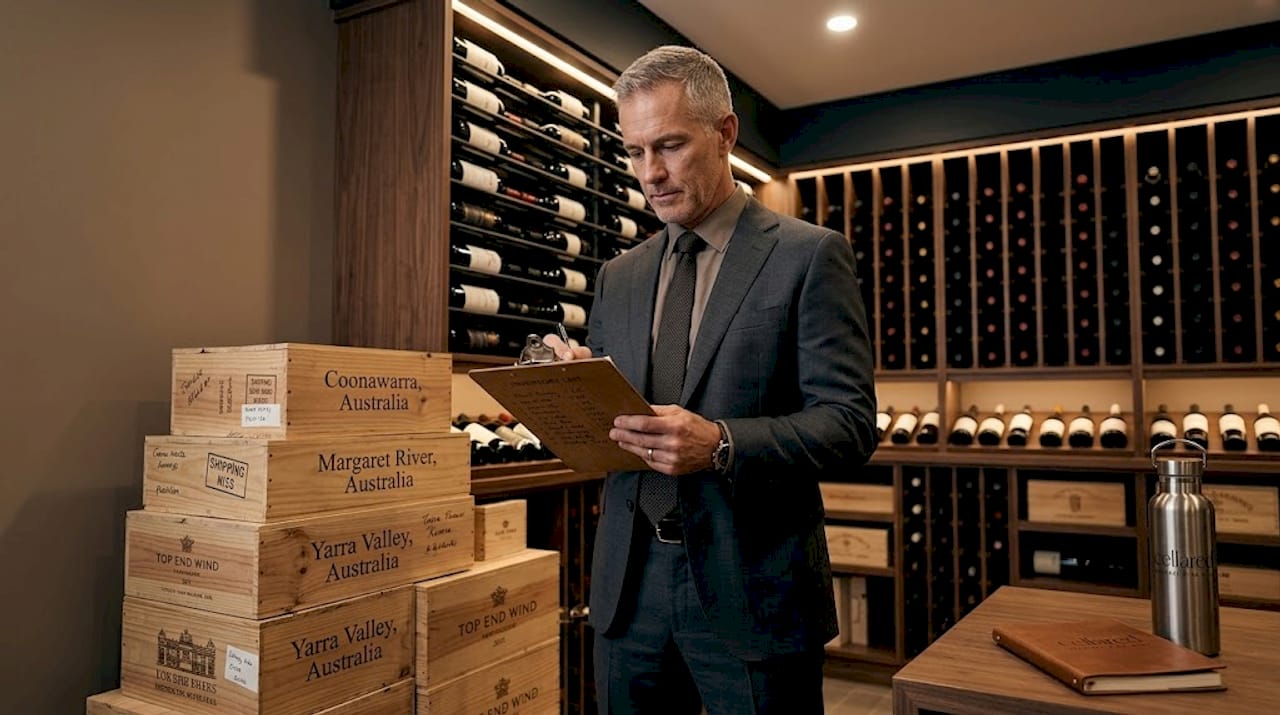
In family law matters, the wine collection is frequently misunderstood as a lifestyle asset rather than a serious financial one. A premium Burgundy cellar accumulated over two decades can represent hundreds of thousands of dollars in value, and that figure requires the same rigour applied to real property or share portfolios. Courts rely on expert, impartial valuations to allocate assets fairly, and a report that does not meet the required standard will simply not serve that purpose.
Consider a scenario: two beneficiaries dispute the value of a deceased parent's cellar containing rare aged Penfolds and verticals of Giacomo Conterno Barolo. One party produces a casual appraisal from a wine merchant friend. The other engages an independent specialist who produces a court ready report with full provenance records, current market data, and condition assessments. The court has no real choice about which report it accepts.
Integrating valuation early in estate legal planning also protects against tax penalties. Treating the valuation as a mere compliance step rather than a strategic element of estate planning is a costly misunderstanding of how these processes interact. Understanding the legal aspects of wine collections before proceedings begin puts you in a fundamentally stronger position.
My perspective on what truly matters in court valuations
I have seen a pattern repeat itself with remarkable consistency. Clients arrive in legal proceedings holding a wine appraisal they commissioned some time ago, confident it will suffice. It rarely does. The reason is almost never the valuer's knowledge of wine. It is the absence of legal architecture around the document.
What courts actually want is not an expert opinion about a wine's greatness. They want a methodologically sound, independently verifiable, transparently documented report that answers a specific legal question about a specific asset at a specific point in time. Every element of that sentence matters equally.
In my experience, the valuation date is where the most avoidable damage occurs. People select a date that feels logical rather than one that serves the legal context. That choice, made without proper advice, can anchor a settlement to market conditions that no longer reflect reality, or exclude data that would have supported a stronger position.
The other lesson I keep returning to is this: neutrality is not a bureaucratic formality. It is the substance of the entire exercise. A valuation that carries even the appearance of advocacy is one that opposing counsel will take apart piece by piece. The finest methodology in the world cannot rescue a report written for one party rather than for the court.
My advice is simple. Treat the court ready valuation as part of your legal strategy from the outset, not as a document you produce once proceedings are already well underway. Engage a specialist who understands both the wine market and the legal framework, because expertise in one without the other is not enough.
— David
How Cellared can assist with expert wine valuations

When your legal proceedings involve fine wine, the quality of your valuation determines the quality of your outcome. Cellared Fine Wine produces professional court ready valuations specifically tailored for probate, family law, and asset dispute contexts across Australia. Every report is prepared to the standards courts require: independently verified, methodologically transparent, and grounded in current market intelligence.
Cellared also offers private cellar management and bespoke wine buying services, helping clients protect and grow collection value over time. Whether you need a single valuation report or ongoing advisory support as part of a broader estate strategy, Cellared's specialists bring genuine depth in both the fine wine market and the legal requirements that govern it. For those managing an estate or navigating a legal dispute, professional wine valuation services tailored to your specific circumstances are available now. Reach out to arrange an initial consultation.
FAQ
What is a court ready wine valuation?
A court ready wine valuation is a professionally structured appraisal of a wine collection prepared to meet the evidentiary standards required by courts in legal proceedings such as probate, divorce, and asset disputes. It must comply with recognised valuation standards, define the applicable standard of value, document provenance and storage conditions, and be produced by an independent, neutral expert.
How does a court ready valuation differ from a standard appraisal?
A standard appraisal provides a general market estimate, while a court ready valuation must satisfy specific legal requirements including a defined valuation date, documented chain of custody, normalisation adjustments, and a methodology that can withstand cross-examination by opposing experts.
Why does the valuation date matter in legal proceedings?
The valuation date determines which market data, condition records, and financial information are relevant to the assessment. Courts reject valuations with unclear or improperly chosen dates, and the selection of this date can materially affect the settlement outcome.
Can any wine expert produce a court ready valuation?
Not necessarily. A court ready valuation requires both deep knowledge of the fine wine market and a clear understanding of the legal standards that govern admissible expert evidence. A valuer without experience in legal proceedings or expert witness contexts may produce a report that is commercially sound but legally inadmissible.
How does provenance affect a wine valuation for legal purposes?
Provenance and chain of custody documentation are foundational to a court ready wine valuation. Gaps in storage or ownership history can dramatically reduce a wine's legally recognised value, as courts and buyers treat unverifiable provenance as a material risk that discounts the asset's worth.
Recommended
- Wine valuation standards in 2026: Expert guide for collectors
- Wine Appraisals & Valuations | Cellared | Bespoke Wine Buying, Valuation & Cellar Management
- Probate Wine Valuations | Deceased Estate & Date of Death Reports | Cellared | Bespoke Wine Buying, Valuation & Cellar Management
- Wine & Spirits Valuations | Family Law, Probate & SMSF | Cellared | Bespoke Wine Buying, Valuation & Cellar Management