
Inherited wine collections are classified as tangible personal property, meaning they carry real market value, legal obligations, and preservation requirements that most heirs are wholly unprepared to manage. Unlike shares or superannuation, a cellar of aged Penfolds Grange, Giacomo Conterno Barolo, or Domaine de la Romanée-Conti cannot simply be transferred with a signature and left to its own devices. The intersection of inheritance and wine collections demands immediate, expert-led action. Delay costs money, and in some cases, it destroys irreplaceable bottles that decades of careful collecting built. This guide walks Australian heirs through every critical step, from appraisal and legal compliance to storage continuity and sale strategy.
How to professionally appraise and value inherited wine collections
Wine collections require expert appraisal, not retail price comparisons or online listings, to establish fair market value for probate. This distinction matters enormously. A bottle of 1990 Penfolds Bin 707 listed on an auction aggregator reflects a sale price under specific conditions, not the defensible, documented valuation an executor must submit to the Australian Taxation Office or a probate court. Using the wrong figure exposes the estate to challenge, penalties, and potential undervaluation that shortchanges every beneficiary.
A professional wine collection appraisal considers four core factors:
- Provenance: documented ownership history, original purchase receipts, and cellar records that confirm authenticity and storage continuity
- Rarity and vintage condition: the scarcity of specific vintages, producer reputation, and the physical condition of labels, capsules, and fill levels
- Current market demand: live auction results from Langton's, Hart Davis Hart, and Christie's, cross-referenced against private sale data
- Storage history: whether bottles were held in climate-controlled conditions or subjected to temperature fluctuation, which directly affects drinking windows and resale price
The risk of undervaluation is not theoretical. Improper documentation during probate routinely results in collections being assessed at a fraction of their true worth, leaving heirs with less and creating disputes that outlast the estate process itself.
Pro Tip: Commission a probate wine valuation from a specialist within the first four weeks of taking executor responsibility. Courts and the ATO accept independent, market-led valuations far more readily than self-reported estimates or retail price guides.

To find a qualified valuer in Australia, look for professionals with demonstrated auction market knowledge, experience preparing court-ready reports, and familiarity with both Old World and New World fine wine. Cellared Fine Wine provides exactly this service, with valuations prepared for probate, insurance, and family law purposes.
What are the legal and tax obligations for inherited wine in Australia?
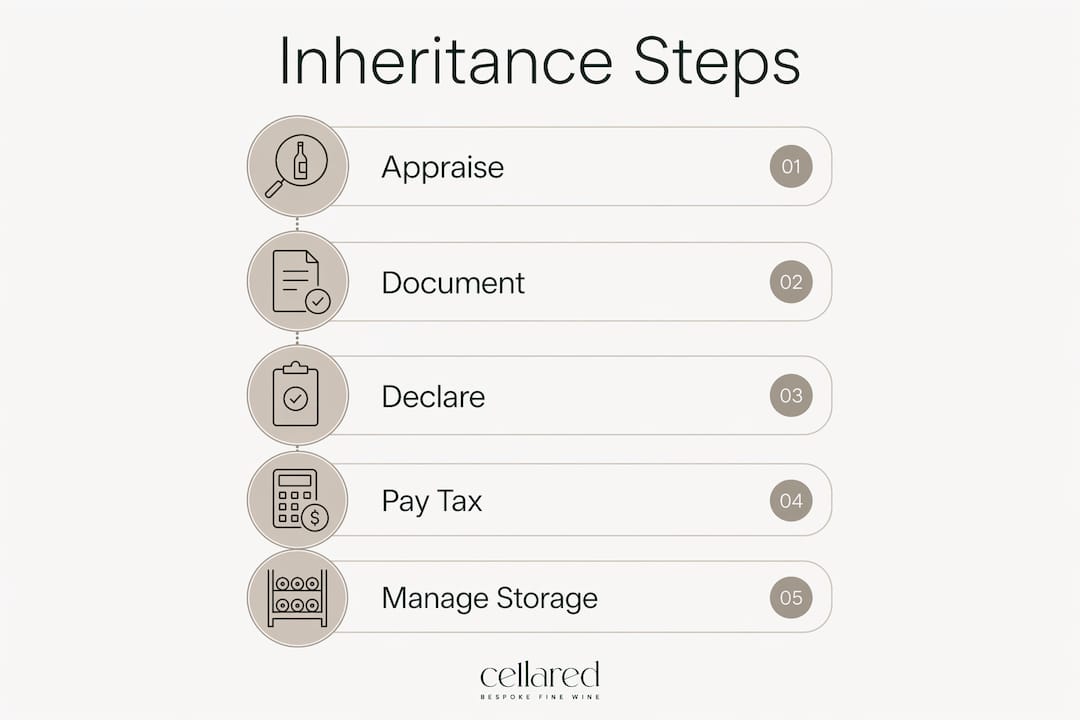
Wine inheritance laws in Australia sit at the intersection of estate law, capital gains tax, and, in some cases, liquor licensing. Heirs who treat a cellar as simply "stuff left behind" face real financial and legal exposure. The following steps outline the correct sequence for legal compliance.
- Obtain probate and establish executor authority. The executor must be formally appointed before taking any action with the collection, including moving bottles or contacting storage facilities.
- Commission a fair market valuation for estate reporting. This figure forms the cost base for any future capital gains tax calculation if bottles are later sold.
- Review storage membership and reserve agreements immediately. Organisations like The Wine Society allow nominated beneficiary transfers, but these transfers require executor action and adherence to specific procedural rules. Delays can complicate access to stored wine.
- Check for any liquor licence or winery-related obligations. If the deceased held a producer or retailer licence, licensing requirements can lapse during estate transfer, destroying business value overnight if ignored.
- Understand capital gains tax timing. Wine sold within 12 months of inheritance may attract a higher CGT rate than wine held longer. Timing the sale strategically, in consultation with a tax adviser, can preserve significant value.
One sobering precedent from 2026 illustrates the stakes of legal carelessness. A court imposed a nearly $110,000 fine in an inheritance case where legal filings relied on unverified, AI-generated citations rather than verified research. This underscores a principle that applies directly to wine estate administration: every legal document, every valuation, and every filing must be anchored in verified, professional expertise.
For a thorough overview of compliance obligations, the legal aspects of wine collections resource from Cellared Fine Wine covers the key requirements Australian executors face.
How does storage affect the value of an inherited wine collection?
Neglecting storage for even three to six months during probate can ruin bottles worth thousands of dollars. This is one of the most preventable causes of value loss in wine inheritance, yet it happens constantly because executors are focused on legal paperwork rather than cellar conditions. Fine wine is a living product. Temperature spikes above 20°C accelerate ageing unpredictably. Vibration disturbs sediment and disrupts the slow chemical processes that give aged Burgundy or Barolo their complexity.
The key storage obligations for heirs and executors include:
- Maintain climate control continuity. If the deceased used a professional storage facility, continue the account and pay fees without interruption. If wine is stored at home, arrange for a specialist to assess the cellar environment immediately.
- Document current conditions. Photograph the cellar, record temperature and humidity readings, and note any bottles showing signs of seepage, cork push, or label damage. This documentation protects the estate if condition disputes arise later.
- Avoid unnecessary movement. Moving bottles without proper packaging and temperature management causes physical damage. If relocation is necessary, engage a specialist fine wine logistics provider.
- Fund ongoing storage from the estate. Executors have the authority and obligation to use estate funds for reasonable preservation costs. Allowing a collection to deteriorate through inaction is a breach of fiduciary duty.
Pro Tip: If the deceased held wine in a professional cellar management programme, contact the provider on the day you receive executor authority. Most reputable providers will hold the account in good standing while probate is finalised, provided you communicate promptly.
How do families divide an inherited wine collection fairly?
Family-owned wine assets cause disputes because heirs have different levels of involvement, knowledge, and emotional attachment. One sibling may have spent years building the collection alongside the deceased. Another may have no interest in wine at all and simply wants their share in cash. Equal wills do not produce equal outcomes when the asset in question is a cellar of aged Pétrus and Henschke Hill of Grace.
The three primary distribution strategies each carry distinct trade-offs:
| Strategy | How it works | Best suited when |
|---|---|---|
| Value-based allocation | Each heir receives bottles equivalent to their share of the appraised value | Heirs have different preferences but want equitable financial outcomes |
| In-kind distribution | Bottles are physically divided among heirs according to agreed criteria | All heirs want to retain wine and have appropriate storage capacity |
| Sale and divide proceeds | The collection is sold through auction or private sale; proceeds are distributed | Heirs prefer liquidity or cannot agree on physical division |
Structured agreements differentiating active and passive heirs are the most effective tool for preventing conflict in complex estates. A buy-sell agreement, for example, allows one heir to purchase another's share at the appraised value, preserving the collection's integrity while providing liquidity to those who want it. Family trusts and wine collections are increasingly paired together in Australian estate planning precisely because a trust structure allows the collection to be held, managed, and eventually distributed according to rules set by the original collector, rather than the competing preferences of grieving heirs.
Estate plans benefit from trust structures and buy-sell agreements funded by life insurance to manage both family dynamics and liquidity pressures. The executor's role is to implement these structures faithfully, which is why appointing someone with genuine knowledge of fine wine markets is far preferable to defaulting to the family solicitor.
What are the best options for selling an inherited wine collection?
High-value inherited wine sold through auction houses or brokers achieves materially better returns than fire-sale liquidations, which can lose 20 to 40 per cent of appraised value. That figure represents the cost of urgency and inexperience. Heirs who understand their options and plan the sale properly recover far more for the estate.
The main channels for selling inherited wine in Australia are:
- Specialist auction houses. Langton's and Mossgreen are the most recognised Australian platforms for fine wine. They attract serious collectors, provide market transparency, and achieve strong results for blue-chip producers. Seller commissions typically range from 10 to 15 per cent.
- Private wine brokers. A specialist broker like Cellared Fine Wine can place bottles directly with known buyers, often achieving prices above auction estimates for rare or single-bottle lots that might not attract competitive bidding in a public sale.
- Direct private sale. Selling directly to collectors or wine investment funds is possible for well-documented collections with strong provenance. This route requires the most preparation but eliminates commission costs.
- Partial retention. Not every bottle needs to be sold. Heirs who appreciate fine wine may choose to retain the best-drinking bottles and sell the investment-grade stock, balancing personal enjoyment with financial return.
Timing matters as much as channel selection. Selling immediately after probate, without a valuation or market assessment, is the single most common cause of underperformance. A structured exit strategy that accounts for market cycles, seasonal auction calendars, and the specific producers in the collection will consistently outperform a rushed liquidation.
Key takeaways
Inherited wine collections demand immediate professional appraisal, uninterrupted storage management, and a considered sale or distribution strategy to protect both financial value and family legacy.
| Point | Details |
|---|---|
| Appraise immediately | Commission a specialist valuation within four weeks of executor appointment to meet probate requirements. |
| Maintain storage continuity | Contact storage providers on day one; temperature failure during probate destroys irreplaceable value. |
| Comply with legal obligations | Review storage memberships, licensing, and CGT timing before making any decisions about the collection. |
| Plan distribution carefully | Use value-based allocation, in-kind division, or structured sale to prevent family disputes. |
| Sell through the right channel | Auction houses and specialist brokers recover 20 to 40 per cent more than unplanned liquidations. |
What I have learned from working with inherited wine collections
The heirs who protect the most value are almost never the ones who know the most about wine. They are the ones who act quickly, ask the right questions, and resist the pressure to make irreversible decisions under grief. I have seen collections worth hundreds of thousands of dollars diminished not by market forces, but by six weeks of inaction while a family waited for legal formalities to resolve themselves.
The most common mistake I observe is treating a wine collection like a bank account. Heirs assume the value is fixed, that it will wait patiently while everything else is sorted out. It will not. A cellar of aged Burgundy or mature Clare Valley Riesling is in constant, slow transformation. The window for peak drinking and peak sale value is finite, and probate does not pause that clock.
My strongest advice is this: engage a specialist appraiser before you engage anyone else. Not a general estate agent, not a solicitor with a passing interest in wine, and certainly not an online price aggregator. The valuation standards that apply in 2026 are specific, defensible, and market-led. A report prepared to that standard protects the estate legally, informs every distribution decision, and gives the family a shared, objective basis for what can otherwise become a deeply personal and painful negotiation.
Sentimental value and financial value are not opposites. A collection assembled with passion and patience deserves to be transferred with the same care. The families who honour that deserve expert guidance to match.
— David
How Cellared Fine Wine supports Australian heirs

Cellared Fine Wine works directly with Australian heirs, executors, and estate solicitors to manage every stage of wine collection inheritance. From court-ready probate valuations prepared to ATO and legal standards, through to ongoing cellar management that preserves condition and value during probate, Cellared brings specialist expertise to one of the most overlooked areas of estate administration. For families considering a sale, Cellared's market knowledge and private buyer network consistently achieves results above what general auction channels deliver. If you have inherited a wine collection and are uncertain where to begin, Cellared Fine Wine offers a confidential initial consultation tailored to your specific situation.
FAQ
What is the first step when inheriting a wine collection?
Commission a professional appraisal from a specialist fine wine valuer immediately after receiving executor authority. This establishes fair market value for probate reporting and forms the cost base for any future capital gains tax calculation.
Does inherited wine attract capital gains tax in Australia?
Wine sold after inheritance is subject to capital gains tax based on the difference between the probate valuation and the sale price. Holding wine for more than 12 months before selling generally attracts the 50 per cent CGT discount for individuals.
How do I transfer wine held in professional storage after someone dies?
Contact the storage provider directly with proof of executor appointment. Organisations like The Wine Society allow storage transfer procedures for nominated beneficiaries, but these require formal documentation and prompt action to avoid access complications.
Can I divide a wine collection equally among multiple heirs?
Physical division is possible but requires a professional appraisal to ensure each heir receives bottles of equivalent market value. Value-based allocation, in-kind distribution, or a structured sale with divided proceeds are the three recognised approaches for equitable distribution.
How much can I lose by selling inherited wine without professional advice?
Unplanned or rushed liquidations of inherited wine collections can lose 20 to 40 per cent of appraised value compared with sales conducted through specialist auction houses or private brokers with proper market preparation.