
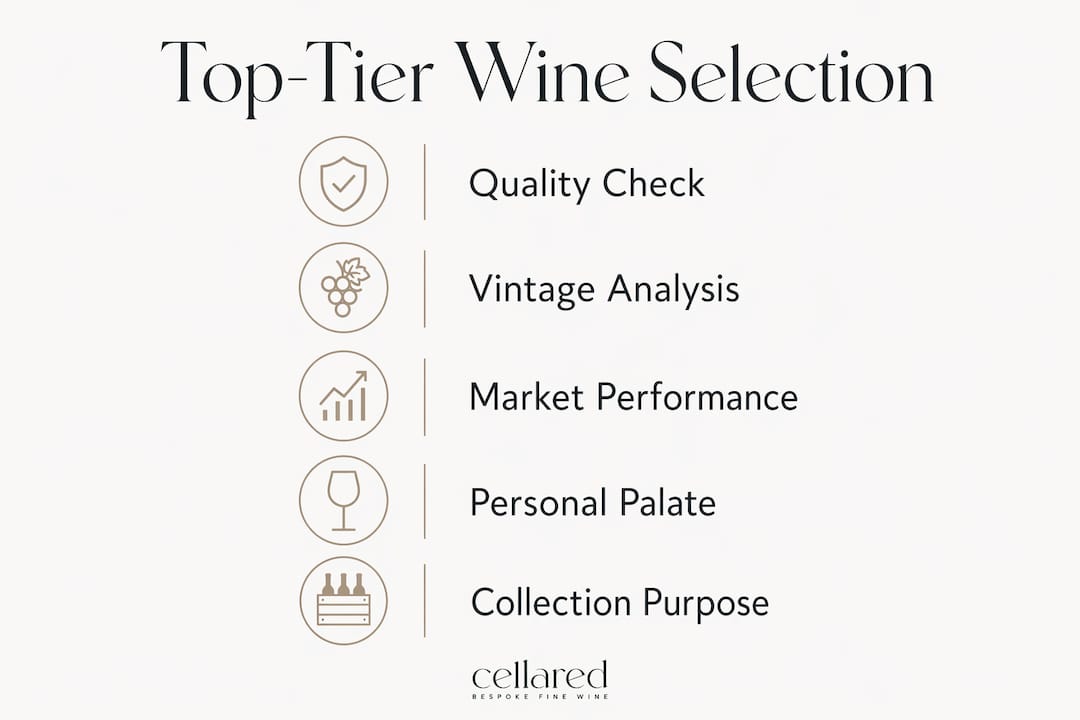
The process for selecting top-tier wines is a disciplined approach that combines quality assessment, provenance verification, and investment analysis to build a collection worth both drinking and holding. Top-tier wines are defined by producer reputation, vintage consistency, scarcity, and a minimum ten-year ageing window. The finest examples sit within recognised classification tiers such as Bordeaux Grands Crus and Burgundy Premier and Grand Cru appellations. Collectors who apply a systematic method avoid the twin traps of overpaying for prestige and overlooking genuine value. This guide sets out the criteria, tools, and steps that distinguish a considered acquisition from an expensive impulse.
What key criteria define top-tier wines for selection?
Top-tier wines meet a specific set of measurable standards, not just a high price tag. The most reliable producers carry at least twenty years of consistent critic scores above 90 and produce fewer than 5,000 cases per vintage. That combination of longevity and scarcity signals genuine quality rather than marketing momentum.
Vintage quality is the second pillar. A producer's reputation means little if a particular vintage suffered poor growing conditions. Collectors track price movement across multiple consecutive vintages for the same estate, identifying where quality and value align rather than simply buying the most celebrated year.
Ageing potential separates fine wine from good wine. Professional collectors require a minimum ten-year drinking window from vintage date before a wine qualifies as top-tier. A Barolo from a great producer in a great year may not reach its peak for fifteen to twenty years. That patience is part of the discipline.
Classification frameworks provide a third layer of confidence. The MICHELIN Grape Selection evaluates estates across five pillars: agronomy, technical mastery, identity, balance, and vintage consistency. This estate-level assessment goes well beyond a single bottle score and gives collectors a durable confidence marker. The 2025 Cru Bourgeois classification reinforces this approach, with only 14 wines earning the top Exceptionnel tier after mandatory site visits and five-vintage panel tastings.
- Producer track record: 20+ years of scores above 90 with production under 5,000 cases per vintage
- Vintage quality: Confirmed by expert panels and price movement across five or more consecutive years
- Ageing potential: Minimum ten-year drinking window from vintage date
- Classification standing: Recognised tier within a formal system such as Cru Bourgeois, Grand Cru, or MICHELIN Grape Selection
- Scarcity: Limited production volumes that support long-term price appreciation
Pro Tip: When assessing a new producer, check whether their scores have held across at least three different vintages with contrasting growing conditions. Consistency under pressure is the true mark of a top-tier estate.
How to assess vintage quality and market performance
Systematic vintage analysis begins with charting price curves across five or more consecutive releases from the same producer. This reveals whether a wine appreciates steadily, spikes on release and fades, or trades at a persistent discount relative to its peers. Each pattern tells a different story about market confidence and collector demand.

Outlier vintages offer some of the best opportunities in fine wine. Seasoned collectors identify vintages trading at 30% or more below comparable years and cross-check them against critic scores. If the quality is confirmed but the market has not yet recognised it, the entry point is genuinely attractive. This is not speculation. It is disciplined value identification.
Market liquidity deserves as much attention as quality. Bid-offer spreads on wines priced above $500 can exceed 15%, which significantly erodes investment returns. By contrast, top Bordeaux first growths and Burgundy Grands Crus typically carry spreads below 10%. Understanding this spread before purchase is the difference between a liquid asset and a beautiful bottle you cannot sell at a fair price.
| Metric | What to look for | Why it matters |
|---|---|---|
| Five-vintage price curve | Steady appreciation or stable floor | Confirms consistent market demand |
| Outlier vintage discount | 30% or more below peer vintages | Signals potential value entry point |
| Bid-offer spread | Below 10% for top-tier wines | Indicates strong secondary market liquidity |
| Critic score consistency | 90+ across multiple vintages | Validates producer quality over time |
Indices such as Liv-ex pricing data provide real-time secondary market benchmarks. Tracking the Liv-ex 1000 trend over twelve months shows whether the broader fine wine market is expanding or contracting, which informs both the timing and the allocation of new acquisitions.
Integrating personal palate and collection purpose
A collection built entirely on investment metrics is a portfolio, not a cellar. The most satisfying collections balance market-driven acquisitions with bottles chosen for personal pleasure. Aligning at least some purchases with your own palate creates a cellar you genuinely want to open, not just monitor.
Structuring your cellar across three tiers gives clarity to every purchase decision. The first tier holds everyday enjoyment wines, accessible and ready to drink. The second tier covers mid-term bottles, typically five to ten years from peak. The third tier holds long-term treasures, the wines that reward patience and anchor the collection's value.
Defining a clear exit strategy before purchase prevents the most common collector mistake: buying trophy bottles with no realistic market exit. Before acquiring any bottle above a certain price threshold, decide whether it is destined for consumption, private resale, or auction. That decision shapes how many bottles you buy, how you store them, and when you act.
- Provenance documentation: Retain purchase receipts, storage records, and condition reports for every investment-grade bottle
- Storage conditions: Temperature-controlled, humidity-stable storage is non-negotiable for wines held beyond five years
- Liquidity awareness: Avoid concentrating more than 20% of a collection in low-liquidity producers or obscure appellations
- Exit thesis: Set a target price and intended use for each acquisition before the purchase is made
Pro Tip: Pair a top-tier Burgundy with a well-matched dish to experience its full expression. Understanding wine and food pairing deepens your sensory knowledge of a wine's character, which in turn sharpens your selection instincts.
What are the practical steps for executing the top-tier wine selection method?
A repeatable selection process removes emotion from the equation and replaces it with structured judgement. Applying a sequence of occasion, style, region, producer, vintage, and price eliminates guesswork and keeps every acquisition aligned with collection purpose. The steps below translate that framework into a working method.
- Identify the quality tier. Confirm the producer sits within a recognised classification or meets the 20+ years, 90+ score, sub-5,000 case threshold. Do not proceed without this foundation.
- Run the five-vintage price analysis. Chart release and secondary market prices across five consecutive vintages. Look for a stable floor or steady appreciation, and flag any outlier vintages trading at a meaningful discount.
- Verify the ageing window. Confirm the target vintage carries a minimum ten-year drinking window from its release date. Cross-check with at least two independent critic assessments.
- Assess market liquidity. Check the bid-offer spread on the secondary market. Prioritise wines with spreads below 10% unless the bottle is designated purely for personal consumption.
- Document the purchase rationale. Record the intended use (consumption, resale, or auction), the target exit price, and the storage plan before completing the purchase.
- Review portfolio allocation. Confirm the acquisition maintains a balanced spread across blue-chip producers and emerging estates. Avoid concentrating more than 30% of total cellar value in a single appellation or producer.
| Step | Action | Key threshold |
|---|---|---|
| Quality tier check | Confirm classification or score history | 90+ scores over 20+ years |
| Vintage price analysis | Chart five consecutive vintages | Stable floor or steady appreciation |
| Ageing window verification | Cross-check two critic assessments | Minimum ten years from vintage |
| Liquidity assessment | Review secondary market spread | Below 10% for investment bottles |
| Portfolio allocation review | Check concentration by producer and region | No single producer above 30% of cellar value |
Pro Tip: Review your cellar's composition at least once a year. Markets shift, producers evolve, and bottles that once anchored your collection may now represent the best time to sell.
Common mistakes in selecting top-tier wines and how to avoid them
Relying solely on critic scores is the most widespread error among collectors. A score of 98 points from a single critic in a single tasting context tells you very little about how a wine will perform over ten years in your cellar. Scores are a useful filter, not a final verdict.
Ignoring liquidity is the second critical mistake. Collectors who buy rare, low-production bottles from obscure appellations often find themselves holding assets with no willing buyers at a fair price. The secondary market for fine wine rewards wines with established demand, not just rarity.
- Confusing prestige with quality: A famous label does not guarantee consistent quality across vintages. Verify the specific vintage, not just the producer's reputation.
- Overbuying single vintages: Concentrating heavily in one exceptional year leaves a collection exposed if market sentiment shifts or the vintage underperforms at maturity.
- Neglecting provenance records: Bottles without clear storage history and purchase documentation lose significant value on resale and at auction.
- Skipping the exit thesis: Buying without a defined purpose or target price leads to emotional decision-making and missed opportunities to realise gains.
- Ignoring portfolio balance: A collection weighted entirely toward blue-chip Bordeaux or Burgundy lacks the diversity that protects against regional market corrections.
Key takeaways
The most effective process for selecting top-tier wines combines producer track record, vintage price analysis, ageing potential, and a clearly defined exit strategy before any acquisition is made.
| Point | Details |
|---|---|
| Producer track record | Require 20+ years of scores above 90 and production under 5,000 cases per vintage. |
| Vintage price analysis | Chart five consecutive vintages to identify value outliers and confirm market demand. |
| Ageing potential | Confirm a minimum ten-year drinking window from vintage date using two independent assessments. |
| Liquidity check | Prioritise wines with secondary market bid-offer spreads below 10% for investment bottles. |
| Exit strategy | Define consumption, resale, or auction intent and a target price before every purchase. |
Why the best collections are built on discipline, not desire
The collectors I respect most share one quality: they are as rigorous about what they do not buy as what they do. The fine wine market rewards patience and method. It punishes impulse and sentiment.
The MICHELIN Grape Selection framework changed how I think about estate evaluation. Before it existed, a single high score from a celebrated critic carried enormous weight. Now, assessing an estate across agronomy, technical mastery, identity, balance, and vintage consistency gives a far more durable picture of quality. A wine that scores 95 in a great vintage but 88 in a difficult one tells a very different story from an estate that consistently delivers 92–95 across contrasting conditions.
The outlier vintage strategy is, in my view, the most underused tool available to collectors. Markets are driven by narrative. When a vintage receives mixed early reviews, prices soften even if the wine is genuinely excellent. Collectors who do the work, cross-check the scores, and buy with conviction at a 30% discount to peers are the ones who build collections with real depth and real value.
My honest advice is this: grow your collection at a measured pace. A cellar of 200 bottles you understand deeply is worth more, in every sense, than 500 bottles acquired on momentum. Review your holdings annually, rotate what has peaked, and never stop tasting. The sensory knowledge you build at the table is the same knowledge that sharpens your selection instincts at the point of purchase.
— David
How Cellared Fine Wine supports your selection process
Selecting top-tier wines with confidence requires more than a checklist. It requires market intelligence, provenance expertise, and a trusted adviser who understands both the investment and the pleasure of a well-built collection.
Com offers bespoke wine buying tailored to each collector's goals, whether that means sourcing a specific vintage, building a structured cellar across three tiers, or identifying value in an underappreciated appellation. Com's professional wine valuations are court-ready and market-led, covering insurance, probate, and private advisory purposes. For collectors who want to manage their holdings with the same rigour applied at the point of purchase, Com's cellar management service provides ongoing oversight, documentation, and strategic review. Every service is built around one principle: helping you buy well, value accurately, and enjoy the world's finest wines with complete confidence.
FAQ
What makes a wine qualify as top-tier?
Top-tier wines come from producers with at least twenty years of consistent critic scores above 90 and production volumes under 5,000 cases per vintage. They must also carry a minimum ten-year ageing window from vintage date.
How do I find value in top-tier wine selection?
Identify outlier vintages trading at 30% or more below comparable years from the same producer, then verify quality with independent critic scores. These bottles offer genuine value without sacrificing provenance or ageing potential.
Why does bid-offer spread matter when selecting fine wines?
Bid-offer spreads above 15% on secondary markets significantly reduce the effective return on investment-grade bottles. Top Bordeaux and Burgundy Grands Crus typically carry spreads below 10%, making them more liquid and easier to exit at a fair price.
What is the MICHELIN Grape Selection and why does it matter?
The MICHELIN Grape Selection rates wine estates across five pillars: agronomy, technical mastery, identity, balance, and vintage consistency. It provides an estate-level quality marker that is more durable than a single-bottle critic score.
How many bottles should I buy of a single vintage?
Avoid concentrating more than 30% of total cellar value in a single producer or appellation. Define your exit strategy, whether consumption, resale, or auction, before purchase, and buy only the quantity that fits that plan.