Selecting wines for future value is defined as the deliberate acquisition of bottles with documented pedigree, scarcity, and ageing potential that drive price appreciation over time. This practice sits at the intersection of connoisseurship and considered investment, demanding more than a good palate. Collectors who succeed understand that region reputation, critic influence, provenance documentation, and storage conditions are the true engines of appreciation. This guide walks you through the criteria, tools, step-by-step process, and pitfalls that separate a rewarding wine portfolio from an expensive hobby.
What criteria determine a wine's potential for future value?
The most reliable indicator of future value is the combination of region pedigree, production scarcity, and verified provenance. These three factors consistently separate wines that appreciate from those that plateau or decline.
Region and producer reputation form the foundation of any wine selection guide. Regions with centuries of documented terroir expression and strict appellation controls, such as Bordeaux, Burgundy, and Champagne, produce wines with proven secondary market demand. Producers like Domaine de la Romanée-Conti, Château Lafite Rothschild, and Dom Pérignon show steady price appreciation driven by scarcity and global collector demand. Their track records are not accidents. They reflect the compounding effect of limited production, critical acclaim, and decades of market liquidity.
Scarcity and production volume directly shape price trajectories. A wine produced in quantities of fewer than a few thousand cases commands a structural premium that mass-produced bottles never achieve. When demand from collectors in Asia, Europe, and North America converges on a small allocation, prices move sharply upward.
Critic scores and vintage quality act as short-term catalysts and long-term anchors. A 98-point score from a respected critic can double the release price of a wine within months. Vintage quality matters because it determines the wine's ageing potential, and wines that cannot develop gracefully over 10–20 years rarely reward patient collectors.
- Prioritise wines from appellations with strict production controls and documented terroir
- Seek producers with a history of secondary market liquidity, not just critical praise
- Verify that the vintage has the structural backbone to age, not merely the marketing
- Confirm provenance documentation before any purchase, regardless of the seller's reputation
Pro Tip: Cross-reference critic scores from multiple sources before committing to a purchase. A wine praised by one voice but ignored by others carries more risk than one with broad critical consensus.
What tools and conditions are needed to preserve future-value wines?
Proper storage and documentation are not optional extras for the serious collector. They are the infrastructure that protects every dollar invested.
Bonded storage is the most tax-efficient way to hold fine wine. Wine held in bonded storage is not subject to VAT or duty unless removed for private consumption. This deferral preserves net returns over the holding period and is standard practice among professional investors. A wine stored incorrectly, even briefly, can lose both quality and provenance integrity, making it unsaleable at its true value.
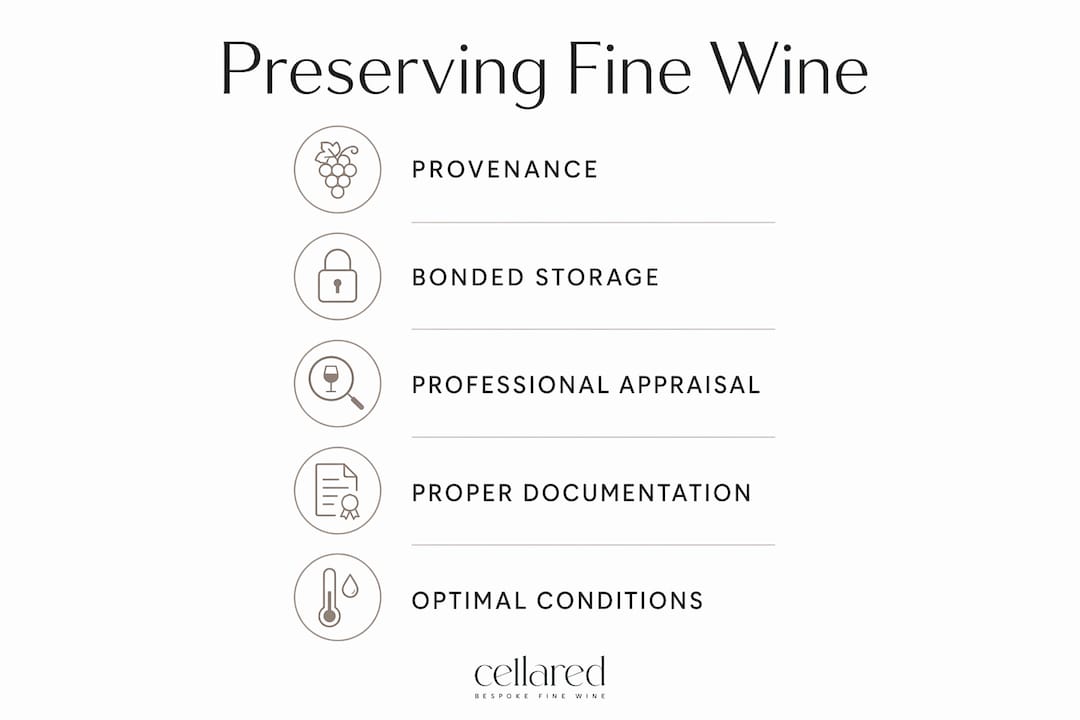
Provenance documentation is the authentication framework that underpins every credible transaction. Proper provenance tracking and storage in bonded facilities maintains authenticity and condition, which are the two qualities buyers scrutinise most at auction. Without a clear chain of custody, even a genuinely great bottle becomes difficult to sell at full value.
Professional appraisals and valuations protect collectors from both overpaying on acquisition and underselling on exit. Regular independent valuations, particularly for insurance and estate planning purposes, ensure the collection is accurately represented on paper. Cellared Fine Wine provides court-ready valuations for precisely these circumstances.
| Tool or condition | Purpose | Key benefit |
|---|---|---|
| Bonded storage | Tax-deferred holding | Defers VAT and duty until withdrawal |
| Provenance documentation | Authentication | Maintains chain of custody and buyer confidence |
| Professional valuation | Accurate pricing | Supports insurance, probate, and sale decisions |
| Secondary market tracking | Price intelligence | Identifies optimal buy and sell windows |
Pro Tip: Request a full storage history from any seller before purchase. A wine that has spent even a short period outside temperature-controlled conditions may have compromised ageing potential, regardless of its label.
How do you select wines for future appreciation, step by step?
A disciplined acquisition process is what separates collectors who build genuine wealth from those who accumulate bottles they cannot sell.
-
Research vintages and producers with a market outlook in mind. Start with the classic regions and identify which recent vintages have the structural quality to age. Market downturns can offer genuine buying opportunities. Bordeaux 2021 and Lafite saw price reductions that re-engaged buyers post-downturn, rewarding those who bought with patience and conviction.
-
Consult trusted merchants, sommeliers, or specialist advisers. The fine wine market rewards relationships. A specialist with deep market knowledge can identify allocations before they reach the open market and flag producers gaining traction in emerging regions. Cellared Fine Wine offers bespoke wine buying services built around exactly this kind of intelligence.
-
Assess condition and provenance before every purchase. Examine the fill level, label condition, and capsule integrity of any bottle you consider. Request storage records and, where possible, visit the cellar. A wine with impeccable provenance commands a premium at resale that more than justifies the due diligence.
-
Buy en primeur where the opportunity exists. Purchasing bottles on release is typically cheaper than later auction prices and guarantees provenance authenticity from the outset. En primeur purchases from reputable négociants or direct from the château represent the cleanest possible entry point for the serious collector.
-
Monitor and manage the collection actively. Wine investment is not a passive exercise. Track secondary market prices through auction results and specialist indices. Rebalance the portfolio as wines approach their drinking windows or as market demand shifts. Cellared's cellar management services provide the ongoing oversight that protects and grows a collection over time.
-
Diversify across regions, styles, and vintages. Top investors look beyond classic regions to lesser-known but promising wines to hedge against poor vintages or demand shifts in any single appellation. Italian producers such as Masseto and Screaming Eagle from California have demonstrated that investment-grade quality is not confined to France.
What mistakes and risks should you avoid when selecting investment wines?
The risks in fine wine investment are real, and the most damaging ones are the easiest to overlook.
- Buying without documented provenance is the single most common and costly mistake. A wine without a clear storage history is a liability, not an asset. No matter how prestigious the label, an unverifiable bottle will struggle to achieve full value at auction.
- Underestimating transaction costs erodes returns silently. Auction commissions range between 15–25%, and when combined with insurance and storage fees, these costs can consume a significant portion of any gain. Calculate the total cost of ownership before acquisition, not after.
- Overconcentrating in one region or style amplifies risk. A portfolio built entirely on Bordeaux is exposed to any shift in critical fashion, currency movements, or regional vintage failure. Diversification is not a concession to uncertainty. It is a structural requirement of sound wine portfolio management.
- Consuming investment-grade bottles prematurely is a temptation that destroys capital. The finest wines are often at their most seductive before they reach their peak, and opening a bottle intended for the cellar is a decision that cannot be undone.
"Fine wine should be treated as a satellite investment, representing a small portion of a diversified portfolio. Fine wine is typically 5–10% of a well-diversified portfolio, with 3–5% of net worth recommended as an inflation hedge. Illiquidity and sensitivity to economic downturns make concentration a genuine risk."
The fine wine investment risks that catch collectors off guard are rarely the dramatic ones. They are the slow accumulation of poor storage decisions, undocumented purchases, and transaction costs that were never properly modelled.
Key takeaways
Selecting wines for future value requires provenance verification, bonded storage, diversification across regions, and disciplined cost management at every stage of acquisition and holding.
| Point | Details |
|---|---|
| Provenance is non-negotiable | Always verify storage history and chain of custody before any purchase. |
| Bonded storage preserves returns | Holding wine in bond defers VAT and duty, protecting net investment gains. |
| Transaction costs are significant | Auction commissions of 15–25% must be modelled before acquisition, not after. |
| Diversification reduces risk | Spread holdings across regions, styles, and vintages to hedge against demand shifts. |
| En primeur offers clean entry | Buying on release secures lower prices and the strongest possible provenance. |
What I have learned from years of watching collectors get this right and wrong
The collectors who build genuinely valuable cellars share one quality that has nothing to do with budget: patience married to discipline. They do not chase the most talked-about wine of the moment. They buy with a ten-year horizon and resist the urge to open bottles that were never meant for the table yet.
What surprises most newcomers is how much of the work happens before the purchase. The research, the provenance checks, the storage arrangements, the cost modelling. By the time a serious collector commits to a case, the decision is almost already made. The bottle is simply the final step in a process that began weeks earlier.
I have also watched collectors make the mistake of treating wine investment as purely financial. The best collections I have seen are built by people who genuinely love wine. That passion drives better decisions. It keeps them curious about emerging regions, attentive to vintage variation, and honest about when a wine is approaching its peak. Collectors who see only spreadsheets tend to miss the signals that only a tasting note can reveal.
The 2026 market offers real opportunity for those willing to build a fine wine portfolio with rigour. Certain Bordeaux and Italian vintages have shown annual returns exceeding 5% in recent years. Those numbers attract attention. But the collectors who actually capture those returns are the ones who did the groundwork long before the headlines appeared.
— David
Cellared Fine Wine: bespoke support for serious collectors
Selecting wines with genuine appreciation potential takes more than enthusiasm. It takes market intelligence, provenance expertise, and the kind of relationships that open doors to allocations most collectors never see.
Cellared Fine Wine works with collectors, investors, and private clients to source rare and hard-to-find bottles, manage collections with care, and provide independent wine valuations for insurance, probate, and private advisory purposes. Whether you are building a new collection or refining an existing one, Cellared brings deep market knowledge and a highly personal service to every engagement. Visit Cellared Fine Wine to discuss bespoke wine buying, cellar management, and current market opportunities with a specialist who understands both the passion and the investment.
FAQ
What makes a wine investment-grade?
Investment-grade wines come from prestigious regions with strict appellation controls, have documented provenance, and are produced in limited quantities. Consistent critical acclaim and a proven secondary market are also defining characteristics.
How much of a portfolio should fine wine represent?
Fine wine is typically 5–10% of a well-diversified portfolio, with 3–5% of net worth recommended as an inflation hedge. Its illiquidity means it works best as a satellite holding alongside more liquid assets.
What is en primeur and why does it matter for collectors?
En primeur is the practice of buying wine before it is bottled, directly from the producer or a négociant. It typically secures a lower price than later auction purchases and provides the strongest possible provenance from the outset.
How do transaction costs affect wine investment returns?
Auction commissions alone range between 15–25%, and when combined with storage, insurance, and duty costs, they can consume a substantial share of any gain. Modelling total cost of ownership before acquisition is a non-negotiable step.
Why is provenance so critical to wine value?
Provenance establishes the full storage and ownership history of a bottle, which buyers and auction houses scrutinise closely. A wine without verifiable provenance is difficult to sell at full value, regardless of the label or vintage.