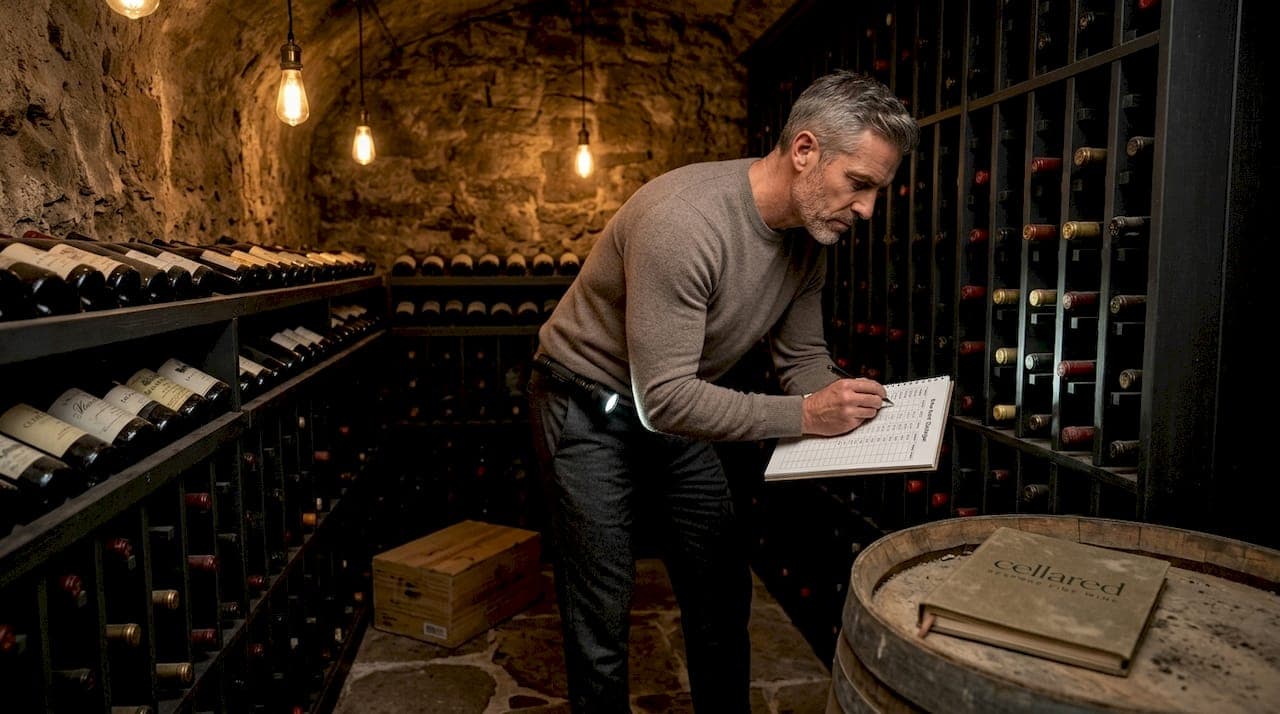
A cellar audit is one of those practices that collectors assume they already understand, yet most have never truly conducted one. Far beyond a cursory bottle count, what is a cellar audit in its fullest sense is a structured, evidence-based reconciliation of your physical wine inventory against documented records, storage conditions, and provenance data. For collectors, investors, and estate managers across Australia and APAC, this distinction carries real financial and legal weight. A cellar done well protects value, establishes authenticity, and informs every major decision your collection demands.
Table of Contents
- Key takeaways
- What a cellar audit actually is
- How to conduct a cellar audit step by step
- Cellar management best practices after an audit
- Challenges in cellar audits across Australia and APAC
- Why regular cellar audits protect your investment
- My perspective on cellar audits
- How Cellared can help you audit with confidence
- FAQ
Key takeaways
| Point | Details |
|---|---|
| Beyond the bottle count | A cellar audit reconciles physical stock with provenance records, condition data, and documentation, not just quantities. |
| Provenance underpins value | Chain of custody records transform a collection from sentimental to investable, supporting resale and insurance claims. |
| Environment matters | Temperature (12–15°C) and humidity (55–75%) verification are non-negotiable audit steps that protect cork integrity and ageing potential. |
| Technology strengthens accuracy | Digital inventory systems, sensors, and wine apps reduce reconciliation errors and maintain ongoing audit integrity. |
| Regular audits pay dividends | Scheduled audits reveal forgotten bottles, overdue drinking windows, and gaps in documentation before they become costly. |
What a cellar audit actually is
A cellar audit is a structured inventory reconciliation that goes considerably further than confirming how many bottles sit on your shelves. It involves physically verifying each bottle, cross-referencing records, assessing storage conditions, and building a defensible chain of custody. Think of it as the difference between knowing a Penfolds Grange exists in your cellar and being able to prove, with documentation, exactly where it came from, how it has been stored, and what it is worth today.
For wine investors and estate managers, the distinction is more than academic. Provenance chain of custody records are what convert a wine collection from a private passion into a verifiable asset. Incomplete or absent provenance erodes buyer confidence and can substantially reduce resale value, particularly for high-demand Australian and international labels.
A thorough cellar audit typically encompasses three interconnected components:
- Physical verification: Confirming each bottle's producer, vintage, format, and condition against your existing records
- Documentation review: Collecting purchase invoices, receipts, import certificates, and timestamped label photographs to establish a traceable custody trail
- Environmental assessment: Evaluating temperature, humidity, light exposure, and vibration levels within the storage space to confirm conditions are appropriate for the wines held
"Provenance is not a paperwork exercise. It is the foundation upon which every valuation, insurance assessment, and sale rests. Without it, even the finest bottles carry uncertainty."
The cellar inspection process, when conducted rigorously, produces a document of record. That record becomes the reference point for insurance underwriting, estate distribution, legal proceedings, and future sales.
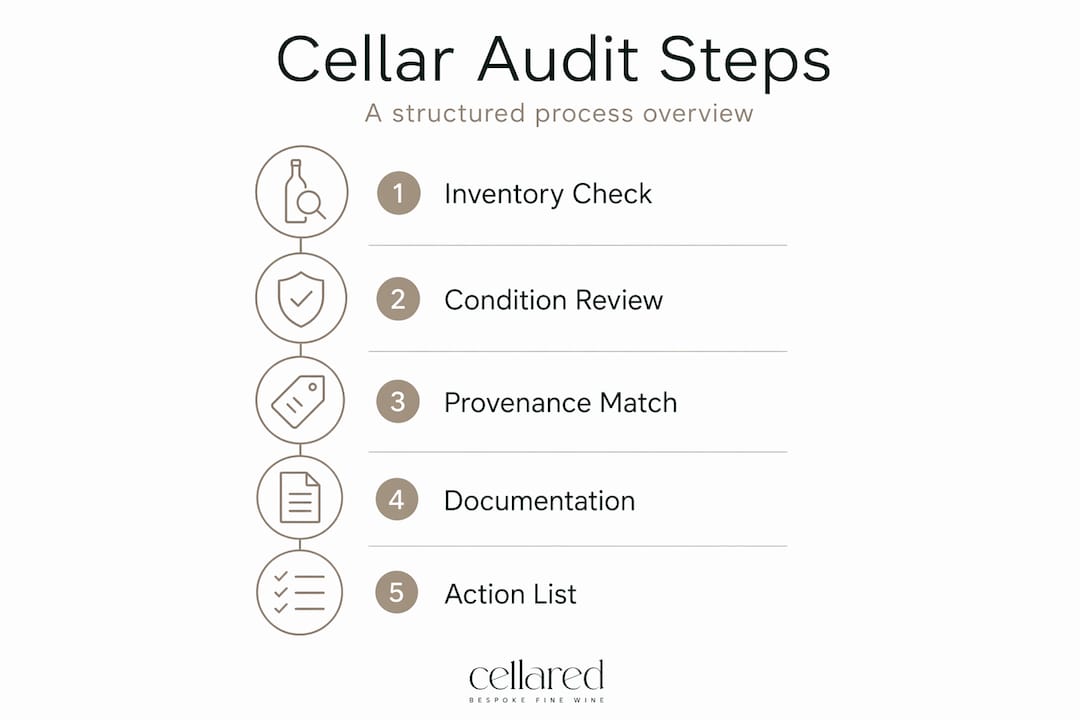
How to conduct a cellar audit step by step
The cellar inspection process is methodical by nature. Approaching it without a defined workflow invites errors that compound across large collections, particularly when multiple vintages and producers share the same physical space.
A well-structured audit follows a logical sequence:
-
Prepare your inventory framework. Before physically touching a bottle, establish the data fields you need to capture. Every bottle requires documentation of producer, vintage, purchase details, bottle format, storage location, and current condition. Using spreadsheet templates or dedicated cellar software before you begin saves significant rework later.
-
Conduct a pilot subset first. For large collections, beginning with a representative sample of 50 to 100 bottles gauges your time per bottle and reveals data entry errors before they multiply. Pilot audits on subsets markedly improve accuracy and efficiency across the full reconciliation.
-
Physically verify every bottle. Work systematically through each bin, shelf, or section. Check labels for signs of damage, seepage, or fill level concerns. Confirm the bottle matches the record in your inventory. Any discrepancy, whether a mislabelled bin or an unlisted bottle discovered during the count, should be flagged and investigated.
-
Photograph as you go. Timestamped label photographs paired with inventory entries form the evidentiary backbone of a credible audit. They support insurance claims and resale negotiations without relying on memory or verbal assurances. Photograph the label, capsule, fill level, and cork if accessible.
-
Check environmental conditions. Temperature ideally sits between 12 and 15°C, with relative humidity maintained between 55 and 75 percent. Consistency over time matters far more than a single perfect reading. Use a calibrated thermometer and hygrometer, and record the readings as part of the audit documentation.
-
Reconcile and update your digital records. After the physical count, transfer all findings into your chosen management system. Digital systems after audit prevent the reconciliation errors that plague paper-based collections, particularly when the same label appears across multiple vintages or formats.
Pro Tip: When photographing bottles for a cellar audit, capture the base of the bottle alongside the label. Sediment levels and fill height visible from the base provide additional condition evidence, particularly valuable for aged Burgundy, Barolo, and Bordeaux.
The audit workflow should feel less like a chore and more like a structured conversation with your collection. Every piece of data you capture adds a layer of protection and clarity that compounds in value over time.

Cellar management best practices after an audit
An audit is not an endpoint. Its real value is realised in the cellar management practices that follow. Applying your audit findings to how you organise, monitor, and plan your collection is where collectors move from passive ownership to genuinely informed stewardship.
Organising for rotation and access
Post-audit, restructure your physical cellar to reflect drinking windows and priority. Wines approaching their optimal drinking window should be positioned for easy access, while those requiring extended ageing can be stored deeper in the cellar. This simple reorganisation prevents the all-too-common scenario of discovering a beautifully aged bottle well past its peak.
Environmental controls aligned with audit findings
Ideal cellaring conditions sit around 10 to 14°C with relative humidity at 60 to 70 percent, maintained consistently through active controls. If your audit reveals temperature fluctuations above acceptable thresholds, address the cause before the next bottle is added.
| Condition | Acceptable range | Risk if outside range |
|---|---|---|
| Temperature | 10–14°C | Accelerated ageing, oxidation |
| Relative humidity | 60–70% | Cork shrinkage, label damage |
| Light exposure | Minimal, UV-filtered | Premature oxidation |
| Vibration | Near zero | Sediment disturbance, cork stress |
Scheduled audits and audit trail documentation
Once is never enough. A formal audit should be conducted at least annually, with lighter spot-checks each quarter for active collections. Maintain a dated audit log so that any gap in custody is immediately visible. This is particularly relevant for Australian collectors who store wine across commercial facilities, private cellars, and bonded warehouses simultaneously.
Key post-audit practices include:
- Linking each bottle or case to its original purchase documentation and storage history
- Setting calendar reminders for drinking window reviews based on audit data
- Registering high-value bottles with your insurer using the audit's photographic and valuation evidence
- Noting any condition concerns so you can monitor deterioration at subsequent audits
Wine inventory apps that incorporate role-based access, audit logs, and encrypted data storage add a further layer of security, particularly important when collections are shared across trustees or estate beneficiaries.
Challenges in cellar audits across Australia and APAC
The practicalities of conducting a cellar audit in the Australian and APAC context carry specific complications that collectors in single-location European cellars rarely encounter. Understanding these in advance allows you to build a more resilient audit methodology.
Many serious collectors across Sydney, Melbourne, Singapore, and Hong Kong maintain stock across multiple locations, splitting collections between home cellars, professional storage facilities, and offshore bonded warehouses. Without audit fields that record transfer dates, location changes, and handling notes, the resulting documentation cannot verify what conditions the bottles experienced during transit. That gap in the chain of custody is precisely what reduces a collection's provenance credibility.
Incomplete documentation is equally common. Estate collections, inherited cellars, and long-held private stocks often arrive with partial or absent purchase records. In these cases, the audit process must work harder: cross-referencing bottle codes, consulting regional importers, and in some instances engaging specialist provenance verification services for suspect high-value lots.
Relevant challenges and their practical solutions include:
- Multiple storage locations: Maintain a transfer log for every bottle movement, noting date, handler, transport method, and destination
- Incomplete provenance records: Engage an independent specialist for heritage or inherited collections where documentation has lapsed
- Legal and insurance requirements: Australian insurers increasingly require formal audit documentation before issuing cover on collections above a certain threshold. Understand your policy's specific evidence requirements before you audit
- Data security during digitisation: Use encrypted wine apps with role-based access when recording high-value collection data, particularly where collections are subject to family law, probate, or SMSF arrangements
Pro Tip: If you store wine commercially, request a formal storage statement from your facility at the start of every audit cycle. This document, combined with your own records, creates an independent corroboration of custody that significantly strengthens both insurance and legal documentation.
The legal aspects of wine collections in Australia extend to probate, family law disputes, and self-managed super fund compliance. An audit conducted without awareness of these frameworks may leave critical evidentiary gaps at precisely the wrong moment.
Why regular cellar audits protect your investment
The benefits of cellar audits extend well beyond administrative tidiness. Collectors frequently discover forgotten wines or bottles that have already passed their optimal drinking window during audits, outcomes that underscore the cost of irregular inventory management. A Côte de Nuits village Burgundy consumed years after its peak, or a Yarra Valley Pinot Noir discovered with seepage and label damage, represents a loss that a timely audit would have prevented.
For investors, the audit record is the asset. When a buyer at auction or a private sale requests provenance documentation, your audit history is the most persuasive evidence available. It shows not merely that the wine exists, but that it has been cared for with precision and intention.
"A meticulous audit history transforms a collection from a personal archive into a market-ready asset. It is the clearest signal of a collector who understands that provenance is not inherited. It is built, bottle by bottle, record by record."
Insurers, estate planners, and family lawyers in Australia are increasingly conversant with fine wine as an asset class. Regular cellar inventory assessment underpins every downstream decision, from insurance renewal to estate distribution and gifting strategies.
My perspective on cellar audits
I have worked with enough collections across Australia and the broader APAC region to recognise a consistent pattern. Collectors who resist the audit process almost always do so because they fear what it will reveal, whether that is missed drinking windows, condition issues, or documentation gaps. But in my experience, those discoveries are never the catastrophe collectors fear. They are information, and information is precisely what makes a collection manageable.
The misconception I encounter most often is that an audit is fundamentally bureaucratic. It is not. Done thoughtfully, a cellar audit is an act of appreciation for the collection itself. You learn which bottles deserve a special occasion soon, which require patience, and which have been quietly holding their ground for decades.
What I have found is that the collectors who embrace regular audits also enjoy their wines more deliberately. There is something profoundly satisfying about opening a bottle at precisely the right moment, knowing it has been stored correctly and documented thoroughly. The meticulous process and the genuine pleasure are not in tension. They reinforce each other.
On technology: the tools available to Australian collectors today are genuinely impressive. That said, no app replaces the physical engagement of handling each bottle and recording what you actually observe. Technology should follow a rigorous physical audit, not substitute for one.
— David
How Cellared can help you audit with confidence
Managing a cellar audit with the depth and rigour it demands is rarely a solo endeavour, particularly when provenance documentation, insurance requirements, and estate planning are in play. Cellared Fine Wine offers bespoke cellar management services designed specifically for collectors, investors, and estate managers who understand that a collection's value is only as strong as its documentation.
From structured inventory assessments and condition reporting through to court-ready wine appraisals and valuations, Cellared brings deep market knowledge and a personal approach to every engagement. Whether you are preparing a collection for insurance, estate distribution, sale, or simply want to understand what you have and what it is worth, the team at Cellared Fine Wine provides the clarity and confidence your collection deserves.
FAQ
What is a cellar audit?
A cellar audit is a structured review that reconciles physical wine inventory with provenance records, purchase documentation, and storage condition data. It produces a defensible evidence trail supporting valuation, insurance, and resale decisions.
How often should I conduct a cellar audit?
Most serious collectors benefit from a formal full audit annually, supported by lighter quarterly spot-checks for active collections. More frequent audits are advisable when collections span multiple storage locations or when bottles are being prepared for sale or insurance review.
What documents do I need for a wine cellar audit?
A thorough audit draws on purchase invoices, import or customs certificates, storage facility statements, timestamped label photographs, and any prior valuation reports. For high-value lots, seller identity records and chain of custody notes strengthen the provenance case considerably.
Why does provenance matter in a cellar audit?
Provenance documentation confirms a wine's authenticity, storage history, and condition over time. Without it, even exceptional bottles attract buyer scepticism and lower auction estimates, which directly affects the collection's investable value.
Can I conduct a cellar audit myself?
For smaller collections, a self-conducted audit using a structured spreadsheet or dedicated wine app is entirely feasible. For high-value collections, collections destined for sale or estate distribution, or those with incomplete documentation histories, engaging an independent specialist ensures the resulting record meets legal, insurance, and market standards.