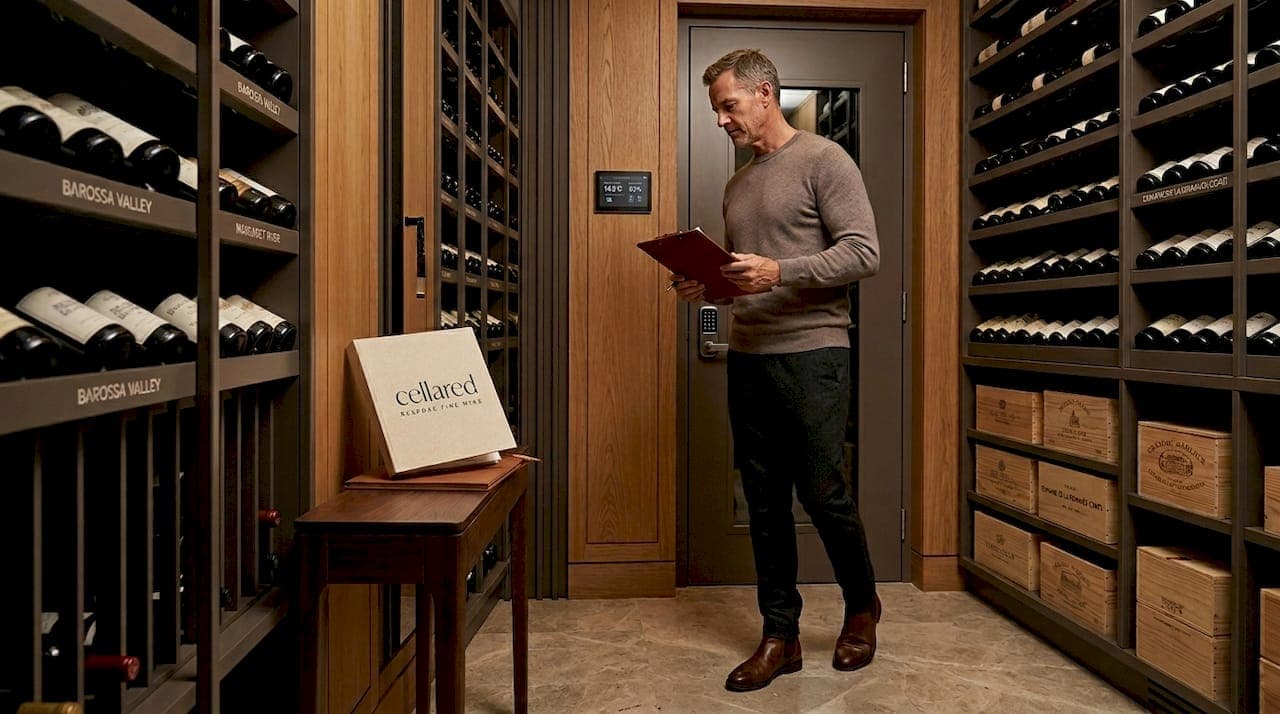
A fine wine collection represents far more than personal pleasure. For serious collectors and investors, it is a meticulous accumulation of provenance, patience, and capital. Yet the risks that can erode that value, including theft, environmental failure, and poor inventory control, are precisely where a structured wine cellar security workflow becomes indispensable. This guide presents the full arc from preparation to verification, giving you a practical, considered framework that treats physical security, environmental stewardship, and inventory discipline as a single unified system rather than three separate afterthoughts.
Table of Contents
- Key takeaways
- Setting up your wine cellar security workflow
- Implementing the workflow step by step
- Common challenges and troubleshooting
- Measuring and maintaining workflow effectiveness
- My honest assessment of wine cellar security
- How Cellared Fine Wine supports your cellar security
- FAQ
Key takeaways
| Point | Details |
|---|---|
| Environmental control is security | Temperature, humidity, and vibration failures are as destructive as theft and must be part of every security workflow. |
| Physical access demands structure | Biometric or coded entry, combined with 24/7 surveillance, forms the backbone of a meticulous cellar access control system. |
| Digital inventory is non-negotiable | Tracking producer, vintage, purchase value, and drinking windows in a dedicated app protects your collection for insurance and resale. |
| Quarterly audits catch costly errors | Reconciling physical bottles against digital records every three to six months prevents minor discrepancies from becoming financial liabilities. |
| Emergency planning is workflow, not option | An off-site disaster recovery plan with insurer contacts and physical tools belongs in every serious wine collection security guide. |
Setting up your wine cellar security workflow
Before you can execute a security routine with any confidence, the foundation must be sound. A cellar's physical and environmental infrastructure is the first line of defence, and cutting corners here renders every downstream security measure considerably less effective.
Environmental controls
The target environment for fine wine storage is precise and unforgiving: temperature between 12°C and 14°C (55°F to 58°F), and relative humidity between 60% and 70%. Humidity below 50% causes cork shrinkage and oxidation, while anything above 80% invites mould on corks and labels. Standard HVAC systems routinely cause vibrations and humidity inconsistencies that are detrimental to wine quality, which is why dedicated wine cooling units with low-vibration compressors and shock-absorbing racking are the preferred choice for investment-grade collections.
Physical and digital prerequisites
Beyond the cellar's climate, you need to establish the infrastructure for secure wine storage that supports active monitoring and recordkeeping.
- Secure entry: Solid-core, insulated doors with commercial-grade deadbolts rated for the expected foot traffic
- Access control: Biometric readers or coded keypads that create a log of every entry and exit
- Surveillance: At minimum, a camera covering the entry point and the main rack area, with footage retained off-site or in the cloud
- Environmental sensors: Continuous temperature and humidity loggers that alert to deviations in real time
- Alarm integration: Alarms tied to both intrusion and environmental triggers, monitored externally
- Inventory platform: A dedicated app tracking producer, vintage, region, purchase data, estimated value, and drinking windows, with photo documentation for insurance purposes
- Backup power: An uninterruptible power supply or generator connection to maintain cooling and monitoring during outages
| Equipment | Purpose | Priority |
|---|---|---|
| Dedicated wine cooling unit | Precise temperature and humidity control | Critical |
| Biometric or coded access | Cellar access control with entry logging | Critical |
| Environmental data loggers | Real-time monitoring and alerting | Critical |
| Surveillance cameras | Visual deterrent and evidence capture | High |
| Inventory management app | Digital recordkeeping for insurance and resale | High |
| Backup power supply | Continuity during outages | High |
| Shock-absorbing racking | Vibration minimisation for ageing wines | Moderate |
Pro Tip: Export your digital inventory to an encrypted off-site backup monthly. Regular exports and remote backups prevent data loss that could be devastating in an insurance claim scenario.
Implementing the workflow step by step
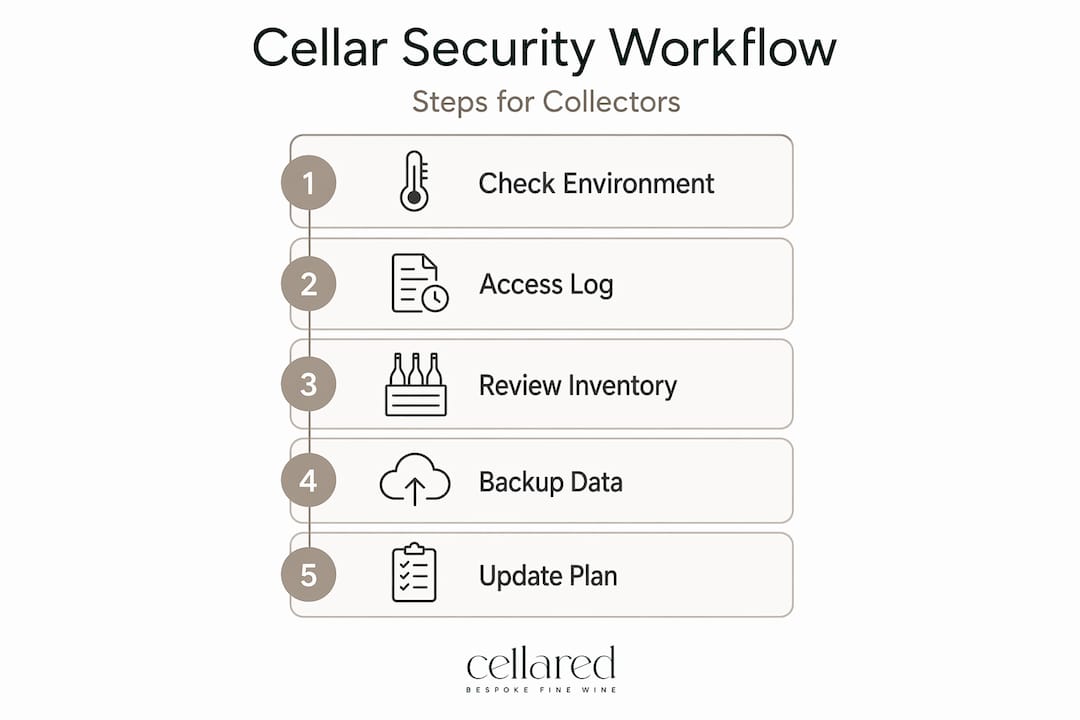
A workflow is only as strong as its consistency. The following numbered sequence represents a structured routine for protecting wine collections at every tier of value, from serious enthusiast to institutional investor.
- Initial inventory audit: Photograph and log every bottle, noting producer, vintage, appellation, purchase price, current estimated value, and intended drinking window. Serialise or tag cases to assist identification after any theft or loss.
- Daily environmental check: Review data logger outputs each morning. Confirm temperature and humidity readings are within parameters. Flag any deviations immediately and document the cause and resolution.
- Weekly physical inspection: Walk the cellar, confirming rack stability, checking for moisture intrusion, verifying alarm and camera function, and noting any bottles that have shifted position.
- Scheduled access log review: Examine the access control log to confirm all entries correspond to authorised individuals. Investigate any anomalies promptly and update access credentials when personnel change.
- Quarterly inventory reconciliation: Reconcile physical bottles against digital records every three to six months. Minor documentation errors, left uncorrected, can translate into significant financial liabilities at resale or insurer review.
- Biannual security audit: Review camera coverage, access hardware, alarm response times, and environmental control calibration. Update protocols where weaknesses are identified.
- Emergency plan review: Confirm the off-site disaster recovery plan remains current, including insurer contacts, bottle priority lists, and emergency kits stocked with waterproof markers, zip ties, and absorbent towels.
| Workflow step | Frequency | Responsible party |
|---|---|---|
| Environmental log review | Daily | Collector or cellar manager |
| Physical inspection | Weekly | Collector or cellar manager |
| Access log review | Weekly | Collector |
| Inventory reconciliation | Quarterly to biannually | Collector with inventory platform |
| Security audit | Biannually | Specialist or cellar manager |
| Emergency plan review | Annually | Collector with insurer |
Pro Tip: Treat environmental alerts with the same urgency as an intrusion alarm. A temperature spike of even 5°C sustained over 48 hours can compress years of ageing potential in a complex Burgundy or aged Barolo.
For a broader view of how private cellar management integrates with annual cost planning, the detail is worth reviewing before you finalise your infrastructure budget.
Common challenges and troubleshooting
Even a well-designed wine cellar security workflow will encounter friction. The distinction between a collector who recovers with minimal loss and one who sustains significant damage often comes down to preparation and speed of response.
- Power outages and HVAC failure: These pose cascading risks that can compromise both environmental stability and alarm connectivity simultaneously. Automated failover protocols, backed by a generator or uninterruptible power supply, are the considered standard for wine vault security measures.
- Inventory discrepancies: When physical counts do not match digital records, resist the instinct to assume a data entry error. Cross-reference access logs and surveillance footage first. The discrepancy may reveal a procedural gap or, in rare cases, an internal security concern.
- Access control failures: Biometric readers can malfunction, particularly in cold, damp cellar environments. Maintain a secondary coded override and document its usage. Change override codes on a scheduled basis regardless of whether an incident has occurred.
- Humidity and temperature fluctuations: These are among the most underestimated risks in protecting wine collections. When sensors flag a deviation, inspect the cooling unit's filter, check door seals, and review whether any structural change has altered airflow.
- Expanding or mixed collections: As collections grow to include both drinking stock and long-term investment bottles, consider segmenting physical storage and access permissions. Investment-grade bottles warrant stricter access and more frequent documentation.
"The collectors who navigate incidents most effectively are those who have rehearsed their response before anything goes wrong. A written emergency plan reviewed annually, with a physical kit kept off-site, is the mark of a mature workflow."
Practical maintenance also includes keeping a written log of every service call on cooling equipment, every access credential change, and every alarm event. This log becomes invaluable during insurance reviews and, if required, in a legal context when collection valuations are contested.
Measuring and maintaining workflow effectiveness
A wine cellar security workflow is not a static document. It is a living system that must evolve alongside the collection it protects.
- Interpret environmental logs with intent: Look for patterns across weeks and seasons, not just daily readings. A gradual upward drift in temperature may indicate cooling unit degradation well before an acute failure event.
- Use audits to verify, not just count: Quarterly reconciliations are most valuable when they are paired with a review of the collection's current insurance coverage. A bottle's estimated value at purchase can differ substantially from its market value two years later.
- Act on incident reviews: Every alarm event, every access anomaly, and every environmental deviation should generate a brief written review. What triggered it? How quickly was it resolved? What protocol change, if any, does it warrant?
- Commission periodic professional appraisals: Professional facilities and bonded storage with advanced security and provenance documentation enhance market value for investment-grade bottles. Regular independent valuations ensure your insurance coverage reflects current market realities.
- Align the workflow with collection growth: A system designed for 300 bottles will not serve a collection of 1,200 with the same integrity. Schedule a formal workflow review whenever the collection grows by more than 25% or when a significant acquisition is made.
Modern high-value wine security at institutional facilities includes daily physical inspections alongside biometric access and automated environmental lockdowns. There is no reason a serious private collector cannot apply the same principles at a proportionate scale.
For practical guidance on organising your collection to maximise both security and drinking value, a structured approach to rack allocation and access zoning complements every workflow.
My honest assessment of wine cellar security
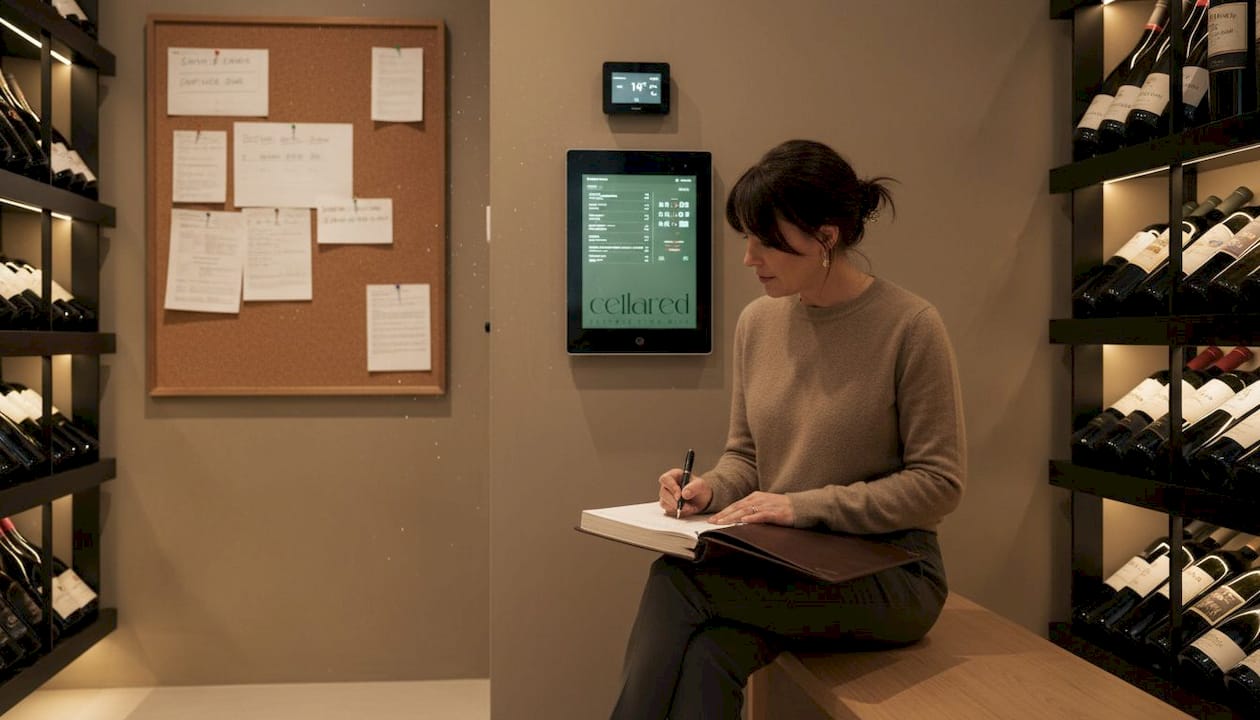
In my experience working with collectors across a range of collection sizes, the most persistent vulnerability is not a broken lock or a failed camera. It is the quietly mounting environmental failure that nobody noticed because nobody was looking with intention.
I have seen cellar owners invest substantially in biometric entry systems while their humidity logger had been offline for three months. The irony is that the environmental data, consistently reviewed and acted upon, would have prevented more value destruction than any physical security upgrade. Collectors routinely underestimate environmental failures as a genuine security risk, and that gap in thinking is where significant losses occur.
What I have found works, without exception, is treating the workflow review itself as a scheduled event on the calendar. Not a mental note. Not something triggered only by an incident. A routine workflow with scheduled audits and periodic incident drills is what separates a collection that appreciates in value from one that silently deteriorates. The physical and digital systems are only as effective as the discipline behind them.
The collectors whose cellars I respect most are those who could hand you a written account of every alarm event, every environmental deviation, and every access credential change over the past two years. That kind of record is not obsessive. It is simply the standard of care that a serious asset deserves.
— David
How Cellared Fine Wine supports your cellar security
Managing a fine wine collection at the level it deserves requires more than good intentions and the right app. Cellared Fine Wine offers bespoke cellar management services that integrate inventory oversight, environmental guidance, and independent market-led valuations into a cohesive, professionally managed system. Whether you need a court-ready appraisal for insurance or probate, expert advice on access control configuration, or a complete review of your current security protocols, the team at Cellared brings deep market knowledge and a highly personal approach to every engagement. For complex or high-value collections, working with a specialist is not a luxury. It is the logical extension of the workflow you have already built.
FAQ
What is a wine cellar security workflow?
A wine cellar security workflow is a structured, repeatable system combining physical access controls, environmental monitoring, and digital inventory management to protect a wine collection from theft, damage, and financial loss.
What temperature and humidity should a wine cellar maintain?
A cellar should maintain temperature between 12°C and 14°C and humidity between 60% and 70%. Humidity below 50% risks cork shrinkage, while above 80% promotes mould on corks and labels.
How often should I audit my wine inventory?
Collectors should reconcile physical stock against digital records quarterly or biannually. Minor documentation errors left uncorrected can create significant financial liabilities during insurance claims or resale.
What should a wine cellar emergency plan include?
A disaster recovery plan should be kept off-site and include insurer contacts, current appraisals, a bottle priority list, and a physical kit with waterproof markers, zip ties, and absorbent towels for first-response management.
Is biometric access worth the investment for a private cellar?
For collections of significant value, biometric or coded cellar access control creates an auditable entry log that both deters unauthorised access and provides critical evidence if a security incident occurs. The investment is proportionate to the risk.