Wine classification systems are codified legal and institutional frameworks that categorise wines by geographic origin, production criteria, and quality designations. For collectors and enthusiasts, understanding wine classification systems is the single most reliable method for decoding a label before a bottle is opened. France's Appellation d'Origine Contrôlée (AOC/AOP), Italy's Denominazione di Origine Controllata e Garantita (DOCG), Spain's Denominación de Origen (DO), and Germany's Prädikat system each operate on distinct logic. Knowing the difference between them shapes every serious purchasing and investment decision you make.
What are the main types of wine classification systems?
Classification frameworks serve dual roles: protecting producers' geographic names as intellectual property and providing consumers with a baseline quality assurance. These two aims frequently pull in opposite directions, which is why reading a label with genuine understanding requires more than recognising a familiar term.
The three dominant classification categories are:
- Geographic origin classifications (Protected Designation of Origin or PDO, Protected Geographical Indication or PGI, and the American Viticultural Area or AVA): These define where a wine comes from, with PDO being the strictest tier under EU law.
- Quality tier classifications based on vineyard prestige, aging requirements, or grape ripeness: Burgundy's Grand Cru, Spain's Reserva, and Germany's Prädikat Spätlese each represent a different logic within this category.
- Production method distinctions: Some systems regulate permitted grape varieties, maximum yields, and winemaking techniques as conditions of classification.
Classification systems vary fundamentally between vineyard-based, time-based, and ripeness-based models. Conflating these logics is one of the most common and costly errors collectors make.
The EU's PDO/PGI system rests on three mechanical pillars: delimitation of the geographic zone, specification of production methods, and legal enforcement. These pillars are what give long-established appellations their reliability and, ultimately, their market value.

Pro Tip: When assessing a wine for purchase, identify which classification logic applies first: geographic, aging, or ripeness. A Spanish Reserva and a German Spätlese are both "quality tier" wines, but the criteria behind each label are entirely different.
How do major wine regions differ in their classification approaches?
Regional classification frameworks reflect centuries of tradition, politics, and terroir. The table below captures the core distinctions collectors need to understand.
| Region | System | Primary Logic | Key Tier Example |
|---|---|---|---|
| France | AOC/AOP | Geographic origin + production rules | Grand Cru (Burgundy) |
| Italy | DOC/DOCG | Geographic origin + tasting approval | DOCG (77 zones) |
| Spain | DO/DOCa | Geographic origin + aging time | Gran Reserva |
| Germany | Prädikat | Grape ripeness (must weight) | Spätlese, Auslese |
| USA | AVA | Geographic origin only | Napa Valley AVA |
| Australia | GI | Geographic origin only | Barossa Valley GI |
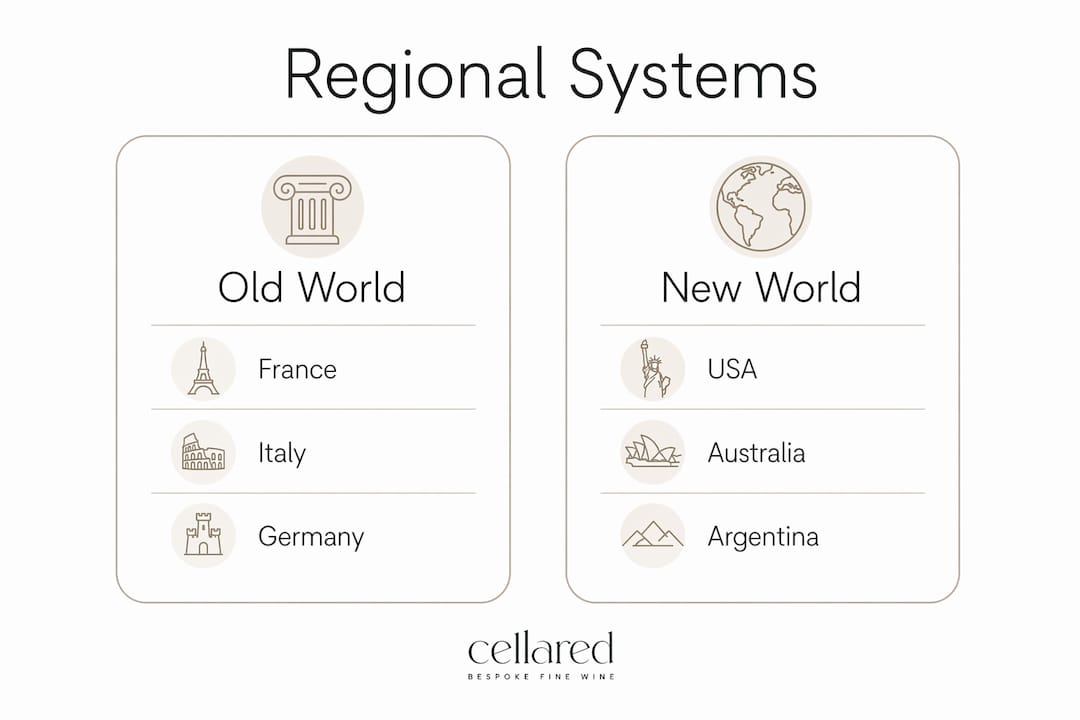
France operates one of the world's most hierarchical systems. Burgundy's Grand Cru designation is reserved for 33 specific vineyards covering roughly 580 hectares, representing less than 1.5% of the Côte d'Or's total area. That scarcity is structural, not accidental. It is precisely why Grand Cru Burgundy commands the prices it does on the secondary market.
Italy layers complexity upon complexity. As of 2023, Italy recognised 77 DOCG zones requiring government tasting panel approval before bottling, alongside more than 341 DOC zones with less stringent oversight. The DOCG designation signals that a wine has passed an additional layer of scrutiny, though it does not guarantee a style you will prefer.
Spain uses an aging-based hierarchy that is among the most transparent in the world. Gran Reserva wines require a minimum of 60 months total aging with at least 18 months in oak. Crianza, the entry tier, requires shorter aging with a minimum of 12 months in oak. The label tells you precisely how long the wine has rested before release.
Germany's Prädikat system is unique in that it measures grape ripeness at harvest, expressed as must weight (Oechsle). Kabinett sits at the lighter end; Trockenbeerenauslese represents grapes harvested at extraordinary concentration. The system says nothing about aging and everything about the raw material.
New World systems such as the US AVA and Australia's Geographic Indication (GI) are geographic-only frameworks. They confirm where a wine comes from but impose no quality tier, aging requirement, or ripeness standard. A Barossa Valley GI label tells you the grapes were grown there. It tells you nothing about how the wine was made.
Pro Tip: For investment-grade purchases, prioritise wines from systems with strict production specifications and legal enforcement, not just geographic demarcation. The EU's PDO framework offers stronger provenance assurance than a New World GI alone.
What are the most common misconceptions about wine classifications?
Classification protects origin and codifies a production baseline. It does not guarantee flavour, drinking pleasure, or investment return. This distinction matters enormously for collectors who rely on labels as proxies for quality.
Several persistent misconceptions deserve direct correction:
- "Grand Cru always means the same thing." It does not. Grand Cru lacks global standardisation: in Burgundy it is tied to specific vineyard sites; in Bordeaux it is linked to châteaux and subject to periodic reclassification. Comparing a Burgundy Grand Cru to a Saint-Émilion Grand Cru Classé requires understanding two entirely different frameworks.
- "A higher classification tier always means a better wine." Classification tiers reflect compliance with defined criteria, not absolute quality. A meticulous producer working within a DOC zone may craft a wine that surpasses a careless DOCG producer in every sensory dimension.
- "Low-tier classified wines are not worth collecting." Some of the most sought-after experimental wines carry only a generic Vin de France or Vino da Tavola designation. Producers who deliberately step outside strict appellation rules to use non-permitted varieties or unconventional techniques often release these wines under the lowest available classification. The label understates the wine's ambition entirely.
- "Classification equals taste." Classifications codify technical parameters such as soil, yield, and permitted varieties. They do not define flavour profiles or guarantee a style that suits your palate or your cellar's needs.
The tension between producer protection and consumer assurance is real. A classification system designed primarily to defend a region's commercial interests will not always align with a collector's search for the finest expression of a grape variety.
How does classification knowledge improve collecting and investment strategies?
Applying classification knowledge systematically transforms how you approach both the auction room and the merchant's list. Here is a structured approach:
- Identify the classification logic first. Before assessing a wine's vintage or producer reputation, determine whether the classification is geographic, aging-based, or ripeness-based. This frames every subsequent judgement correctly.
- Use appellation tier to assess provenance reliability. Wines from strictly enforced PDO appellations carry stronger provenance assurance than those from geographic-only systems. For insurance and probate valuations, this distinction is material.
- Recognise the three EU pillars when evaluating investment-grade bottles. Delimitation, production specification, and legal enforcement are the structural foundations of long-term appellation prestige. Appellations with all three pillars intact have historically maintained or grown their market value.
- Factor in producer and vintage independently. Classification frameworks differ in logic and rules, so a label must be read with awareness of its specific regional context. A Barolo DOCG from a weak vintage in the hands of a great producer is a different proposition from the same designation in an exceptional year.
- Seek out lower-tier classifications for experimental value. Experienced collectors actively seek low-tier classified wines known for innovation or non-conventional styles. These bottles can offer exceptional drinking value and, occasionally, significant appreciation potential as the producer's reputation grows.
- Cross-reference classification with independent ratings. Systems such as the Wine Advocate's Robert Parker scores or Jancis Robinson's assessments provide a layer of quality evaluation that classification alone cannot supply. Use both together for a complete picture when building a fine wine portfolio.
Pro Tip: When a wine carries only a generic regional designation despite commanding a premium price, research the producer's history. Some of the world's most collectible bottles deliberately sit outside their region's classification rules.
Key takeaways
Wine classification systems are the structural foundation of every serious collecting and investment decision, and reading them correctly requires knowing which logic, geographic, aging, or ripeness, underpins each label.
| Point | Details |
|---|---|
| Classification logic varies by region | Identify whether a system is geographic, aging-based, or ripeness-based before drawing quality conclusions. |
| Grand Cru is not universal | The term means different things in Burgundy, Bordeaux, and Alsace; always verify the regional context. |
| Low-tier labels can hide exceptional wines | Producers using non-permitted varieties often release outstanding bottles under generic designations. |
| EU PDO pillars signal investment reliability | Delimitation, production specification, and enforcement underpin the long-term prestige of top appellations. |
| Classification does not equal taste | Technical compliance with appellation rules confirms origin and method, not flavour or drinking pleasure. |
Why classification alone has never been enough for me
I have spent years working with collectors who arrive with a list of DOCG and Grand Cru labels, confident that tier alone justifies the price. The classification is the starting point, not the conclusion. What I have observed repeatedly is that the most rewarding collections are built by people who understand the framework and then look beyond it.
The most instructive example I can offer involves a client who passed over a Vino da Tavola from Tuscany because the label carried no DOC designation. That wine was a Supertuscan from a producer whose reputation has since become legendary. The classification said nothing. The producer's name said everything. That bottle would now be worth multiples of its original price.
Classification knowledge changes your behaviour in the merchant's room. You stop treating a DOCG as a guarantee and start treating it as a starting point. You begin asking what the classification does not tell you: the vintage conditions, the producer's philosophy, the cellar's track record. For collectors interested in fine wine buying, that shift in thinking is the difference between assembling a collection and building one with genuine depth and value.
The collectors I respect most carry classification knowledge lightly. They know the rules well enough to know when a producer has broken them deliberately, and they treat that as a signal worth investigating rather than a reason to walk away.
— David
How cellared fine wine helps you apply classification knowledge
Understanding the framework is one thing. Applying it with confidence across dozens of regions, producers, and vintages is another matter entirely.
Cellared Fine Wine works with collectors and investors to translate classification knowledge into precise, market-led decisions. Whether you need a court-ready wine valuation that accounts for appellation provenance, bespoke buying advice that identifies investment-grade bottles across multiple classification systems, or professional cellar management that organises your collection by region and tier, Cellared brings the depth of expertise your collection deserves. Explore the full range of services at Cellared Fine Wine and collect with greater clarity and confidence.
FAQ
What is a wine classification system?
A wine classification system is a legal or institutional framework that categorises wines by geographic origin, production method, aging requirements, or grape ripeness. These systems, such as France's AOC, Italy's DOCG, and Germany's Prädikat, provide collectors with a structured basis for assessing provenance and quality.
How are wines classified in france versus italy?
France classifies wines primarily by geographic origin and strict production rules, with Burgundy's Grand Cru reserved for just 33 specific vineyard sites. Italy adds a tasting panel requirement at the DOCG level, with 77 recognised DOCG zones requiring government approval before bottling.
Does a higher classification tier guarantee a better wine?
No. Classification tiers confirm compliance with defined criteria, not absolute quality or flavour. A skilled producer working within a lower-tier DOC zone can craft a wine that surpasses a poorly managed DOCG in every respect.
What does grand cru mean across different regions?
Grand Cru lacks a single global definition. In Burgundy it identifies specific vineyard sites covering roughly 580 hectares; in Bordeaux it is linked to châteaux and subject to periodic revision. Always verify the regional context before drawing comparisons.
Why do some exceptional wines carry low classification tiers?
Producers who use non-permitted grape varieties or unconventional winemaking techniques often fall outside strict appellation rules and release their wines under generic designations such as Vin de France or Vino da Tavola. These bottles can represent outstanding quality and collecting value despite their modest label classification.