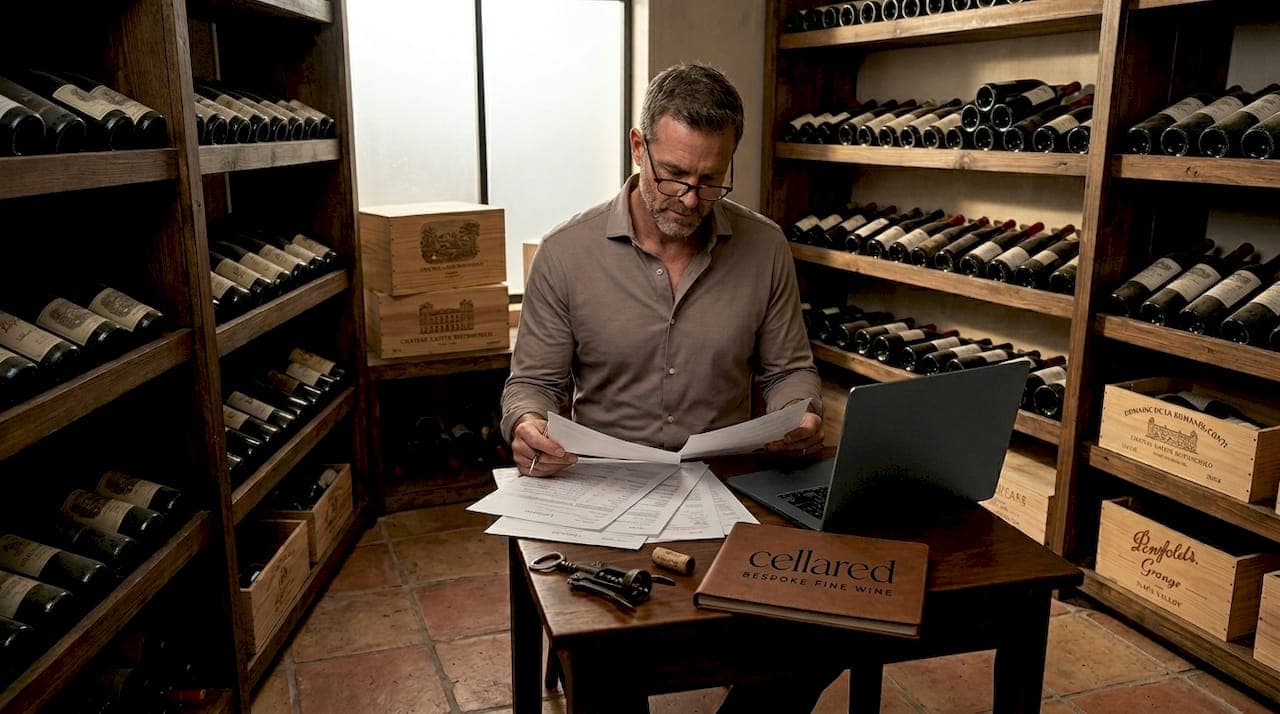
Provenance is the single most decisive factor in rare wine valuation, yet experienced collectors know it is anything but a single standard. A bottle of 1996 Penfolds Grange or 1990 Romanée-Conti carries enormous monetary weight, and that weight rests entirely on the strength of its provenance story. For high net worth collectors and investors across Australia and the APAC region, understanding that provenance operates across several overlapping frameworks is not merely academic; it is the foundation upon which every confident, defensible acquisition or disposal decision must rest.
Table of Contents
- How to approach wine provenance: Criteria for collectors
- Custody and documentation provenance
- Regulatory and geographic provenance
- Analytical and scientific authentication
- Digital identity and traceability: Next generation provenance
- Comparing wine provenance types: Strengths and weaknesses
- Why defensible provenance requires an integrated approach
- Expert support for advanced wine provenance and valuation
- Frequently asked questions
Key Takeaways
| Point | Details |
|---|---|
| Provenance layers | True wine provenance for collectors combines documentation, regulatory, and scientific evidence. |
| Australian/APAC standards | Local regulations require auditable records and make label claims directly tied to origin verification. |
| Scientific authentication | Analytical testing is vital for high-value bottles, especially if paperwork is incomplete or fraud risk is high. |
| Digital future | Digital traceability is emerging as an advanced, tamper-evident solution but works best in combination with other methods. |
| Integrated approach | Combining provenance types delivers the strongest assurance and increases collection value. |
How to approach wine provenance: Criteria for collectors
Wine "provenance" in fine-wine valuation is commonly treated as a documented chain of custody covering ownership, storage and handling conditions, and authenticity documentation. Yet restricting provenance to paperwork alone is a costly oversimplification. A seasoned collector should treat provenance as a multi-layered concept that demands triangulation across three distinct evidence types.
A practical way to think about the types of wine provenance for valuation and investment decisions is to separate:
- Custody documentation provenance — the physical and paper trail of ownership, purchase, and storage history
- Regulatory and geographic provenance — official designation systems that link a label's identity to defined geographic boundaries and production rules
- Scientific compositional provenance — analytical authentication methods that verify varietal origin, vintage, and composition at the molecular level
Why does this matter? Because relying on a single evidence type creates fragile due diligence. Impeccable paperwork means nothing if the label or region cannot be independently verified. Regulatory certification is meaningless if storage conditions have been compromised. And scientific analysis alone, while powerful, cannot tell you who owned the bottle and how it was transported across three continents.
Each of these evidence types carries different weight in different scenarios. For auction acquisitions, custody documentation is usually the first line of scrutiny. For wines arriving from less regulated markets, regulatory and geographic provenance demands closer attention. For contested estates or high-profile fraud cases, scientific authentication often becomes decisive.
"The most defensible valuation is one supported by evidence from all three provenance types, not just the most convenient."
Applying wine valuation frameworks that account for this complexity is what separates professional-grade due diligence from wishful thinking. Before any acquisition above a modest threshold, a thorough wine valuation checklist should incorporate questions drawn from each of the three provenance types.
Pro tip: Always request documentation up-front and cross-reference it against supporting evidence, including regulatory certifications and physical bottle inspection, before committing to valuation or purchase. If a seller resists this process, treat that resistance as a red flag of its own.
Custody and documentation provenance
With the general framework in mind, the evidence type collectors encounter most frequently in practice is documentation and custody records. This is provenance in its most traditional sense: the documented story of who owned a wine, where it was stored, and how it moved from the producer's cellar to your hands.
A complete chain of custody for a fine wine typically comprises:
- Original purchase invoices from the producer, négociant, or reputable retailer
- Auction house records showing bidder, sale price, and lot description
- Shipping and transport certificates confirming temperature-controlled logistics
- Storage facility records detailing cellar conditions, humidity, and access logs
- Cellar management notes for privately held collections, ideally with regular condition assessments
Physical inspection must accompany documentary review. A collector examining a bottle of mature Burgundy should assess ullage levels (the space between the wine and the cork), cork condition, label integrity, and capsule appearance. Discrepancies between a bottle's physical condition and the claimed storage history are among the most telling indicators of provenance risk. A wine supposedly stored immaculately in a temperature-controlled facility should not present with excessive seepage or a loose, fragile cork.
Securing reliable documentation is far easier when sourcing from reputable merchants or estates directly. Gaps in the chain, missing invoices, or unexplained changes in storage location are not automatically disqualifying, but they demand deeper investigation before any significant acquisition. According to provenance guidance for collectors, when parts of the chain are missing, risk and resale value typically drop and buyers are right to perform more rigorous physical and documentary checks.
"Every gap in the custody record is a question without an answer — and unanswered questions carry a price."
This principle applies with particular force to the fine wine buying guide approach we advocate: acquiring well means knowing the complete story before committing capital.
Pro tip: Non-negotiable documentation should include at least one original purchase record tied to a verifiable source, a continuous storage record, and an independent condition report. Any collection presented without these three anchors warrants significant price adjustment or withdrawal from consideration.
Regulatory and geographic provenance
Solid documentation is only part of the story. Regulatory and regional authenticity form an equally critical provenance type, one that is often underweighted by collectors outside of Europe but carries enormous legal and financial significance in APAC markets.
Regulatory origin designations function as a provenance type in their own right: they link label identity to defined geographic boundaries and production rules, certifying that what is claimed on the label reflects a legally auditable reality. The major designation systems include:
- EU PDO (Protected Designation of Origin) and PGI (Protected Geographical Indication) — the overarching European framework
- France's AOC (Appellation d'Origine Contrôlée) — governing varieties, yields, and techniques by commune
- Italy's DOC and DOCG — from denominazione di origine controllata to the highest guaranteed tier
- Spain's DO and DOCa — protecting regional identities from Rioja to Priorat
- Australia's GI (Geographic Indication) — defining regional identity for everything from the Barossa Valley to Margaret River
For Australian and APAC collectors, a key provenance benchmark is that label claims including variety, vintage, and GI are tied to auditable production-chain records and regulatory controls, implemented through Wine Australia's compliance systems and export controls. This is not merely bureaucratic formality; it means that a bottle of Australian Shiraz carrying a Barossa Valley GI has been subject to a verifiable regulatory process that can be traced back to specific vineyard sources.
"Regulatory provenance is the legal skeleton beneath the aesthetic beauty of a fine wine label."
For collectors assessing regional regulations as part of their due diligence, understanding which designation systems apply to a given wine, and confirming compliance records, significantly reduces the risk of acquiring misrepresented product. This is especially relevant when purchasing rare European bottles through APAC auction channels, where chain of custody from producer to hammer may span multiple regulatory jurisdictions.
Analytical and scientific authentication
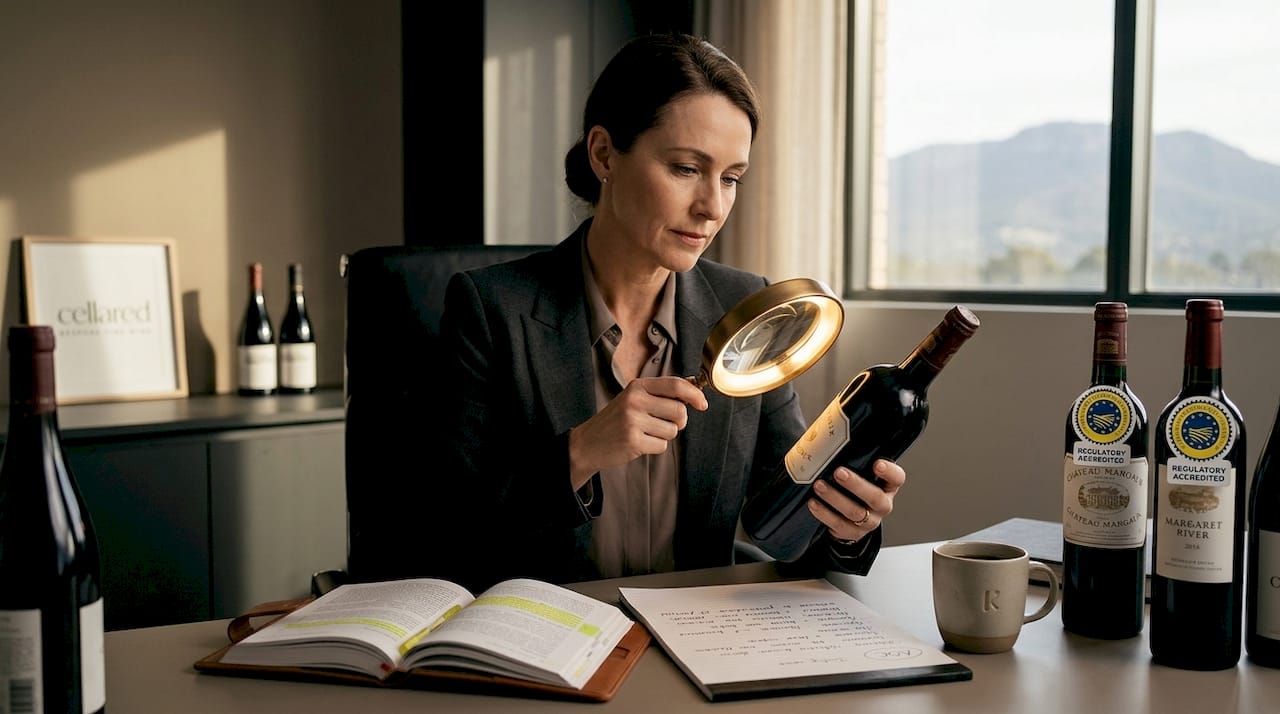
What if conventional paperwork and official regional designations still leave residual doubt? This is where the science enters the cellar. Scientific authentication has matured into a genuine and increasingly relied-upon provenance type, capable of verifying declared identity elements such as varietal composition, geographic origin, and vintage with remarkable precision.
The primary technologies in current use include:
- Stable isotope analysis — measures ratios of isotopes like carbon-13 and oxygen-18, which vary with geography and climate, allowing laboratory verification of a wine's claimed origin and vintage year
- DNA fingerprinting — identifies grape variety at the genetic level, invaluable for detecting mislabelled varietals or counterfeit renditions of prestigious single-variety wines
- Nuclear magnetic resonance (NMR) spectroscopy — creates a detailed chemical fingerprint of a wine's composition, enabling comparison against reference libraries
- Gas chromatography-mass spectrometry (GC-MS) — identifies trace chemical compounds that correlate with specific terroir, winemaking techniques, and age
Scientific authentication becomes most necessary in three specific scenarios: when standard documentation is incomplete or absent, when a wine comes from a region or producer associated with elevated fraud risk, and when the transaction value is substantial enough to justify the investment in laboratory analysis. High-profile fraud cases in recent years involving prestigious Burgundy and Bordeaux labels have demonstrated that even sophisticated buyers can be deceived by convincing paperwork, making scientific checks the increasingly preferred backstop for identifying investment-grade wine above significant price thresholds.
Emerging trends are accelerating the integration of machine learning with compositional data, creating predictive models that can cross-reference a wine's chemical profile against thousands of authenticated samples with growing accuracy.
Pro tip: When commissioning scientific authentication, collaborate exclusively with laboratories that produce legal-grade reports, meaning documentation structured to meet evidentiary standards in courts or arbitration proceedings. For collections held as assets or involved in estate disputes, this distinction is material.
Digital identity and traceability: Next generation provenance
Scientific analysis is powerful but not always scalable across large collections. So how are the world's leading estates and auction houses future-proofing provenance for the next generation of high-value acquisitions?
Digital bottle identity and traceability systems represent an emerging provenance type, combining IoT-enabled sensors, NFC chips, RFID tags, and blockchain ledgers to maintain a tamper-evident record from production through distribution. These systems can capture and permanently record:
- Temperature and humidity exposure throughout transport and storage
- Geographic tracking data at key custody transfer points
- Seal integrity alerts triggered if a bottle is opened or the closure compromised
- Authenticity verification links accessible via smartphone scan at point of sale or resale
Several prestigious estates in Bordeaux and Burgundy have piloted NFC-chip-embedded labels that allow buyers to scan and retrieve the full digital provenance record instantaneously. In Asia-Pacific markets, particularly in Hong Kong, Singapore, and mainland China where fine wine investment is growing substantially, digital traceability is becoming a competitive differentiator for premium producers aiming to protect both brand integrity and collector confidence.
The most sophisticated deployments combine digital records with the scientific and documentary provenance types described above, creating a multi-layered record that is far more difficult to fraudulently replicate than any single method. For rare wine valuation purposes, a bottle supported by both a scientific certificate and a clean digital traceability record commands meaningful price premiums in competitive auction markets.
Pro tip: When assessing bottles at auction or private sale, ask specifically whether digital tracking or authentication features are present. An absence of digital provenance is not disqualifying, but its presence adds a layer of confidence that should be reflected in your offer strategy.
Comparing wine provenance types: Strengths and weaknesses
With each approach explained, the following table provides a direct comparison to guide your decision about which combination is appropriate for your circumstances.
| Provenance type | Key strengths | Key weaknesses | Best use case |
|---|---|---|---|
| Custody documentation | Widely available; directly addresses ownership history | Easily falsified; gaps reduce confidence rapidly | Standard acquisitions with known seller history |
| Regulatory and geographic | Legally verifiable; jurisdiction-backed | Does not address individual bottle condition or storage | Confirming label authenticity and regional compliance |
| Scientific authentication | Objective; highly accurate; legally defensible | Costly; requires specialist laboratory access | High-value, high-risk, or disputed acquisitions |
| Digital traceability | Real-time; tamper-evident; scalable | Only covers bottles with systems installed; emerging adoption | New-release premium bottles from digitally enabled estates |
Situations where a single provenance type may suffice are rare but do exist. For example, a recent-release Australian wine purchased directly from an estate with full digital tracking and clean GI certification requires less supplementary scrutiny than a twenty-year-old imported Burgundy with patchy auction records. As a general principle, due diligence for serious collections demands triangulation across all three traditional types, with heavier reliance on scientific checks for high-risk or documentation-sparse cases.
The key variables to weigh when deciding how much provenance evidence is enough are: transaction value, bottle age, source reputation, regional fraud risk, and intended purpose (personal consumption, insurance, resale, or estate planning).
Why defensible provenance requires an integrated approach
Here is a perspective that emerges from working closely with serious collectors across Australia and the broader APAC region: most provenance failures are not caused by outright fraud. They are caused by well-intentioned buyers who placed excessive confidence in a single type of evidence and did not ask the hard follow-up questions.
A buyer might hold immaculate auction records for a 1982 Pétrus yet fail to notice that the bottle's physical condition tells a different story. Another might rely on the prestige of a grand cru designation without confirming that the specific label in their hands has passed any form of chemical scrutiny. Both scenarios represent defensible provenance that is not, in practice, particularly defensible at all.
The integrated approach is now the baseline for professional due diligence on acquisitions above the $10,000 per bottle threshold. For collections built as diversification strategies within broader asset portfolios, and particularly for those constructing fine wine portfolio strategies with an eye toward future resale or estate transfer, the cost of integrated provenance assessment is trivially small compared to the financial exposure of a disputed or devalued bottle.
APAC regulatory frameworks place particular emphasis on label and production record integrity, which means buyers in this region must be prepared to scrutinise documentary and regulatory provenance with a rigour that goes beyond what some European or North American buyers might consider standard. When a collection reaches institutional scale, integrated provenance is no longer optional. It is the difference between a collection that holds its value through any market or legal test, and one that does not.
Expert support for advanced wine provenance and valuation
For collectors who understand that provenance is the engine of long-term fine wine value, professional guidance transforms complexity into clarity. Navigating custody records, regulatory compliance, and scientific authentication simultaneously is a specialised discipline, and the consequences of getting it wrong can be significant.
Cellared Fine Wine offers expert wine appraisals and professional wine valuation services that incorporate all three provenance types into every assessment. Whether you are acquiring a significant parcel, preparing a collection for insurance, or managing an estate through a complex legal process, our court-ready valuations and bespoke advisory services are structured to protect your position. Our wine cellar management solutions also ensure that the provenance story of your collection continues to strengthen, not weaken, over time.
Frequently asked questions
How does missing provenance documentation affect wine value?
Missing provenance documentation increases risk and typically reduces resale value, as missing links in the chain prompt buyers to apply greater scrutiny, demand steeper discounts, or withdraw from acquisition altogether.
What is the difference between GI, AOC, and DOC on wine labels?
These are regulatory origin systems linking label claims to specific regions and rules: GI in Australia, AOC in France, DOC in Italy. Each system details geography, permitted varieties, and production standards, functioning as defined geographic boundary certification for the wines they govern.
When should scientific authentication be used for wine provenance?
Scientific authentication is most important when standard documentation or regulatory records are incomplete, or for very high-value wines and suspected fraud cases where high-risk or documentation-sparse cases demand objective, laboratory-grade verification.
Does digital wine traceability totally prevent wine fraud?
Digital traceability reduces fraud risk but does not eliminate it; tamper-evident records from production through distribution are most effective when combined with documentary and scientific provenance methods rather than used in isolation.
Are Australian wines better protected by provenance compared to other regions?
Australian wines benefit from strong provenance controls because label claims including variety, vintage, and GI are tied to auditable production-chain records, though no regulatory system removes the need for supporting documentation and physical assessment.