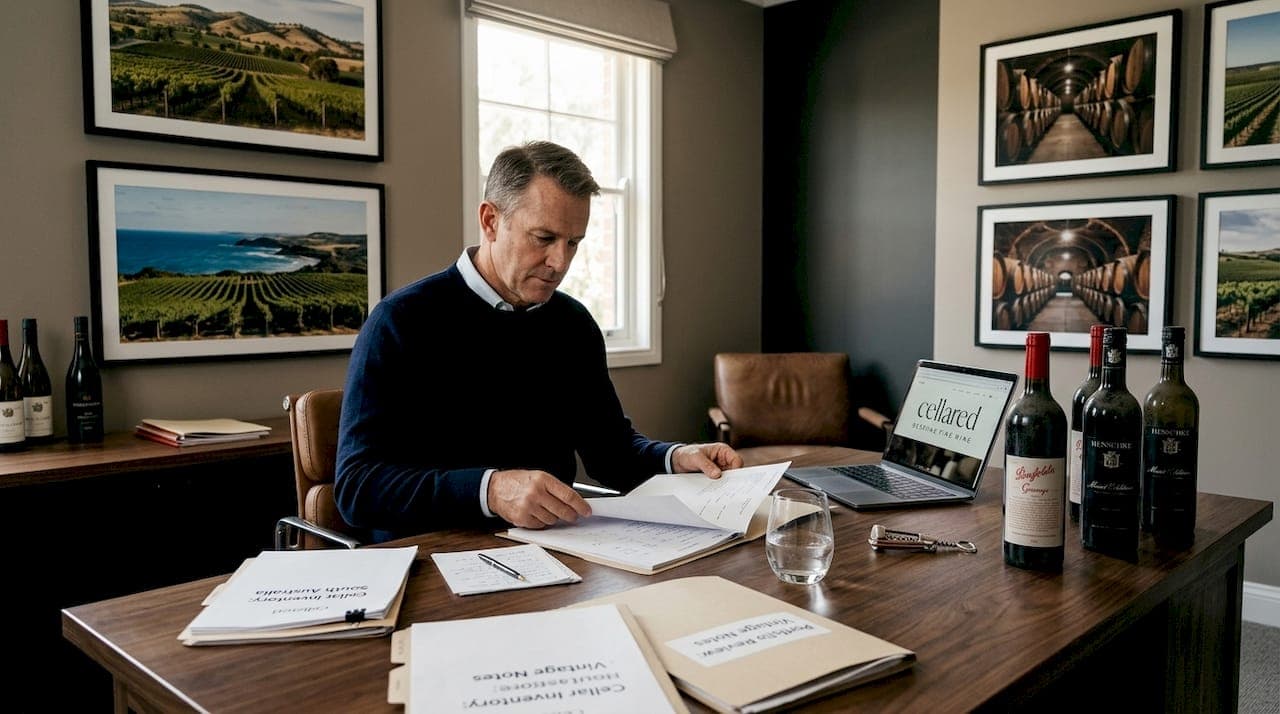
A single overlooked detail in a wine valuation can erase tens of thousands of dollars from a collection's worth before a single bid is placed or an estate settled. For collectors, investors, and trustees managing significant cellars across Australia and the APAC region, a methodical, professionally structured approach to valuation is not a luxury but a necessity. This guide provides a meticulous, step-by-step wine valuation checklist, drawing on globally recognised standards and deep market expertise, to ensure every bottle you hold is assessed with the rigour and precision its true value demands.
Table of Contents
- Core criteria for professional wine valuation
- Step-by-step valuation checklist for collectors
- How to assess provenance and storage conditions
- Combining quantitative data and market context
- Summary wine valuation checklist for instant application
- Why most wine valuations go wrong (and how to get it right)
- Take your next wine valuation further with expert help
- Frequently asked questions
Key Takeaways
| Point | Details |
|---|---|
| Document every detail | Invoices, provenance, and storage records are non-negotiable for premium valuations. |
| Meet storage benchmarks | Temperature, humidity, and bonded storage protect long-term value for Australian and APAC collectors. |
| Use both numbers and narrative | Combine market data and qualitative factors to avoid undervaluing rare bottles. |
| Apply a repeatable checklist | Following each step ensures your collection’s value is maximised and protected if challenged. |
| Independent advice amplifies value | Professional review minimises errors and brings peace of mind for major assets. |
Core criteria for professional wine valuation
With the stakes clearly defined, understanding the pillars of valuation helps you avoid the classic pitfalls that even experienced collectors encounter. A professional wine valuation is never a matter of intuition alone. It rests on documented, repeatable criteria that can withstand scrutiny in court, an insurance claim, or a contested estate.
The practical wine valuation checklist accepted by specialists includes five foundational criteria: scarcity, provenance, maturity, market depth, and total costs. Each criterion carries weight, and missing even one introduces risk.
The five core valuation criteria at a glance:
- Scarcity: Total production volume, remaining global supply, and whether bottles are still available through primary or secondary markets.
- Provenance: Full chain of custody from the producer, including storage history and supporting documentation.
- Maturity: Where the wine sits relative to its optimal drinking window and peak investment horizon.
- Market depth: Recent comparable auction results, private trades, and live listing data for the specific bottle or producer.
- Total costs: Storage fees, insurance premiums, transportation, customs, and anticipated selling costs.
Understanding wine valuation standards gives you the vocabulary and framework to engage professional valuers on equal footing. The following comparison illustrates how each criterion contributes to overall valuation weight:
| Criterion | Why it matters | Common pitfall |
|---|---|---|
| Scarcity | Drives premium for rare and limited releases | Overlooking secondary market supply |
| Provenance | Validates authenticity and storage integrity | Incomplete chain of custody records |
| Maturity | Affects buyer demand and drinkability | Assessing outside the drinking window |
| Market depth | Anchors value to real, verifiable trades | Using outdated or thin comparables |
| Total costs | Net realisation is what matters to investors | Underestimating storage and selling fees |
Pro Tip: Always request a formal written checklist from your valuer before engagement begins. Any specialist operating to genuine professional standards will welcome the transparency and will structure their report accordingly.
Scarcity, in particular, requires careful nuance. A wine produced in limited quantities thirty years ago may have an even smaller remaining supply today as bottles are consumed or lost to poor storage. Understanding wine sourcing in depth helps you appreciate why some bottles command extraordinary premiums while superficially similar bottles from the same region do not. The story of scarcity is always evolving.
Step-by-step valuation checklist for collectors
Understanding the criteria is vital, but methodical application is what ensures nothing slips through the cracks. The following numbered sequence is the backbone of any credible valuation exercise, whether you are engaging a professional valuer or conducting an initial self-assessment before seeking expert advice.
- Collect all documentation. Gather original purchase invoices, importer certificates, storage facility records, insurance documents, and any prior appraisal reports. Gaps in documentation will reduce defensibility and, in many cases, reduce value directly.
- Physical inspection. Examine each bottle for label condition, capsule integrity, cork appearance where visible, and fill level, referred to as ullage. The ullage measures how much wine remains in the bottle and is a direct indicator of storage quality and potential oxidation risk.
- Photograph comprehensively. Capture the label front and back, the capsule, the shoulder fill level, and any distinguishing marks or damage. Identifying investment-grade wine often comes down to these precise visual records when disputed valuations proceed to insurance or legal proceedings.
- Gather market comparables. Source recent auction results and current listing prices for the same producer, vintage, and format. This is market depth in practice, and it is the most objective anchor for any valuation figure.
- Apply logistics and payment safeguards. For collections held across APAC, verify that transportation and customs documentation is in order. Fraud risk in wine transactions is real and growing, particularly in secondary markets across the region.
A robust checklist for valuation execution follows this sequence precisely: documentation collection, physical inspection with photography, market comparable research, and logistics verification. Each step builds on the last, creating an audit trail that protects you in any formal setting.
"A wine collection without proper documentation is like a property title without a survey. The asset may be extraordinary, but its value is impossible to defend without evidence."
Pro Tip: Photograph every bottle before and after handling, both for your insurance audit trail and to demonstrate the care taken during inspection. Insurers and courts regard this level of documentation as evidence of professional diligence.
When you set out to build a wine portfolio for long-term investment or estate planning, establishing this checklist discipline from the moment of first purchase eliminates the scramble to reconstruct records later. The cost of good record-keeping is trivial compared to the value it protects.
How to assess provenance and storage conditions
The next critical step is proving your wine's journey and care. Provenance is the single most consequential factor that separates a strong valuation from a deflated one, particularly for bottles exceeding several thousand dollars per case.
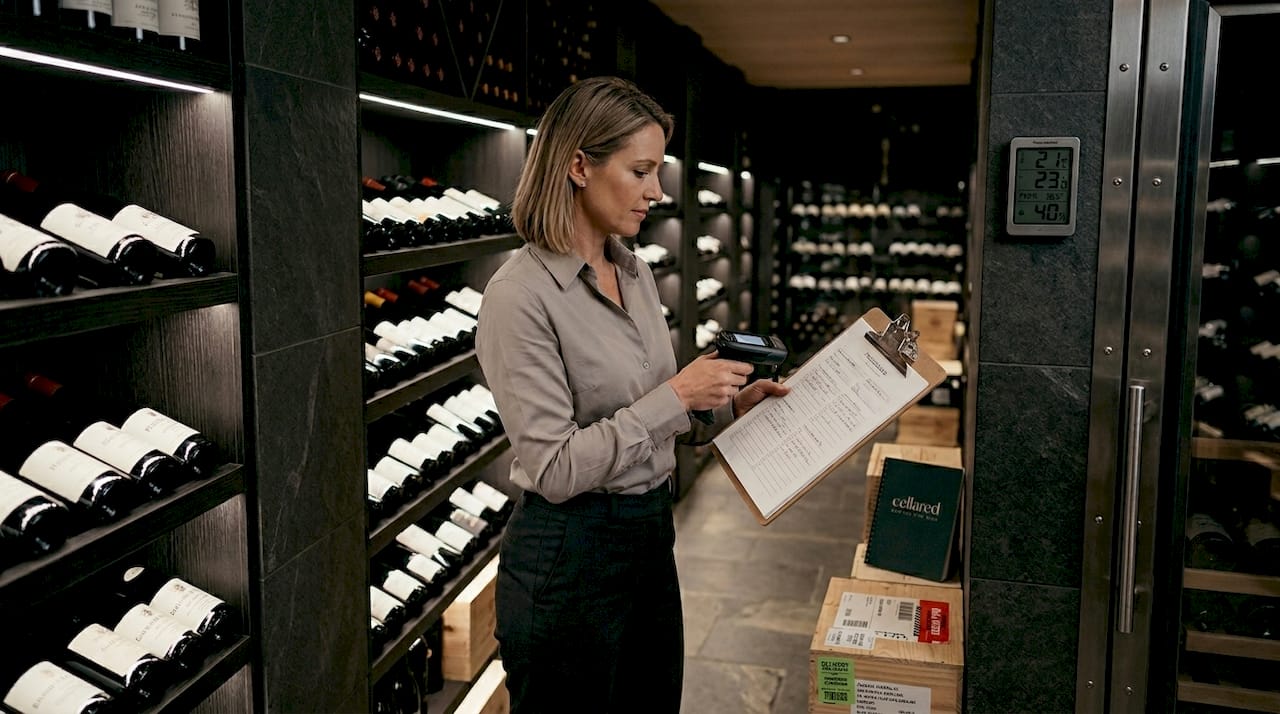
Storage benchmarks accepted by professional valuers, insurers, and auction houses require a consistent temperature between 12 and 14 degrees Celsius, relative humidity between 60 and 75 per cent, minimal exposure to light, and negligible vibration. Bonded and professionally managed storage facilities provide verifiable compliance with these benchmarks, which translates directly into buyer confidence and higher realisable values.
| Storage factor | Optimal benchmark | Risk of deviation |
|---|---|---|
| Temperature | 12 to 14°C | Accelerated ageing, oxidation |
| Humidity | 60 to 75% | Label damage, cork desiccation |
| Light exposure | Minimal to none | Premature degradation, "lightstruck" fault |
| Vibration | Negligible | Sediment disruption, premature evolution |
Poor provenance or inadequate storage documentation can erase scarcity premiums entirely, even where the wine itself remains in excellent condition. A Pétrus or DRC Romanée-Conti held in a domestic kitchen pantry for twelve months, regardless of its intrinsic quality, will face severe resistance at auction.
Key provenance documentation you should hold for every significant bottle:
- Original purchase invoice with producer or merchant letterhead
- Storage facility receipts and temperature log records
- Transfer of ownership records if the wine changed hands
- Independent valuation reports from previous assessments
- Insurance declarations that specify storage location and conditions
Effective cellar management tips begin with establishing this paper trail from the moment a bottle enters your possession. Retroactively attempting to reconstruct provenance is expensive, time-consuming, and often unconvincing to professional buyers and valuers.
"Provenance is not merely history. It is the living evidence that every decision made in care of this wine was deliberate, documented, and worthy of the liquid inside."
Engaging professional cellar management from the outset eliminates the provenance risk entirely. When a third-party specialist manages your collection within a bonded facility with temperature monitoring, every record is created and maintained independently, removing any question of self-serving documentation.
Combining quantitative data and market context
All records in order, your next step is analysing hard data and the unique story behind each bottle. This is where wine valuation transcends a simple price lookup and becomes a genuine exercise in market intelligence.
Accurate valuations require both quantitative and qualitative factors, combining trade data and market indices with buyer sentiment, estate reputation, and cultural prestige. Relying on numbers alone misses the buyer premiums that attach to wines with compelling narratives, celebrated producers, or exceptional vintage stories.
Quantitative factors to incorporate:
- Recent auction hammer prices for the specific wine and vintage
- Live secondary market listing prices across multiple platforms
- Fine wine index performance (Liv-ex 100, Liv-ex 1000, regional sub-indices)
- Historical price trajectory over three, five, and ten-year periods
Qualitative factors equally important:
- Producer reputation and critical standing in the current market
- Vintage narrative, including weather conditions and regional consensus
- Buyer sentiment in target markets, particularly in APAC and North Asia
- Scarcity story and the emotional resonance of the wine's origin
Remarkably, weather-based models outperform critics when predicting quality and subsequent price performance for Bordeaux vintages. This finding, drawn from quantitative analysis of long-run price data, reminds us that expert ratings, while useful, should never serve as the sole or primary driver of a valuation.
A thorough fine wine market guide explores how market depth, index data, and buyer appetite interact to determine the realisable value of a collection at any given point in time. Understanding this interaction is what separates collectors who sell well from those who leave significant value unrealised.
The most defensible valuations weave quantitative rigour with a nuanced reading of sentiment and context. A Grand Cru Burgundy in a poor market for Burgundy may be technically undervalued by the numbers, while the same bottle at the height of collector enthusiasm may command a premium that pure data cannot justify. Both realities matter.
Summary wine valuation checklist for instant application
With the detailed approach covered, here is an at-a-glance master checklist to guide repeat valuations. Whether managing a single cellar or overseeing a large estate, this structured reference ensures consistency across every assessment.
| Step | Action required | Key documentation |
|---|---|---|
| 1 | Collect all purchase and storage documentation | Invoices, storage logs, import certificates |
| 2 | Physical inspection of each bottle | Ullage record, label condition notes |
| 3 | Comprehensive bottle photography | Pre and post-handling images |
| 4 | Compile market comparables | Auction results, live listings, index data |
| 5 | Assess provenance integrity | Chain of custody, facility records |
| 6 | Evaluate storage conditions against benchmarks | Temperature and humidity logs |
| 7 | Apply total cost analysis | Storage, insurance, selling, transport fees |
| 8 | Obtain independent professional valuation | Signed valuation report for formal purposes |
For estate wine sales, this checklist becomes an essential instrument during probate, family law proceedings, or when preparing a collection for sale or transfer. Adapting it for large estate valuations involves applying the same steps systematically across every bottle or case, with special attention to ensuring consistency of documentation format for legal admissibility.
The following sequence summarises the repeat-use workflow:
- Begin with documentation audit before any physical handling.
- Conduct physical inspection in controlled conditions with adequate lighting.
- Cross-reference every bottle against market comparable data.
- Confirm storage compliance against professional benchmarks.
- Engage an independent valuer for any bottle or collection exceeding meaningful thresholds.
- Review and update the valuation every twelve to twenty-four months or before any major transaction.
This checklist is deliberately designed for use by both private collectors and professional advisers. Its value lies not in complexity but in disciplined, consistent application every time a valuation is required.
Why most wine valuations go wrong (and how to get it right)
In our experience working with collectors and estates across Australia and the APAC region, the most costly valuation errors rarely arise from fraud or spectacular oversights. They arise from the quiet assumption that a wine's value is either self-evident or can be resolved by a single data point, a critic's score, a recent auction result, or a provenance certificate in isolation.
The truth is more demanding. Accurate valuation requires both rigorous quantitative evidence and a sensitive reading of the market's qualitative mood. Combining data with sentiment sounds straightforward, but in practice it requires market fluency that cannot be acquired from a checklist alone.
We have observed collectors in the APAC region dismiss the significance of buyer premiums attached to specific producers in certain markets. A wine commanding strong premiums in Hong Kong or Singapore may trade at a discount in Sydney simply because the local collector base has different preferences and lesser familiarity with that producer. Ignoring this geographical dimension is a recurring and expensive mistake.
Another common error is treating provenance documentation as a binary matter: either you have it or you don't. In reality, the quality and coherence of documentation exists on a spectrum, and a skilled valuer will assess not just whether records exist but whether they tell a believable and consistent story. Partial records that raise questions may be worse than acknowledged gaps that can be explained transparently.
Our strongest advice: validate any significant valuation with an independent expert who has no stake in the outcome. The fine wine buying guide reinforces this principle at the point of acquisition, but it applies equally at the point of valuation. Independence is the foundation of credibility, and credibility is what unlocks the maximum realisable value of any collection.
Take your next wine valuation further with expert help
Safeguarding a fine wine collection requires more than good intentions and a well-organised cellar. It demands professional, independent assessment that stands up in every formal context, from insurance renewals to estate distributions and private sales.
Cellared Fine Wine provides wine appraisal services and professional wine valuations that are court-ready, market-led, and structured for Australian and APAC collectors. Whether you are preparing for probate, updating insurance cover, or considering a significant sale, our independent valuations deliver the certainty and precision your assets deserve. Our wine cellar management service ensures your collection is stored, documented, and maintained to the highest standards from the moment we engage. Speak with our specialists to understand exactly what your collection is worth and how to protect that value for the long term.
Frequently asked questions
What documentation is essential for a high-value wine valuation?
You need original purchase invoices, detailed storage records, and full provenance documentation to support the strongest possible valuation. Collecting documentation is always the first step in any credible valuation process.
How do storage conditions affect wine value in Australia?
Storage maintained below 14°C with 60 to 75 per cent humidity and minimal light and vibration preserves value and buyer confidence, and is the standard expected by insurers, auction houses, and professional buyers.
Is expert critic rating essential for valuation?
Expert ratings are useful but weather-based models outperform critics for predicting quality and price performance in key regions like Bordeaux, making quantitative data a more reliable primary anchor.
What is the most overlooked component of a wine valuation?
Market depth, meaning recent and comparable auction results, is frequently skipped by collectors, leading to valuations that are either inflated or significantly understated relative to actual realisable value.
Can I use this checklist for both private collections and estates?
Yes, the checklist is designed to scale from a single-bottle appraisal to a large estate collection, and it serves equally well as a preparation guide when engaging a professional valuer for formal purposes.