
A trophy wine is a bottle that has earned the highest accolade in a professional wine competition, awarded only after surviving a rigorous blind-tasting process in which judges assess balance, complexity, length, and regional expression. The term carries a second, equally compelling meaning among collectors: any bottle of exceptional personal or cultural significance, whether for its rarity, provenance, or the story woven into its existence. These two definitions coexist, and understanding both is what separates a serious collector from a casual enthusiast.
At their core, trophy wines function as symbols of wealth and status, often commanding prices that exceed their intrinsic quality. The distinction from other award categories is worth grasping clearly:
- Competition trophy: The pinnacle award in a wine show, granted only to wines that have already won gold medals and then outperformed all others in their class.
- Gold medal: A high score for exceptional quality, but not the top tier. Many gold medals are awarded; trophies are far fewer.
- Best in class: An intermediate honour recognising the finest wine within a specific category, often a stepping stone to a trophy.
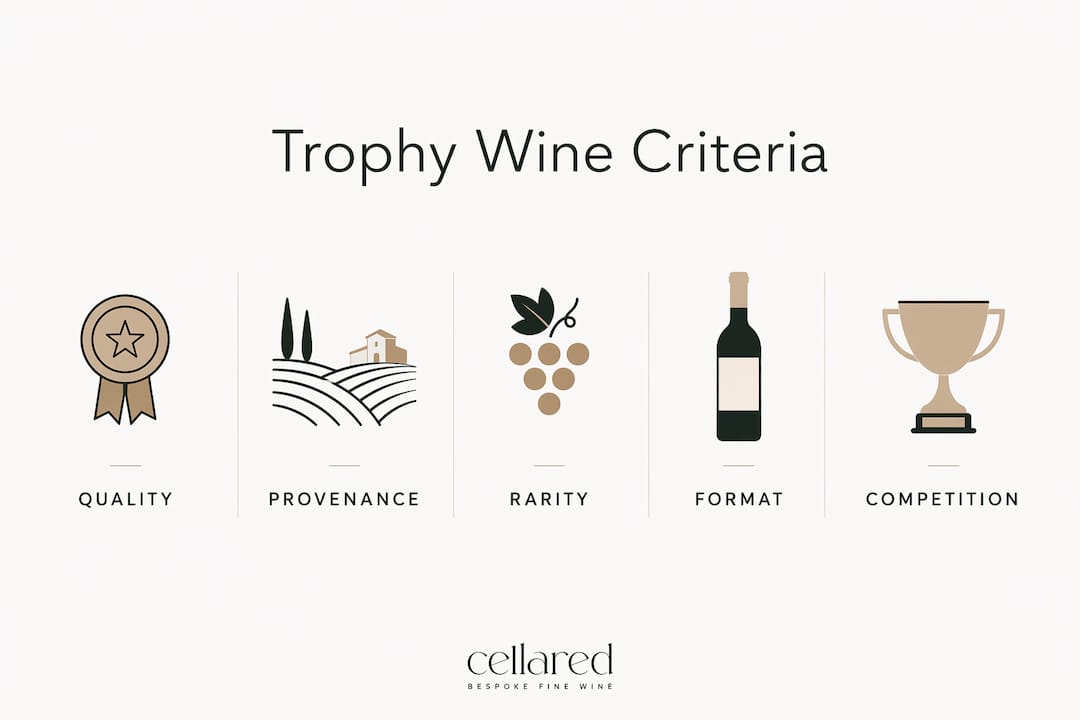
- Collector's trophy: A bottle prized for rarity, provenance, format (such as a magnum), or personal meaning, independent of any formal competition result.
The term is sometimes used pejoratively, implying a wine bought more for its label or social cachet than for genuine enjoyment. That tension between objective quality and perceived status sits at the heart of what makes trophy wines so fascinating to collectors and connoisseurs alike.
How do wines qualify for trophies in Australian competitions?

Australian wine shows follow a structured, multi-stage process before any bottle earns a trophy. The pathway is deliberate and demanding, designed to ensure that only wines of genuine distinction reach the final round.
The qualification process typically unfolds in the following stages:
- Entry and classification: Wines are entered by category, variety, and vintage, then assigned to judging classes of comparable styles.
- Blind tasting: Judges assess wines without knowing the producer or price. Panels score on aroma, palate, balance, complexity, and finish.
- Medal allocation: Wines scoring above defined thresholds receive bronze, silver, or gold medals. Only gold medal wines advance to trophy consideration.
- Best in class: Gold medal winners compete within their class; the highest-scoring bottle takes Best in Class.
- Trophy judging: Best in Class winners from related categories compete for the overall trophy in their division, such as Best Red, Best White, or Best Sparkling.
- Champion trophy: In major shows, trophy winners then compete for the supreme accolade, the Champion Wine of the Show.
Major Australian competitions awarding trophies include the Royal Sydney Wine Show, the Royal Melbourne Wine Awards, the National Wine Show of Australia in Canberra, and the Limestone Coast Wine Show. Each operates under its own judging panel, but all share this tiered structure. The competitive rarity is striking: at the 2025 Trophy Wine Show in South Africa, only a small fraction of entries were awarded trophies, illustrating just how selective the trophy tier remains across international competitions.
Recent Australian trophy wine winners worth knowing (2025–2026)
The following wines represent some of the most celebrated trophy winners from recent Australian and internationally recognised competitions, spanning the full range of styles that define the country's viticultural ambition.
| Producer | Wine | Region / Origin | Trophy Category |
|---|---|---|---|
| Brown Family Wines (Pirie) | Pirie Sparkling | Tasmania | Best Sparkling |
| Kreglinger Wine Estates | Kreglinger Vintage Sparkling | Tasmania | Best Sparkling |
| Sidewood Estate | Sidewood Chardonnay | Adelaide Hills | Best White |
| Kyneton Ridge (Skipping Rabbit) | Skipping Rabbit Pinot Noir | Macedon Ranges | Best Red |
| Allegiance Wines | Allegiance The Loyalty Shiraz | Barossa Valley | Best Red |
| Nyetimber | Blanc de Blancs Magnum 2016 | England | IWC Champion Sparkling 2025 |
| Tolpuddle Vineyard | Chardonnay 2023 | Tasmania | IWC Champion White 2025 |
Key observations from the current competition cycle:
- Tasmania dominates sparkling: Both Pirie (Brown Family Wines) and Kreglinger Wine Estates have built reputations for cool-climate sparkling wines that consistently challenge Champagne benchmarks.
- Mornington Peninsula and Macedon Ranges continue to produce Pinot Noir of trophy calibre, with Kyneton Ridge's Skipping Rabbit label earning recognition for its Macedon terroir expression.
- Sidewood Estate in the Adelaide Hills has emerged as a benchmark for Chardonnay, its wines reflecting the region's elevation-driven acidity and fine texture.
- Allegiance Wines demonstrates that the Barossa Valley's Shiraz tradition remains as competitive as ever at the trophy level.
Pro Tip: When researching trophy winners, cross-reference results from multiple Australian shows in the same vintage year. A wine that wins trophies at both the Royal Sydney and Royal Melbourne shows has passed two independent judging panels, which is a far stronger quality signal than a single competition result.
Why trophy wines matter: culture, market value, and expert insight

Trophy wines function as far more than a quality guarantee. They occupy a unique position in Australian wine culture, sitting at the intersection of connoisseurship, investment, and social ritual.
Winning a trophy in a respected competition can significantly increase a wine's market value and reputation almost overnight. Retailers reprice, allocations sell out, and secondary market demand accelerates. For producers in emerging regions, a single trophy can redefine how the trade perceives their entire portfolio.
The collector psychology around trophy wines is equally compelling. According to wine expert Bob Campbell MW, the definition of a trophy wine is fluid: it can be any high-quality bottle with special personal or collector value that extends beyond rarity or price alone. A bottle from the year of a marriage, a wine that stumps expert tasters in a blind setting, or a magnum reserved for a gathering of ten — all qualify. Large formats like magnums carry particular trophy status because of their rarity and the social occasion required to justify opening them.
Collectors also seek narrative value in their trophy bottles. Historical provenance, an unusual acquisition story, or a wine tied to a significant personal event can elevate a bottle's prestige well beyond its score on any judging sheet. The concept has evolved considerably: what began as genuine rarity held by a privileged few has broadened into a market phenomenon shaped by brand names and speculative demand.
Trophy wines also act as living assets within a collection. Opening a trophy bottle creates a quiet pressure to source an equal or superior replacement, which drives both the secondary market and the advisory services that support serious collectors. Understanding the fine wine market is therefore inseparable from understanding what trophy wines represent within it.
Pro Tip: Treat your trophy wines as active portfolio decisions, not passive acquisitions. Before opening one, identify its replacement. Cellared's cellar management service can help you track, value, and plan around the crown jewels of your collection.
Cellared Fine Wine offers professional wine valuations and bespoke buying services for collectors seeking to acquire, assess, or manage trophy-calibre bottles with confidence. Whether you are building a cellar or need a court-ready valuation for insurance or estate purposes, Cellared brings deep market knowledge to every decision.
Key takeaways
Trophy wines represent the pinnacle of both competitive wine judging and collector culture, combining objective quality assessment with personal, cultural, and market significance.
| Point | Details |
|---|---|
| Trophy vs gold medal | Only gold medal wines advance to trophy judging; trophies are awarded to the best among the best. |
| Australian competition structure | Shows like the Royal Sydney and Royal Melbourne use tiered blind tasting, with trophies reserved for Best in Class winners. |
| Recent Australian standouts | Producers including Pirie, Kreglinger, Sidewood, and Allegiance Wines have earned trophies across sparkling, white, and red categories. |
| Collector definition | Bob Campbell MW defines a trophy wine as any high-quality bottle with special personal or collector value beyond rarity or price. |
| Market impact | A trophy win from a respected competition can accelerate secondary market demand and reprice a wine's entire allocation. |
FAQ
What is a trophy wine in a competition context?
A trophy wine is the highest award in a wine show, given only to gold medal winners that then outperform all others in their class through blind judging. It sits above Best in Class and represents the most selective tier of recognition in professional wine competitions.
Is a trophy wine always expensive?
Not necessarily. While many trophy wines command premium prices, Bob Campbell MW notes that the definition extends to any bottle of exceptional personal or collector value, including wines chosen for their ability to challenge expert tasters or mark a significant occasion.
Where did the term "trophy wine" come from?
The word "trophy" traces to the Greek tropaion, a monument erected at the point where an enemy was turned back in battle. Applied to wine, it evolved to describe bottles kept as marks of superiority, wealth, or social distinction, a usage that accelerated with the rise of fine wine collecting in the twentieth century.
What makes a wine a good trophy for a cellar?
The finest cellar trophies combine objective quality, a compelling provenance or story, and rarity. Large formats like magnums add social occasion value. For collectors, the collectibility factors that define a trophy bottle include ageing potential, producer reputation, and the narrative behind the acquisition.
How do Australian wine shows compare internationally?
Australia's major shows, including the Royal Sydney Wine Show and the National Wine Show of Australia, follow the same tiered blind-tasting structure used by competitions like the International Wine Challenge, where only a fraction of entries reach trophy level. The rigour is comparable, and Australian trophy results carry genuine weight in the global fine wine market.