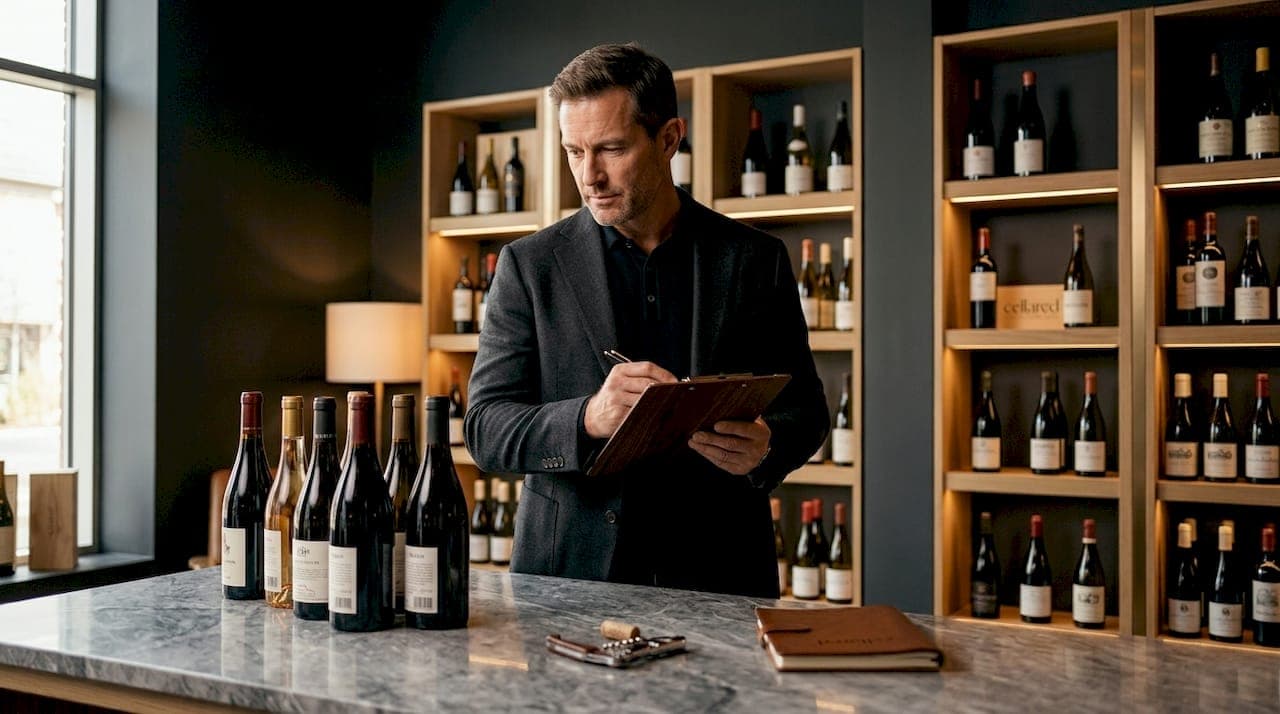
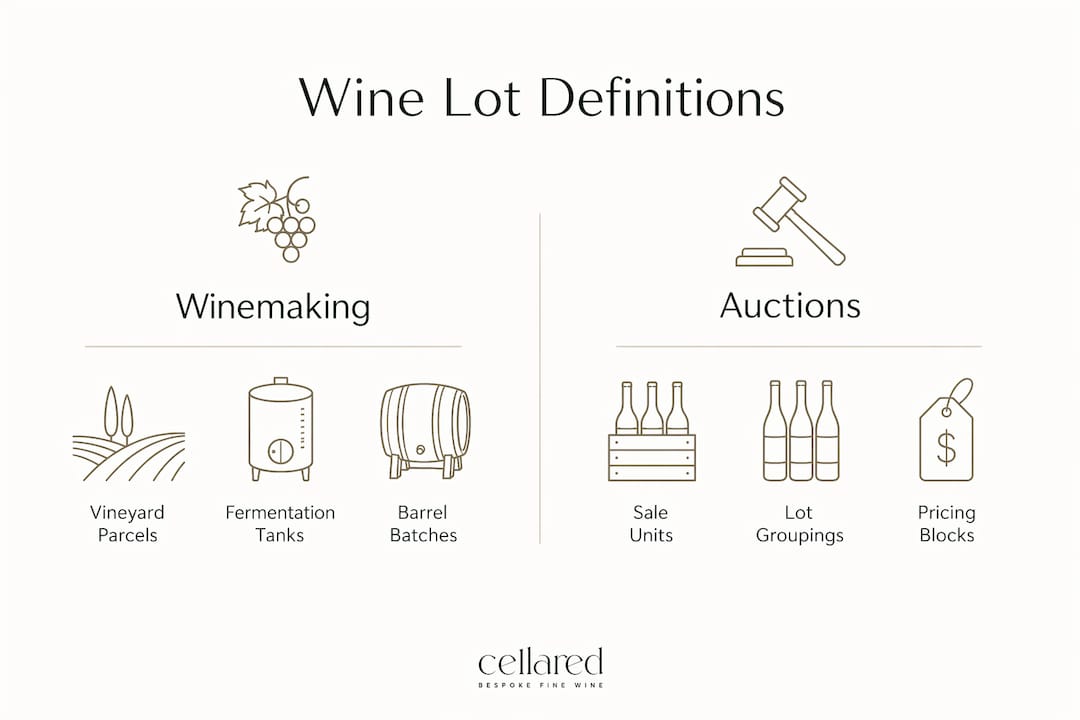
A wine lot is defined as a designated batch or grouping of wine bottles identified by a unique lot number, serving as the fundamental unit for production, traceability, and sale. The term operates across two distinct contexts: the winery floor, where lot numbers track individual barrels or fermentation tanks, and the auction room, where a lot represents the unit of sale under a single catalogue number. For collectors and investors, understanding what is a wine lot is not merely academic. It is the foundation of provenance verification, quality assessment, and confident buying in both primary and secondary markets. Cellared Fine Wine works with this level of detail every day.
What is a wine lot in the winemaking process?
A wine lot begins in the vineyard. Winemakers assign lot numbers to specific vineyard parcels, fermentation tanks, or barrel groups from the moment fruit is harvested. This granular identification system makes traceability possible at every stage of production, from crush through to bottling.

Top wineries manage 30–60 distinct lots per vintage to maintain quality and pinpoint faults. That number reflects the complexity of serious winemaking. Each lot is treated as a separate entity, assessed independently before any blending decision is made.
One barrel lot equals roughly 24 cases of 750ml bottles, based on the standard 59-gallon barrel. That is a small enough volume to manage with precision, yet significant enough to influence a final blend meaningfully. Winemakers can taste, analyse, and decide the fate of each lot without compromising the rest of the vintage.
Lot traceability allows targeted quality control and rapid isolation of faults. If a single barrel develops a fault, the lot number system allows the winemaker to remove it cleanly. The rest of the vintage remains intact. This is the quiet power of lot management: surgical precision in a process that could otherwise be chaotic.
The blending stage, known in French winemaking as assemblage, draws on this lot system directly. Winemakers select the finest lots and blend them into the final wine during late winter or early spring. Lots that do not meet the standard are declassified or sold in bulk.
Key functions of lot tracking in the winery include:
- Vineyard parcel identification: Isolating fruit from specific blocks to preserve terroir expression
- Fermentation management: Tracking individual tanks or barrels through alcoholic and malolactic fermentation
- Fault isolation: Removing compromised lots without affecting the broader vintage
- Blending precision: Selecting and combining lots to achieve the desired style and complexity
- Regulatory compliance: Meeting traceability requirements set by bodies such as the TTB in the United States and equivalent EU authorities
Pro Tip: When buying directly from a producer, ask which lot numbers are included in your allocation. A single vintage may contain multiple lots with subtly different characteristics, particularly for barrel-select or single-vineyard releases.
What defines a wine lot in auctions and secondary markets?
In the auction room, the wine lot definition shifts from production to commerce. An auction lot is the atomic unit of sale, comprising one or more items grouped under a single catalogue number. A lot may be a single bottle of Pétrus, a case of Grange, or a mixed selection of Burgundy premiers crus. What matters is that everything within that catalogue number is sold together, to one buyer, at one price.
The grouping strategy behind each lot is deliberate. Auction specialists balance cataloguing costs against maximising appeal and price realisation. Rare, high-value wines are typically offered as individual bottles or original wooden cases to attract the strongest bidding. Lower-value wines are often grouped into mixed lots to generate interest and move volume efficiently.
Buyer's premiums typically add 20–25% on top of the hammer price. That figure is not negotiable and applies to every lot regardless of size or value. Collectors who overlook this cost when setting a budget regularly find themselves paying materially more than anticipated.
Settlement and logistics follow a defined timeline. Buyers generally complete payment and arrange collection within 7–14 days of the sale. Storage arrangements, insurance, and transport all fall to the buyer once the hammer falls.
Provenance and storage history heavily influence a lot's value. Gaps in provenance may reduce the auction estimate or lead to outright disqualification of the lot. A case of 1996 Krug with documented cellar history from release commands a fundamentally different price than the same wine with unknown storage.
The practical steps for evaluating an auction lot before bidding:
- Review the catalogue description carefully. Note the lot number, bottle count, format, and any condition remarks.
- Examine provenance documentation. Request storage records, purchase receipts, or import documentation where available.
- Inspect physical condition. Check fill levels, label condition, and capsule integrity in person or via detailed photographs.
- Verify lot consistency. Confirm that all bottles share the same lot number prefix, indicating a single production run.
- Calculate the total cost. Add the buyer's premium to your maximum bid before committing to a ceiling price.
Inconsistent lot number prefixes within a single auction lot are a warning sign. Mixed lot prefixes can indicate reconditioning or bottles drawn from different production runs, which may harm value and buyer confidence. A well-informed collector treats lot number consistency as a basic due diligence check, not an optional extra.
For a thorough grounding in auction buying strategy, understanding lot structure is the logical starting point.
What does small-lot winemaking actually mean?
Small-lot winemaking is a qualitative production philosophy, not a legal category. No universal legal definition exists for the term. Its value lies in signalling a hands-on, site-specific approach to fermentation management rather than a fixed case count.
The TTB in the United States and equivalent EU regulatory bodies require lot identification for traceability purposes. Neither mandates a volume threshold for what constitutes a "small" lot. A producer labelling a wine as small-lot is making a statement about method, not quantity.
Small-lot winemaking allows decisions on specific 40-case lots that would be impractical at larger scales. A winemaker managing a 40-case barrel can taste it weekly, adjust sulphur additions precisely, and decide independently whether it belongs in the flagship blend or a second label. That granularity is simply not possible when managing thousands of cases in a single tank.
For collectors, small-lot wines carry genuine appeal for several reasons:
- Terroir specificity: Each lot reflects a single vineyard block, preserving site character that blended volumes obscure
- Limited availability: Small production runs create genuine scarcity, which supports long-term value
- Winemaker attention: Individual lot management means more decisions per bottle, not fewer
- Traceability depth: Lot-level records are typically more detailed for small-run wines, supporting provenance verification
The relationship between small-lot production and estate-grown or estate-bottled designations adds another layer. Estate-bottled wines, under TTB regulations, must be grown, produced, and bottled by the same entity on the same property. Small-lot wines often carry this designation, but not always. The two terms describe different things. Understanding wine vintage basics alongside lot terminology gives collectors a more complete picture of what they are buying.
Pro Tip: Do not assume a small-lot label automatically signals investment-grade quality. Assess the producer's track record, the specific vineyard block, and the vintage conditions independently before making acquisition decisions.
How to identify wine lot information on bottles and labels
Lot codes appear on virtually every commercially produced wine, though their format varies by producer and market. Lot codes are typically prefixed with 'L', 'LOT', or 'BATCH' followed by alphanumeric sequences that encode production-specific information. Knowing how to read these codes gives collectors a practical tool for provenance verification.
The table below outlines common lot code formats and what each element typically reveals:
| Code element | What it indicates | Example |
|---|---|---|
| Prefix (L, LOT, BATCH) | Identifies the field as a lot or batch code | L2403 |
| Year digits | Year of production or bottling | 24 = 2024 |
| Sequential number | Fermentation run or bottling order | L2403 = third run of 2024 |
| Tank or barrel code | Specific vessel used in fermentation | L2403B = barrel B |
| Suffix letters | Shift, line, or facility identifier | L2403B-A = facility A |
Consistency across bottles in a case is the most important check a collector can make. Every bottle in a genuine, undisturbed case should carry the same lot code. Inconsistent lot number prefixes signal mixed or reconditioned batches, which may indicate the case was assembled from different sources after original sale. This is particularly relevant for older vintages where bottles may have been reconditioned or topped up.
EU regulations require lot identification on all wine labels sold within member states, typically as a small "L" followed by a code near the base of the label. US TTB requirements similarly mandate lot identification for domestic and imported wines. These regulatory frameworks exist precisely because lot traceability protects both producers and consumers.
Collectors building a cellar for long-term investment should record lot codes at the point of purchase. This creates an independent provenance record that supports future wine appraisals and valuations and strengthens the case for a buyer at auction.
Key takeaways
A wine lot is the single most important unit of identification in both winemaking and wine commerce, and understanding it gives collectors a measurable advantage in provenance verification, auction bidding, and long-term valuation.
| Point | Details |
|---|---|
| Wine lot definition | A wine lot is a designated batch identified by a unique lot number, used in production and sale. |
| Auction lot structure | Auction lots group one or more bottles under a single catalogue number, with buyer's premiums of 20–25% added to hammer price. |
| Small-lot winemaking | Small-lot is a qualitative production choice with no fixed legal definition; it signals site-specific, hands-on fermentation management. |
| Lot code identification | Lot codes prefixed with L, LOT, or BATCH encode production run, vessel, and bottling date; consistency across a case confirms provenance. |
| Provenance and value | Gaps in provenance or inconsistent lot codes reduce auction estimates and may disqualify a lot from sale entirely. |
Why lot knowledge is the collector's sharpest tool
Collectors often focus on vintage, producer, and critic scores. Lot-level detail rarely enters the conversation until something goes wrong at auction or during a valuation. That is a costly oversight.
I have seen cases where a perfectly presented case of mature Bordeaux lost a third of its estimated value because the lot codes across the twelve bottles did not match. The wines were genuine. The provenance was not. Someone had assembled that case from bottles purchased separately, possibly from different cellars with different storage histories. The lot codes told the story before anyone opened a bottle.
The inverse is equally true. A collector who arrives at auction with documented lot codes, original purchase receipts, and consistent storage records commands a premium. Buyers pay more for certainty. Lot-level documentation is the most concrete form of certainty available in the secondary market.
Small-lot labels deserve particular scrutiny. The term carries genuine meaning when applied by a producer who manages individual vineyard blocks through to bottling. It carries far less meaning when applied to a wine produced in a large facility and simply bottled in smaller quantities. The label does not tell you which situation you are in. The producer's track record, the vineyard source, and the lot documentation do.
My advice to any collector building a serious cellar: treat lot codes as part of the purchase record from day one. Photograph the codes at acquisition, store the records alongside your cellar inventory, and review them before any sale or valuation. The few minutes this takes at purchase can be worth thousands of dollars at auction.
— David
How Cellared Fine Wine supports collectors and investors
Cellared Fine Wine brings specialist expertise to every dimension of wine lot management, from acquisition through to valuation and sale.
Whether you are building a collection from scratch or preparing existing wines for auction, Cellared Fine Wine provides bespoke buying advice grounded in lot-level market knowledge. The team's professional wine valuations are court-ready and market-led, covering insurance, probate, family law, and private advisory purposes. For collectors who want their cellar managed with the same rigour applied to provenance and lot integrity, wine cellar management services keep every bottle accounted for, correctly stored, and ready for market when the time comes. Reach out to discuss your collection and what lot-level expertise can do for its value.
FAQ
What is a wine lot in simple terms?
A wine lot is a specific batch of wine identified by a unique lot number, used to track production, ensure quality, and define the unit of sale in auctions.
How do buyer's premiums affect wine auction lot costs?
Buyer's premiums typically add 20–25% on top of the hammer price, so a lot that sells for $1,000 will cost the buyer $1,200–$1,250 before transport and storage.
How do I check lot code consistency in a wine case?
Examine the lot code printed near the base of each label. Every bottle in a genuine, undisturbed case should carry the same prefix and code sequence.
Does small-lot mean better quality wine?
Small-lot signals a hands-on, site-specific production approach rather than guaranteed quality. Assess the producer's track record and vineyard source independently before buying.
Why does provenance matter for wine auction lots?
Gaps in storage history or inconsistent lot codes reduce a lot's estimated value and may lead to disqualification from auction, as provenance directly affects buyer confidence and price realisation.