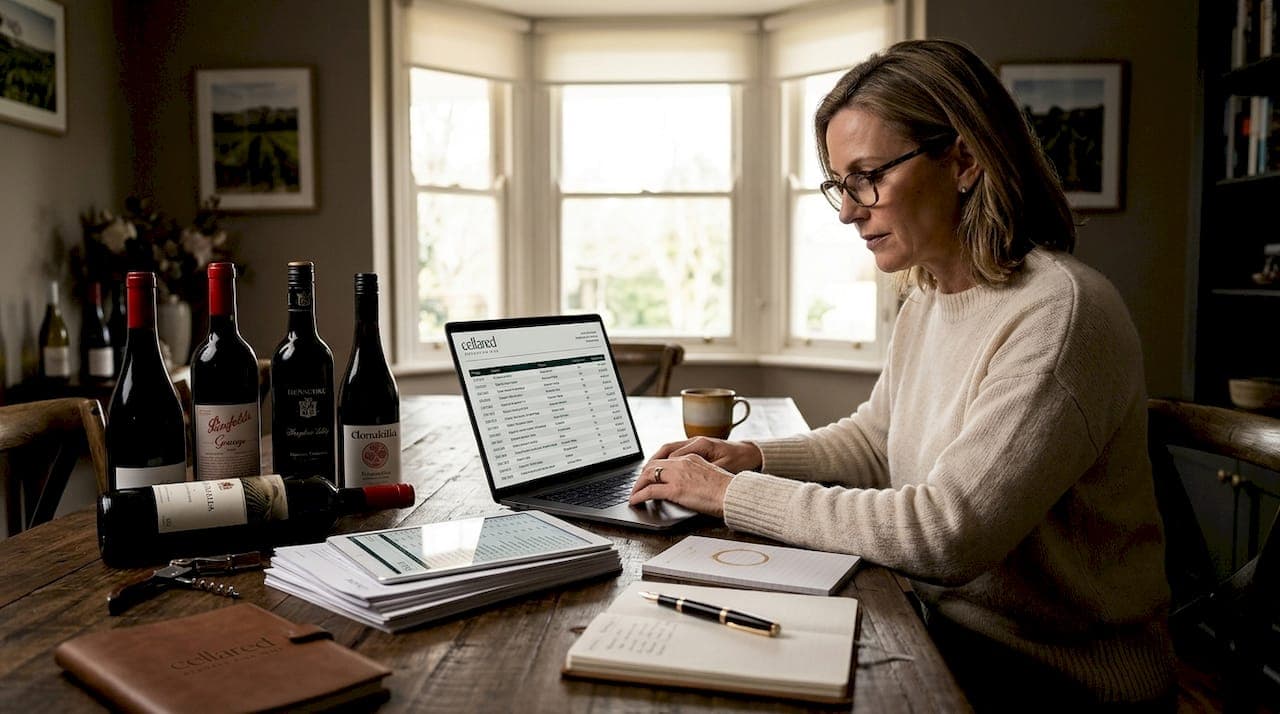
A private wine collection of genuine significance is simultaneously a source of extraordinary pleasure and a complex financial asset. Yet far too many collectors discover, at precisely the wrong moment, that incomplete records, outdated valuations, or mismatched insurance policies have quietly eroded both the monetary and strategic value of what they have spent years, sometimes decades, assembling. Whether you are planning a sale, navigating an estate, or simply seeking greater clarity over your holdings, a rigorous and well-maintained collection workflow is not optional; it is the foundation upon which every sound decision rests.
Table of Contents
- Set your foundation: what you need before you start
- Step-by-step guide: cataloguing, valuation and documentation
- Integrate insurance and policy selection with your workflow
- Benchmark, revalue, and plan for transition or sale
- Our take: what truly sets high-end workflows apart
- Experience professional wine collection management
- Frequently asked questions
Key Takeaways
| Point | Details |
|---|---|
| Catalogue comprehensively | Detailed cataloguing with documentation and photography preserves provenance and value. |
| Defensible valuations | Professional valuations based on condition and records enable proper insurance and market flexibility. |
| Specialised insurance required | Standard home policies may underinsure wine collections, so select cover designed for fine wine. |
| Use benchmarks wisely | Fine wine indices help gauge market value, but always review unique bottle condition and provenance. |
Set your foundation: what you need before you start
Now that you appreciate why proper workflow matters, let us examine the essential foundations that make professional-level wine collection management possible.
Before a single bottle is catalogued or a valuation commissioned, the serious collector must gather the instruments of accountability. This preparatory phase is not administrative housekeeping; it is the act of transforming a passionate accumulation into a defensible, market-ready asset. The collectors who understand this distinction from the outset are the ones who retain flexibility when circumstances change.
Essential documents to assemble first:
- Original purchase receipts and invoices from merchants, brokers, and auction houses
- Warehouse invoices and storage receipts establishing chain of custody
- Prior valuation reports and any correspondence with insurers
- Provenance documentation including producer certificates, release letters, and en primeur confirmations
- Photographic records of labels, capsules, fill levels, and case markings
Beyond documents, you must define what your collection is for. The answer shapes every subsequent decision. A collection managed primarily for drinking requires a different rotation and cataloguing approach than one intended as a long-term investment or a legacy asset for the next generation. Curation strategies vary enormously depending on this underlying intent, and conflating the two goals without a clear framework is one of the most common and costly errors collectors make.
Engaging the right professionals at this foundational stage is equally important. You will need a reputable temperature-controlled storage provider, a specialist valuer experienced in fine wine, and an insurer willing to underwrite the collection at its genuine replacement value. Private client wine services often bundle these functions into a single coordinated offering, which reduces friction considerably.
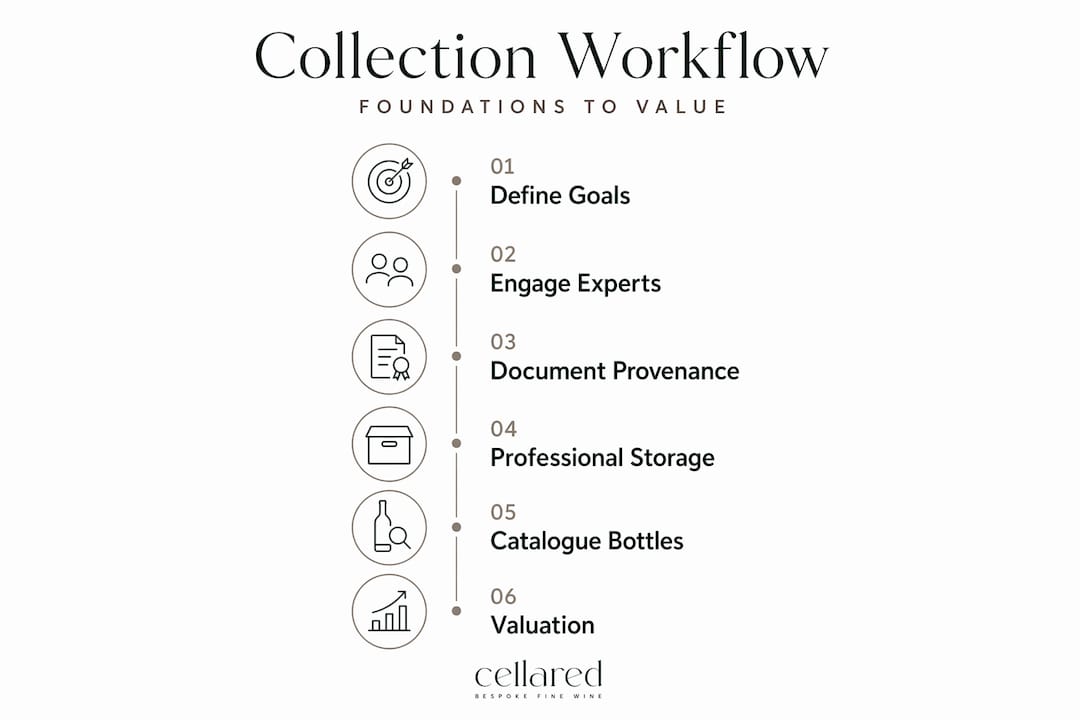
Pro Tip: Service providers commonly bundle cataloguing with professional valuation and photography, aimed specifically at insurance readiness and sale or transition planning. This integration saves time and ensures consistency across your documentation.
| Foundation element | Why it matters | Who provides it |
|---|---|---|
| Provenance documentation | Establishes legitimacy and condition history | Merchant, producer, auction house |
| Professional valuation | Confirms defensible market value | Specialist fine wine valuer |
| Storage records | Proves custody and conditions | Warehouse or private cellar operator |
| Insurance policy | Protects replacement value | Fine wine specialist insurer |
| Photographic catalogue | Visual evidence for claims and sales | Valuer or concierge service |
Step-by-step guide: cataloguing, valuation and documentation
With initial documents and goals set, it is time to move through the collection workflow that ensures defensibility and flexibility.
The cataloguing and valuation process is where ambition becomes architecture. Each step builds on the last, creating a layered record that can withstand scrutiny from insurers, courts, buyers, and beneficiaries alike. Rushing this phase, or approaching it without specialist knowledge, typically produces documentation that fails precisely when it is needed most.
1. Catalogue every bottle with precision and rigour
Each entry in your collection catalogue should include the producer, appellation, vintage, format, and quantity. Beyond these basics, record the lot or case identification numbers that match warehouse records, and photograph every bottle individually where value warrants it. For large-format bottles, rare back-vintages, or single-vineyard parcels, photographic detail at the label, capsule, and fill-level stages is not excessive; it is simply prudent. A wine valuation checklist can guide you through the granular detail required for a catalogue that will actually perform under pressure.
2. Evaluate condition with objectivity
Condition assessment is where many collectors encounter uncomfortable truths. Ullage, the space between the wine and the cork or capsule, is one of the most objective indicators of storage quality and potential spoilage risk. A bottle with high fill and an immaculate label in a temperature-stable environment tells a very different story to one with significant ullage, a stained or peeling label, and an uncertain custody history. Provenance and condition evaluation relies on documentation like receipts, warehouse invoices, and matching lot or case IDs, treating ullage as an objective, storage-related condition input rather than a stylistic consideration.
3. Obtain a defensible professional valuation
A defensible valuation is not merely an opinion; it is a structured, evidence-based assessment that can be reproduced, challenged, and relied upon in formal proceedings. For insurance, probate, family law matters, or private sale, the valuation must be prepared by a specialist with market knowledge and an understanding of the legal and financial context in which it will be used. Our wine appraisals and valuations service is specifically designed to meet this standard, with documentation that withstands formal review.
4. Maintain living documentation
Documentation is not a one-time event. As bottles are consumed, acquired, or moved, the catalogue must be updated. Every withdrawal and addition should be logged with a date, reason, and any accompanying transaction record. This living documentation is what transforms a static snapshot into a genuinely reliable asset register.
Pro Tip: Review your wine valuation standards to understand what criteria a court-ready valuation must satisfy. Not all appraisals are equal, and the difference matters when significant sums or legal outcomes depend on the document.
| Documentation type | Catalogue-ready | Insurance-ready | Court-ready |
|---|---|---|---|
| Basic bottle list | Yes | Partial | No |
| Provenance chain and receipts | Yes | Yes | Partial |
| Professional valuation report | Partial | Yes | Yes |
| Photographic evidence | Yes | Yes | Yes |
| Condition and ullage notes | Yes | Yes | Yes |
Integrate insurance and policy selection with your workflow
Having created defensible valuations and records, protecting your investment is the next vital step, beginning with your insurance workflow.

Insurance is the safety net that most collectors acknowledge intellectually but rarely examine with sufficient care. The gap between what a collection is worth and what a standard policy will actually pay out can be startling, and it typically surfaces at the worst possible time. Fine wine occupies a peculiar position in the insurance landscape: it is simultaneously a consumable product, a luxury good, and a financial instrument, and not all policies treat this complexity with the nuance it demands.
Common gaps in standard contents or homeowner policies:
- Sub-limits on wine or other valuables that are far below collection value
- Exclusions for gradual deterioration, power failure, or temperature fluctuation
- No provision for fluctuations in market value between policy dates
- Lack of agreed-value provisions, meaning disputes at the point of claim
- Absence of cover for wine held in commercial storage facilities offsite
After creating a complete inventory, you should obtain a professional appraisal and select an insurance policy designed specifically for fine wine, noting that standard homeowner's and contents policies routinely have limited coverage that will not reflect the true replacement cost of a serious collection.
"Fine wine insurance, when structured correctly, should mirror the collection's documented value, account for rarity and condition, and be updated whenever material changes occur. Anything less is a false economy." — Cellared Fine Wine
Selecting the right policy means working with an insurer experienced in high-value collectibles or fine wine specifically. You will want an agreed-value policy rather than an indemnity-value policy, which pays only what the insurer determines the wine was worth at the time of loss rather than what it would cost to replace it. Our guidance on insuring fine wine outlines the specific considerations relevant to Australian and APAC collectors, where market access to rare bottles can make replacement genuinely difficult. Integrating your insurance review into your wine cellar management cycle ensures that cover remains current as the collection evolves.
Benchmark, revalue, and plan for transition or sale
With insurance in place, ensure ongoing protection and flexibility by benchmarking, revaluing, and planning for transitions.
A collection that is never benchmarked against market movement is a collection that gradually loses its strategic coherence. Market values for fine wine can shift substantially from year to year, particularly for sought-after appellations such as Burgundy, Champagne, and the great estates of Bordeaux. Understanding where your holdings sit relative to the broader market is what allows you to make intelligent decisions about when to hold, when to sell, and how to position the collection for a future transition.
Market indices as navigation tools:
The Liv-ex Fine Wine 1000 and its constituent sub-indices are the most widely used benchmarks among sophisticated collectors and investors, tracking secondary market pricing across the major fine wine regions. However, indices provide a picture of the market in aggregate; individual bottles are unique, and condition, provenance, and storage history introduce variables that no index can fully capture. Item-level cross-checks remain essential, particularly for older vintages or bottles with unusual provenance.
| Benchmarking tool | Scope | Limitation |
|---|---|---|
| Liv-ex Fine Wine 1000 | Broad market across major regions | Does not account for individual bottle condition |
| Regional sub-indices | Focused on Bordeaux, Burgundy, etc. | May not reflect rare or off-index bottles |
| Auction result databases | Actual sale prices for comparable lots | Condition and provenance not always disclosed |
| Professional revaluation | Item-level, condition-adjusted | Requires specialist engagement |
Revaluation should occur at a minimum annually, and immediately following any substantial acquisition, disposal, or major market movement affecting your key holdings. For collectors approaching a significant life transition, whether that is succession planning, relocation, divorce proceedings, or a decision to sell, the revaluation must be conducted with explicit reference to the purpose for which it will be used.
Pro Tip: When planning for selling your collection or transitioning it to beneficiaries, commission a valuation that explicitly states its purpose. An insurance valuation and a fair-market-value sale valuation are not interchangeable documents, and using one in place of the other can create legal and financial complications.
Engaging private client wine services at the planning stage, rather than as a reactive measure, gives collectors far greater control over timing, pricing, and the presentation of the collection to prospective buyers or successors.
Our take: what truly sets high-end workflows apart
After covering the technical workflow, here is why leading collectors consistently extract more value and experience less stress from their collections than their peers.
The conventional guide to wine collection management focuses almost exclusively on what to do: catalogue, insure, store, and revalue. What it rarely addresses is who should do each thing, and why the separation of roles is often the most important structural decision a collector makes.
A high-HNW workflow typically separates roles in a deliberate and disciplined way: collectors maintain intent, setting and refining the acquisition and drinking policy; storage providers manage the physical environment and operational controls; and valuation specialists produce the defensible documentation required for insurance, transactions, and legal proceedings. The sourcing and transition emphasis that appears in Australian concierge-style offerings reflects a mature understanding of how these roles interact and where the gaps tend to appear.
What we observe consistently is that collectors who conflate these roles, attempting to manage storage, valuation, and strategic planning without specialist support, routinely underestimate the complexity of each function. The consequence is not dramatic; it is gradual. Documentation drifts, valuations age without update, and the collection loses the clarity it needs to be genuinely liquid.
Transition readiness deserves particular emphasis. In our experience, most collectors think about succession, sale, or estate planning far later than is optimal. The collector who builds transition readiness into the annual workflow from the outset is the one whose collection retains its full strategic and financial value regardless of what circumstances arise. This means maintaining records that a family member, executor, or buyer could understand and act upon without specialist translation.
For Australian and APAC collectors, the combination of a well-maintained catalogue, current professional valuations, and comprehensive photographic documentation within a single coordinated service is not a luxury; it is the baseline standard for a collection managed at the level its value demands. Our wine cellar management service is built around precisely this integrated approach.
Experience professional wine collection management
To put these high standards into practice and reduce your workload, lean on trusted experts who specialise in the unique needs of discerning collectors.
Cellared Fine Wine works with collectors, investors, estates, and private clients across Australia and APAC to deliver exactly the kind of integrated, meticulous service that serious collections require. From court-ready wine appraisals and valuations to bespoke cataloguing and photographic documentation, every service is designed to give you clarity, confidence, and genuine market flexibility.
Our wine collection management service combines deep market knowledge with a highly personal approach, ensuring your collection is protected, accurately valued, and positioned for whatever comes next. Whether you are preparing for a significant transaction, reviewing your insurance cover, or planning for the next generation, our professional valuations provide the independent, market-led documentation you need to act with confidence. Contact Cellared Fine Wine to discuss your collection today.
Frequently asked questions
Do I need professional valuation for every bottle in my collection?
Professional valuations are recommended for all bottles with material value, as they provide the documentation needed for both adequate insurance coverage and informed resale decisions. Professional valuation and photography are particularly important when preparing for insurance reviews or collection transitions.
What documentation is essential for a defensible wine appraisal?
Receipts, provenance records, warehouse invoices, and photographic evidence are all critical components of a defensible appraisal. Documentation and provenance chain, including matching lot and case IDs, establishes the integrity of the collection record.
How often should my private wine collection be revalued for insurance?
Collections should be revalued at least annually and immediately following substantial acquisitions or disposals. Updated valuations and policy alignment to the collection's current documentation are essential for maintaining adequate and defensible cover.
Which market indices are most useful for benchmarking private collections?
The Liv-ex Fine Wine 1000 and its sub-indices are widely used by sophisticated collectors, though item-level condition and provenance checks remain necessary because individual bottles vary significantly from index averages.