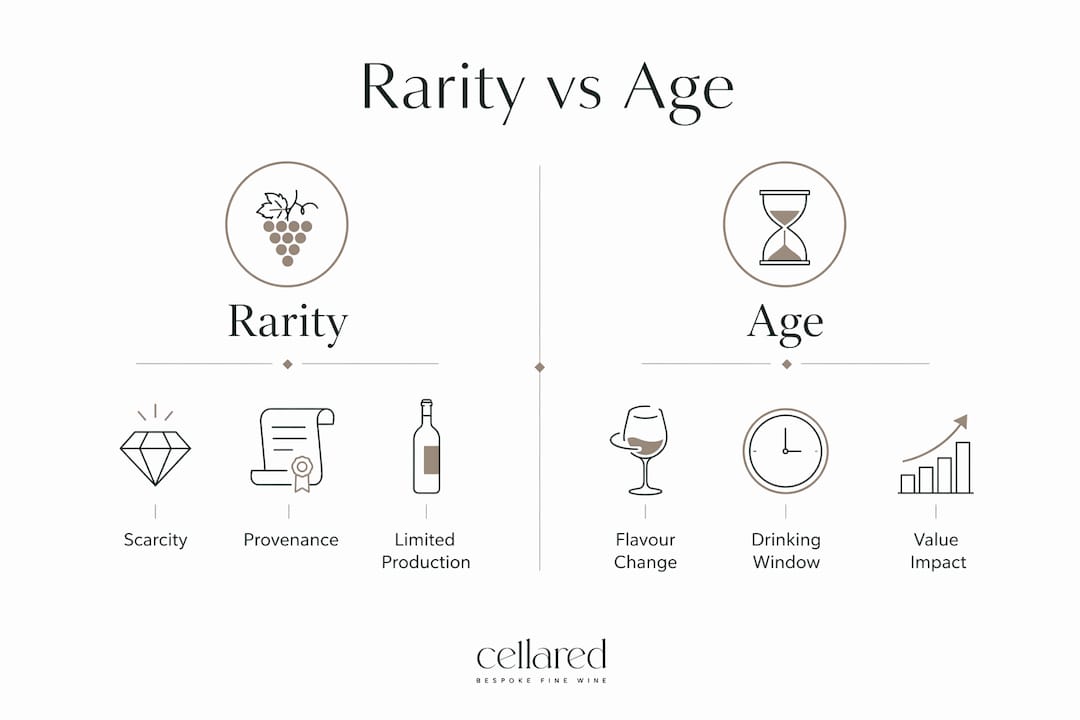
Wine rarity is defined as the scarcity of a bottle driven by limited production, documented provenance, and verified storage history. Age, by contrast, is the time elapsed since vintage, shaping a wine's chemical evolution and sensory character. Explaining wine rarity vs age matters because collectors routinely conflate the two, paying premiums for old bottles that have lost their structure, or overlooking genuinely scarce wines that sit within their prime drinking window. The distinction is not merely academic. It determines whether a bottle belongs in your cellar, your portfolio, or your glass tonight.
What factors determine wine rarity?
Wine rarity results from a combination of forces that restrict supply and authenticate what survives. Rarity stems from low production volume, a unique grape variety or style, and survival through time with unbroken provenance and verified storage. Each of those three conditions must hold simultaneously. A wine produced in large quantities cannot be rare, regardless of its age.
The primary drivers of rarity are:
- Limited vineyard acreage and selective harvesting. Grand Cru vineyards in Burgundy, for instance, cover only a few hectares. Selective harvesting further reduces the number of bottles released each year.
- Documented provenance and ownership history. Provenance and storage conditions directly influence contextual value beyond list price. A bottle with a clear, unbroken chain of custody commands a premium that an identical bottle without records simply cannot.
- Bonded warehouse storage. Wines held in temperature-controlled, bonded facilities carry a verifiable storage history. That record is part of the bottle's identity as a collector's asset.
- Critic scores and vintage reputation. A high score from a respected critic, combined with a celebrated vintage year, amplifies demand against a fixed or shrinking supply. That imbalance is what makes a bottle genuinely rare on the secondary market.
Pro Tip: Before purchasing a bottle on the basis of rarity, request the full provenance documentation. A gap in the ownership record is a red flag that no age or critic score can overcome.
Understanding what affects wine rarity means looking beyond the label and into the bottle's entire life history.
How does wine age affect flavour and value?
Ageing is a chemical process, not a guarantee of quality. Three distinct transformations occur inside a bottle over time, and understanding them separates the collector who buys wisely from the one who buys hopefully.
- Tannin polymerisation. Harsh, grippy tannins in young red wines bind together into longer chains, producing a softer, more velvety texture. Ageing transforms tannins into softer compounds and shifts primary fruity aromas into complex tertiary notes such as leather, tobacco, and dried earth. This is the transformation collectors prize in structured reds like Barolo, Bordeaux, and Hermitage.
- Acid and ester transformation. Acidity integrates with alcohol and residual compounds to produce esters, the aromatic molecules responsible for the haunting complexity of a mature white Burgundy or aged Riesling. The wine's texture broadens and its aromatic register deepens.
- Slow oxidation through the cork. A tiny, controlled exchange of oxygen through the cork softens the wine's edges and allows secondary and tertiary aromas to develop. Poor storage interrupts this process and accelerates spoilage instead.
The concept of the drinking window captures when these processes produce the best result. The optimal drinking window sits in the middle 60% of a wine's ageing potential. Open a bottle too early and the tannins dominate. Open it too late and the fruit has faded beyond recovery.
Not every wine benefits from extended cellaring. Over 90% of global wine production is intended for consumption within 1–3 years of release, and only about 10% carries the structural components suited to long-term ageing. That 10% share is a useful reminder that age-worthiness is the exception, not the rule. A wine needs sufficient acidity, tannin, and sugar or alcohol to act as preservatives. Without that structural balance, time works against the bottle rather than for it.
Pro Tip: Consult a vintage chart guide before committing to long-term cellaring. A great producer in a poor vintage may still produce a wine that peaks within five years, not twenty.
Does older wine always mean rarer and more valuable wine?
The assumption that older equals rarer, and rarer equals more valuable, is one of the most persistent myths in fine wine collecting. It is also one of the most expensive.
Older wines may be rarer due to attrition but not necessarily more valuable or better tasting. Value depends on demand, provenance, and condition. A 1970 Bordeaux from an average vintage, stored in a private cellar with no documentation, is old. It is not rare in any meaningful market sense, and it is unlikely to command a serious price.
The table below illustrates how age and rarity interact across different scenarios:
| Scenario | Age | Rarity | Value driver |
|---|---|---|---|
| Grand Cru Burgundy, documented provenance | High | High | Both age and rarity support value |
| Commercial Bordeaux, poor storage | High | Low | Neither factor supports value |
| Limited release young wine, critic acclaim | Low | High | Rarity alone drives value |
| Standard regional wine, average vintage | Low | Low | Neither factor supports value |
Supply and demand dynamics matter more than the number on the label. A wine from a celebrated but tiny appellation, released just three years ago, can command more at auction than a thirty-year-old bottle from an undistinguished producer. The market prices scarcity and condition, not sentiment.
"The fascination with very old wine often arises from its status as a 'living survivor' of a historical era rather than pure sensory excellence. Collectors pay for the story as much as the liquid."
Successful ageing depends on structural balance rather than simply high alcohol or power. An unbalanced wine does not gain complexity with time. It simply deteriorates more slowly than a wine with no structure at all.
Practical advice for collectors: balancing rarity and age
Collectors who build lasting, rewarding cellars treat rarity and age as two separate variables to be assessed independently, then weighed together. The following principles guide that process.
- Research vintage quality before purchasing for ageing. A good vintage is characterised by balanced warm weather enabling ripeness, sufficient acidity retention, and healthy fruit without disease. These conditions produce wines with genuine ageing potential. A poor vintage rarely improves with patience.
- Assess provenance documentation thoroughly. Review storage records, ownership history, and condition reports before committing capital. Provenance documentation is the single most important factor separating a collectible bottle from an expensive gamble.
- Store correctly from the moment of purchase. Stable cool temperatures of 12–14°C are critical to preserving ageing potential and protecting value. Poor storage can undo decades of careful winemaking in a matter of months.
- Consider your drinking window alongside market trends. A wine approaching its peak drinking window may be at its sensory best but past its investment peak. Decide whether you are buying to drink or buying to hold, and choose accordingly.
- Buy multiple bottles of age-worthy wines. Buying multiple bottles allows collectors to taste and observe evolution over time, enabling better decisions about when to open the remainder of the case. Owning a single bottle forces a one-shot decision with no room for learning.
Pro Tip: When evaluating wines for long-term investment value, separate the question of "will this age well?" from "will this be worth more in ten years?" The answers are often different.
The difference between a rewarding cellar and a costly one usually comes down to discipline. Collectors who resist the romance of age and focus on provenance, structure, and documented storage consistently outperform those who buy on reputation alone.
Key takeaways
Wine rarity and age are distinct forces: rarity is determined by scarcity and provenance, while age shapes flavour complexity and drinking windows, and neither factor alone guarantees value.
| Point | Details |
|---|---|
| Rarity requires provenance | A bottle without documented ownership and storage history cannot be considered genuinely rare on the market. |
| Only 10% of wine ages well | The vast majority of wine is made to drink young; structural balance determines age-worthiness, not producer reputation alone. |
| Age does not equal value | Older wines may be scarcer due to attrition but command higher prices only when provenance, condition, and demand align. |
| Drinking window is critical | The optimal window sits in the middle 60% of a wine's ageing potential; opening too early or too late compromises the experience. |
| Buy multiples for aged wines | Purchasing several bottles of an age-worthy wine allows collectors to track evolution and time their consumption accurately. |
The romance of age versus the reality of rarity
I have opened enough bottles to know that age is seductive in a way that rarity is not. There is something deeply compelling about pulling a cork on a wine that has outlived the vintage by three decades. The colour, the fragrance, the sense of time compressed into a glass. But I have also poured wines that were simply old, not complex, not alive, just tired. That experience recalibrates your thinking quickly.
The collectors I respect most treat age as a tool, not a trophy. They ask whether a wine's structure can carry it through twenty years, not whether twenty years makes a wine worth buying. They scrutinise provenance with the same rigour they apply to the label. They understand that wine maturity is a specific condition, not a synonym for old age.
The most common mistake I see from newer collectors is paying a premium for age without verifying condition. A bottle stored in a warm garage for fifteen years is not a mature wine. It is a damaged one. The story of where a bottle has been is inseparable from the story of what it has become. Rarity without provenance is just scarcity. Age without structure is just time.
— David
How Cellared Fine Wine helps collectors value rarity and age
Understanding the interplay between rarity and age is one thing. Applying that knowledge to real purchasing and valuation decisions is another.
Cellared Fine Wine provides professional wine appraisals that assess both rarity factors and ageing potential, producing independent, market-led valuations suitable for insurance, probate, and private advisory purposes. The team at Cellared also offers private cellar management to maintain the precise storage conditions that preserve a collection's rarity and ageing quality over time. Whether you are building a cellar from scratch, assessing an inherited collection, or sourcing specific bottles for long-term investment, Cellared brings the depth of market knowledge and the personal attention that fine wine decisions deserve. Visit Cellared Fine Wine to learn more.
FAQ
What is the difference between wine rarity and wine age?
Wine rarity refers to scarcity driven by limited production, documented provenance, and verified storage. Wine age is simply the time elapsed since vintage, which affects flavour development and drinking windows but does not automatically create rarity or value.
Does older wine always taste better?
No. Only about 10% of global wine production has the structural components suited to long-term ageing. Wines without sufficient acidity, tannin, or sugar deteriorate rather than improve with time.
What makes a wine genuinely rare?
Rarity requires low production volume, a unique grape variety or appellation, and survival through time with unbroken provenance and storage verification. A single missing link in that chain reduces a bottle's collectible status significantly.
How do I know when to open an aged wine?
The optimal drinking window sits in the middle 60% of a wine's ageing potential. Consulting a vintage chart and seeking advice from a specialist like Cellared Fine Wine helps collectors identify the right moment for specific bottles.
Does price reflect rarity or age?
Price reflects a combination of provenance, condition, demand, and vintage reputation rather than age alone. Restaurant markups can inflate a bottle's price by 200–300%, whereas true investment value depends on the bottle's documented history and market demand.