Some bottles sell for hundreds of thousands of dollars at auction, yet not every expensive or aged wine qualifies as truly rare. The difference matters enormously for collectors and investors who need precision, not assumption, when building or appraising a cellar. Rarity in fine wine is a convergence of production volume, critical acclaim, market demand, and impeccable provenance, a constellation of factors that demands careful, informed navigation. This guide walks through the defining criteria, valuation frameworks, acquisition strategies, and long-term value drivers that separate a genuinely rare wine from a merely costly one.
Table of Contents
- Defining rare wine: What sets it apart
- Valuing rare wine: Indices and real-world premiums
- Acquiring rare wine: Strategies for collectors and investors
- Factors influencing rare wine value: Age, provenance and market forces
- Why traditional definitions miss the mark on rare wine
- Expert support for rare wine collectors
- Frequently asked questions
Key Takeaways
| Point | Details |
|---|---|
| True rarity factors | Scarce production, high ratings, exclusive distribution, and secondary market pricing define rare wine. |
| Reliable valuation tools | Indices like Liv-ex provide transparent benchmarks for rare wine investment and pricing. |
| Smart acquisition strategies | Allocations, auctions, and authentication tools help collectors secure genuine rare bottles. |
| Market forces matter | Age, provenance, and collector demand shift rare wine value over time. |
| Expert support available | Professional services can streamline rare wine appraisal and cellar management for optimal results. |
Defining rare wine: What sets it apart
The word "rare" is used freely in wine marketing, but for serious collectors and investors, it carries a very specific meaning. A wine earns true rarity through a precise combination of measurable and qualitative factors, none of which can be considered in isolation.
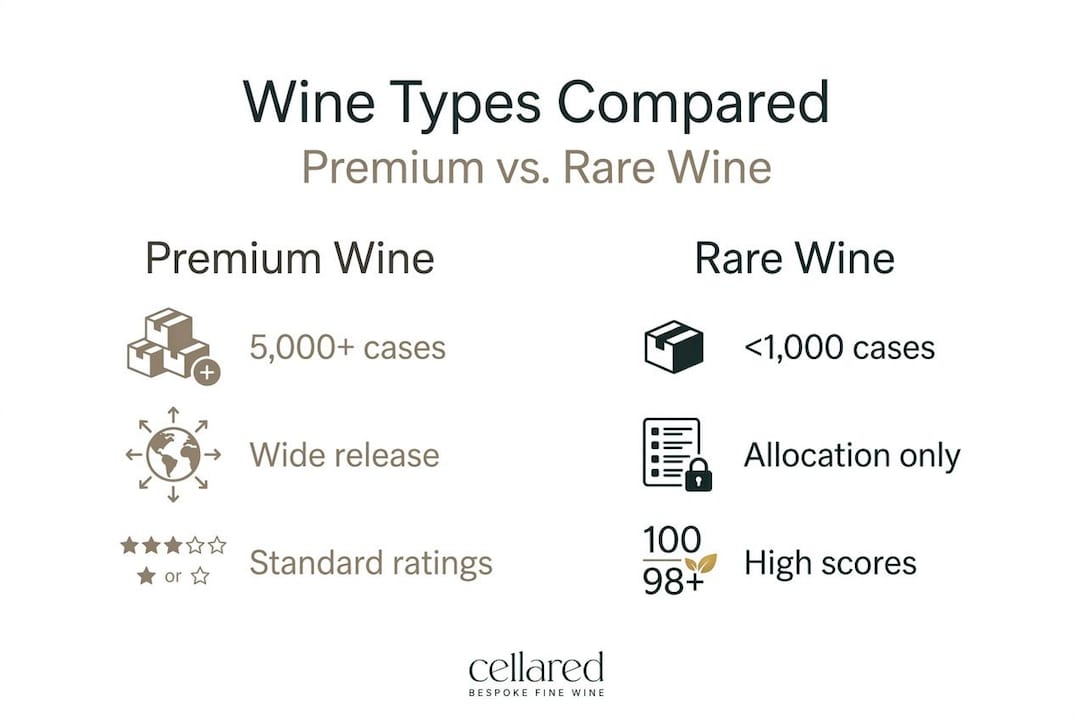
Production volume is the most straightforward starting point. Wines produced below approximately 1,000 cases annually occupy a fundamentally different market position than those with broad commercial distribution. When supply is this constrained, even modest increases in demand produce dramatic price movements. Refer to a solid collectible wine guide for deeper context on how production thresholds interact with collectibility.
Yet volume alone does not create rarity. A wine may be scarce without being desirable. The criteria that genuinely distinguish rare wine include:
- Limited production: Output consistently below 1,000 cases per vintage, creating a structurally constrained supply pipeline
- Mailing list allocation: Access restricted to waitlisted buyers, meaning most collectors never encounter the wine through normal retail channels
- Critical acclaim: Consistent scores of 95 points or above from respected critics, which validates quality and sustains long-term demand
- Secondary market premium: Resale prices substantially exceeding the original release price, a clear signal that the market values the wine beyond its initial positioning
- Producer reputation: A sustained track record across multiple vintages, not just a single celebrated year
The clearest examples come from California cult wines, where key factors include production below 1,000 cases annually, mailing list allocation with long waitlists, consistent 95+ scores, and secondary prices exceeding release prices. Screaming Eagle, Harlan Estate, and Scarecrow represent this archetype: not merely scarce, but actively sought, critically endorsed, and institutionally recognised as investment-grade wine.
Comparison: rare wine vs premium wine
| Factor | Premium wine | Rare wine |
|---|---|---|
| Annual production | 5,000+ cases | Below 1,000 cases |
| Distribution | Broad retail | Allocation and waitlist only |
| Critical scores | 90 to 94 points | 95+ points consistently |
| Secondary market | Near release price | Significantly above release price |
| Provenance requirements | Moderate | Critical and documented |
A well-constructed wine valuation checklist will always begin with these fundamentals before moving to market analysis or storage assessment.
Valuing rare wine: Indices and real-world premiums
With the defining criteria established, the question of how rare wine is valued in practice becomes central to any serious collector or investor's strategy. Wine valuation is both an art and a discipline, drawing on trade indices, auction data, provenance records, and expert assessment.
The most widely referenced benchmark is the Liv-ex fine wine index, a family of indices that tracks the most actively traded fine wines globally. The Fine Wine 1000, for instance, monitors the pricing of the 1,000 most traded wines in the secondary market, offering a broad view of market direction. According to structured fine wine asset class auction index data, fine wine has delivered a 20-year compound annual growth rate of 6.6 to 6.9%, with maximum drawdown of just 10.5% compared to the S&P 500's 42.7% contraction during the 2008 financial crisis. That combination of steady return and comparatively low volatility has attracted serious asset allocators to the category.
Fine wine does not move in lockstep with equities. This decorrelation is one of its most compelling investment attributes, particularly during periods of market turbulence.
Understanding wine valuation standards requires collectors to look beyond headline indices and assess individual bottle or case values with methodical rigour.
Historic auction premiums: selected examples
| Wine | Vintage | Sale price | Venue |
|---|---|---|---|
| Château Lafite Rothschild | 1870 (two magnums) | $306,250 (£226,000) | Sotheby's |
| Romanée-Conti | 1945 (single bottle) | $558,000 | Sotheby's New York |
| Penfolds Grange | 1951 | $38,420 AUD | Langton's |
The Château Lafite Rothschild 1870 auction result is particularly instructive. Two magnums fetching $306,250 reflects not just age, but first growth status, legendary provenance, and the irreversible scarcity of wines from that era. Each of these factors compounds the others; remove any one element, and the value diminishes meaningfully.
Pro Tip: When evaluating a wine's investment case, always compare the current secondary market price to the wine's historical release price and its trajectory over at least five years. A wine rising steadily, rather than spiking on a single auction result, reflects genuine, durable demand.
For collectors looking to maximise value from estate wine sales, understanding these valuation dynamics is essential before approaching any buyer or auction house.
Acquiring rare wine: Strategies for collectors and investors
Understanding valuation naturally leads to the question of acquisition. Rare wines are not found on supermarket shelves, and even specialist retailers often lack access to the most sought-after bottles. Strategic sourcing requires clarity on method, timing, and due diligence.
The three principal acquisition channels each carry distinct trade-offs:
-
Allocation and mailing list access: The purest form of rare wine acquisition. Producers like Screaming Eagle or Domaine de la Romanée-Conti release directly to longstanding clients at release price. Entry to these lists requires patience, relationships, and sometimes years of purchasing history with importers or négociants. The reward is access at prices well below secondary market.
-
Auction purchase: Major houses including Christie's, Sotheby's, and Langton's offer transparency of provenance and competitive price discovery. However, bidding wars on exceptional lots frequently push hammer prices above fair value, and buyer's premiums (typically 20 to 25%) add meaningfully to the cost. Disciplined bidding with a pre-determined ceiling is essential.
-
Private sale and specialist brokers: Transactions between collectors, often facilitated by specialist firms, can offer competitive pricing and more detailed provenance documentation than the auction floor. The risk lies in verification; without a reputable intermediary, authenticity cannot be assumed.
Authentication is a critical discipline within each channel. Evaluating wine investments requires understanding that while authentication technologies like DNA tagging and blockchain provenance records are emerging, visual inspection of ullage (the space between the cork and the wine surface), label condition, and capsule integrity remains the primary method for most transactions. A compromised cork or suspicious label should end a purchase conversation immediately.

The edge case of cult wines reinforces the broader principle: small production alone is insufficient without sustained critical scores and active waitlists. A wine may produce only 500 cases but fail to attract the secondary demand needed to elevate it into genuine rarity. Demand and supply must both be structurally constrained for the rarity premium to hold.
Accessing exclusive wine at allocation requires nurturing relationships with producers, importers, and merchants well before a target vintage arrives. A thorough fine wine buying guide will map these relationships and acquisition pathways in detail, saving collectors from costly reactive decisions.
Pro Tip: Before bidding at auction, verify the lot's storage history independently. A wine from an impeccably documented private cellar is worth more, and carries less risk, than one with gaps in its chain of custody, even if both share the same label.
For those new to sourcing, wine sourcing explained offers a practical overview of how to secure rare bottles with confidence, covering the full spectrum from allocation to broker networks.
Factors influencing rare wine value: Age, provenance and market forces
With acquisition strategies addressed, it is vital to examine the long-term factors that determine whether a wine retains, grows, or loses its rarity premium over time. These forces operate continuously, reshaping the hierarchy of desirable bottles as markets, palates, and economic conditions evolve.
Age and maturity are not automatically synonymous with value. An aged wine commands a premium only when its structure supports longevity. Wines from Bordeaux first growths, Burgundy Grand Cru vineyards, and the finest Barolo producers possess the tannic backbone and acid structure to evolve gracefully over decades. A lesser wine, regardless of age, simply deteriorates. The 1870 Lafite Rothschild achieved its record auction result because its first growth status, exceptional vintage conditions, and extraordinary provenance converged with extraordinary age in a way that is unrepeatable.
The key long-term value drivers for rare wine include:
- Verified provenance: An unbroken chain of custody from producer to current owner, ideally documented through purchase receipts, cellar records, and storage logs
- Optimal storage conditions: Consistent temperature (typically 12 to 14 degrees Celsius), controlled humidity (70 to 75%), minimal vibration, and darkness are non-negotiable for value preservation
- Vintage reputation: Market consensus on the quality of the growing year shapes long-term demand; exceptional vintages from classified producers attract enduring collector interest
- Producer trajectory: A winemaker's ongoing reputation matters. A celebrated producer who maintains quality across decades commands sustained premiums; one whose quality declines risks dragging even historic bottles down in market esteem
- Collector sentiment and fashion: Market trends shift. Burgundy's rise over the past fifteen years elevated prices dramatically, while some previously fashionable Bordeaux have plateaued
Emerging research and market data consistently highlight that securing rare bottles with impeccable provenance records outperforms speculation on wines with uncertain custody histories. Provenance is not merely a bureaucratic nicety; it is a fundamental value determinant.
For a broader view of how these forces interact across different wine categories and regions, the fine wine market guide offers structured analysis and strategic frameworks.
Why traditional definitions miss the mark on rare wine
Here is where it is worth challenging a widespread assumption. Many collectors enter the market armed with a checklist: low production, high scores, famous producer. These criteria are necessary, but they are far from sufficient on their own. Rarity is not a static characteristic. It is a dynamic condition, continuously reshaped by market momentum, authentication technology, and shifting collector sentiment.
The classic indicators, production below 1,000 cases and critical scores above 95, were developed in an era when information asymmetry was the norm. Today, Liv-ex indices, auction databases, and real-time secondary market pricing mean that information is broadly accessible. The question is no longer simply "is this wine rare?" but rather "is this wine's rarity supported by genuine, sustainable demand?"
Fine wine market data shows steady long-term returns, but also recent market corrections that exposed overvalued positions. Collectors who relied solely on production scarcity and scores without tracking trading volumes and market momentum were caught off-guard. The recovery signalled by current Liv-ex trading activity reinforces that fine wine remains a credible long-term asset, but only for investors willing to integrate market intelligence with traditional criteria.
Authentication technology is another dimension that traditional definitions largely ignore. As counterfeiting becomes more sophisticated, the ability to verify a wine's identity using emerging tools, from microchip tagging to blockchain-backed provenance records, is becoming part of the serious collector's due diligence toolkit. Relying solely on label inspection and ullage assessment is increasingly insufficient for high-value transactions.
Understanding wine liquidation strategies also reveals a tension in traditional definitions: a wine may be rare by every classical measure, yet prove difficult to liquidate if the pool of active buyers is shallow. Demand depth matters as much as supply constraint.
The most successful collectors we work with approach rare wine as a living market, not a fixed catalogue. They track indices, build relationships with specialist brokers, monitor authentication developments, and periodically reassess their holdings against current demand. That active, informed posture is what separates collection building from mere accumulation.
Expert support for rare wine collectors
Navigating the world of rare wine with confidence requires more than knowledge. It requires access, expertise, and a trusted partner who understands both the market and the individual nuances of each collection.
Cellared Fine Wine works with collectors, investors, estates, and private clients to source, value, and manage exceptional wine with meticulous care. Whether you need an independent appraisal for insurance or probate through our professional wine appraisals and valuations service, expert oversight of your holdings through wine cellar management, or bespoke sourcing from the world's most celebrated wine regions, Cellared brings deep market knowledge and a highly personal approach to every engagement. Clarity, confidence, and exceptional wine await.
Frequently asked questions
How can I spot fake rare wines when buying?
Verify the complete provenance chain, assess ullage, label condition, and capsule integrity in person, and consider authentication technologies such as DNA tagging or blockchain records for high-value acquisitions. Buying through reputable auction houses adds a layer of transparency, though independent inspection remains essential.
Is rare wine always a better investment than regular wine?
Rare wines typically deliver steadier returns than equities, with 20-year CAGR of 6.6 to 6.9% and significantly lower volatility, but market corrections and shifts in collector demand can impact value, making diversification and ongoing market monitoring important.
Do rare wines need special storage to retain their value?
Proper storage at consistent temperatures, controlled humidity, and verified provenance are non-negotiable for value preservation, and the Lafite Rothschild 1870 auction result demonstrates precisely how exceptional storage and documented provenance compound a wine's desirability and final price.
Why do mailing lists and waitlists matter for rare wine?
They structurally restrict access to the most critically acclaimed bottles, ensuring that demand for cult wines consistently exceeds available supply and sustaining secondary market prices well above the original release price for qualifying wines.