
Wine storage cost is defined as the total ongoing and upfront expenditure required to preserve a wine collection under conditions that protect its quality, provenance, and market value. For collectors weighing their first serious purchase, understanding these costs is as critical as selecting the wine itself. Storage is not a passive expense. It is the difference between a bottle that reaches its drinking window in perfect condition and one that deteriorates quietly in an unsuitable environment. Costs range from a few hundred dollars annually for a home unit to several thousand dollars per year for professional facility storage, depending on collection size, climate control requirements, and the level of service required.
What factors determine wine storage cost?
Wine storage pricing is shaped by several variables, and understanding each one prevents budget surprises later.
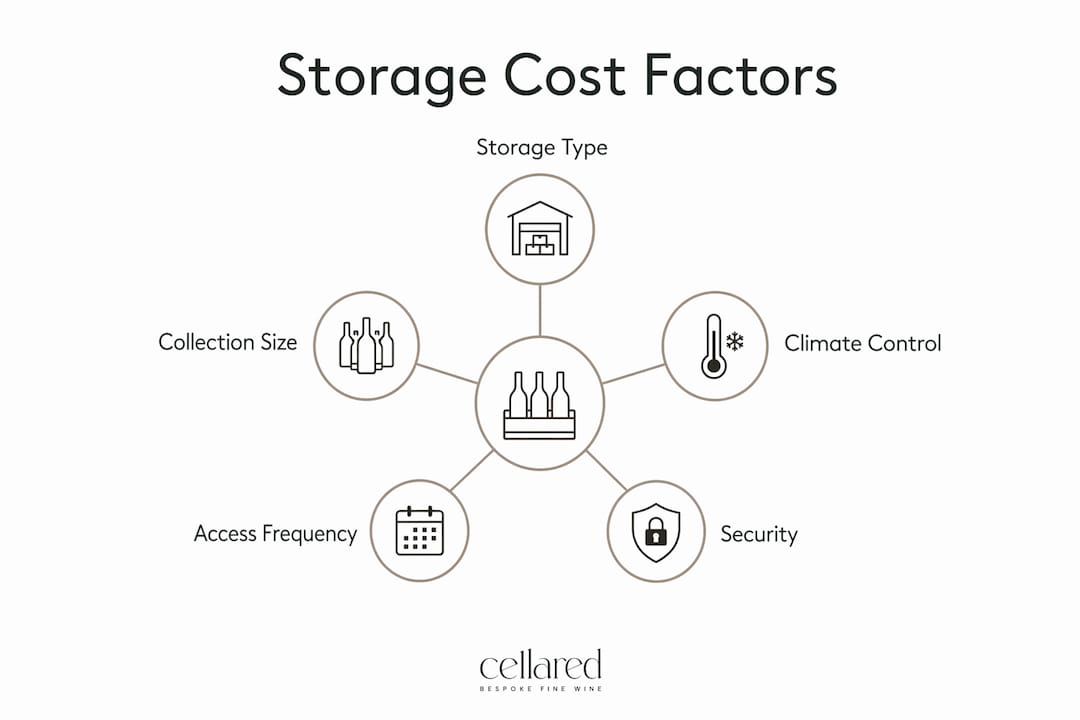
Storage type is the most significant driver. A home wine fridge and a professional bonded warehouse represent opposite ends of the cost and quality spectrum. The environment each provides differs considerably, and that difference carries a price.
Collection size directly affects cost at professional facilities, where per-case annual pricing ranges from $3 to $20, excluding additional fees. Larger collections attract volume considerations, but the base rate per case rarely disappears entirely.
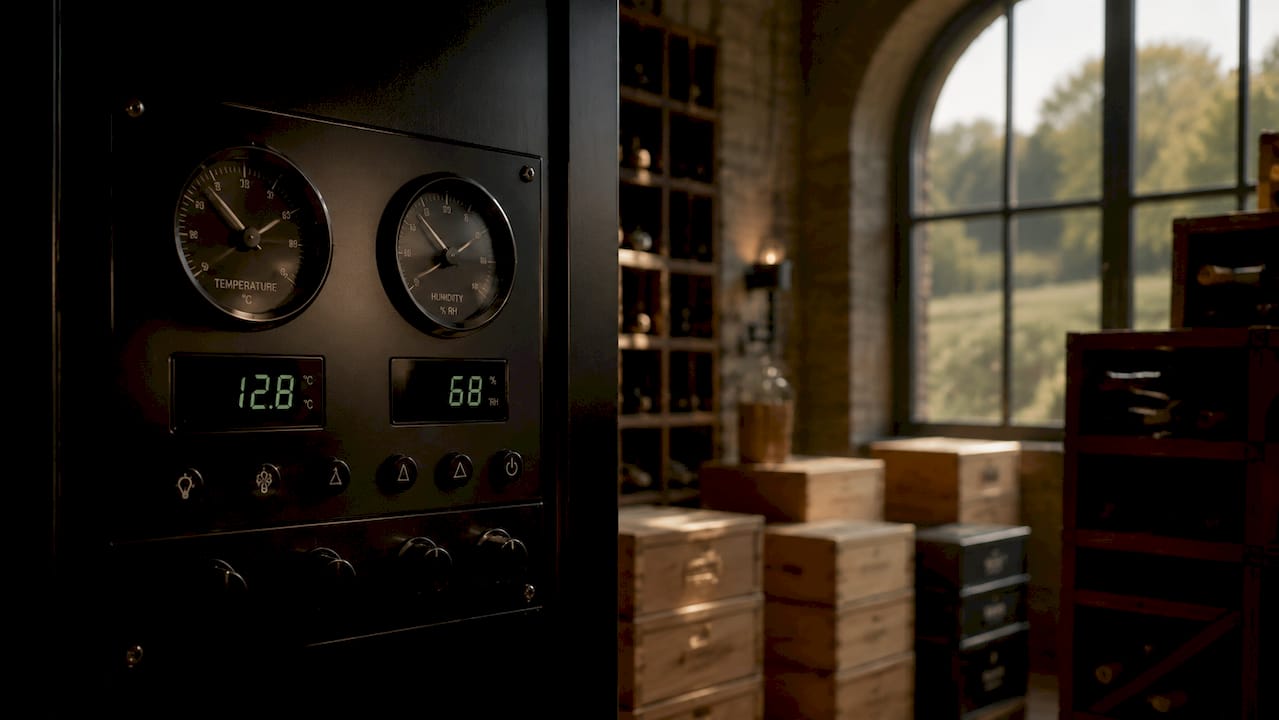
Climate control quality is the primary factor separating generic storage from a true wine cellar. Facilities maintaining a stable temperature of approximately 13°C and humidity between 60–70% charge more, but they protect wine quality over the long term. Cutting corners on climate control is the single most common and costly mistake collectors make.
Access frequency adds operational fees that accumulate quickly. Frequent access leads to higher retrieval and handling charges, particularly at professional facilities with concierge-style services.
Security and insurance are non-negotiable for any collection of meaningful value. Security infrastructure raises facility costs, and those costs are passed on through monthly fees.
Hidden fees include setup charges, transport, cataloguing, and retrieval. These are rarely advertised upfront and can materially alter your wine storage budget.
Pro Tip: Ask any professional facility for a full fee schedule in writing before signing. Request a breakdown of retrieval, handling, and cataloguing charges separately from the base monthly rate.
Home storage vs professional wine storage facilities: which costs more?
The choice between a home unit and a professional wine storage facility is not simply about price. It is about what you are protecting and for how long.
| Feature | Home wine fridge | Professional facility |
|---|---|---|
| Upfront cost | $150–$8,000 | Nil to low setup fee |
| Monthly cost | Electricity and maintenance | $49–$400 depending on unit size |
| Climate control | Variable; dependent on unit quality | Consistent; purpose-built |
| Security | Limited | High; monitored and insured |
| Provenance documentation | None | Audit trail provided |
| Best suited for | Small to medium casual collections | Investment-grade or large collections |
Home wine fridges range from countertop units costing $150–$800 to multi-zone professional-grade models reaching $5,000. Large-capacity freestanding units cost $1,500–$8,000 upfront, with annual operating costs of $300–$800 for electricity and maintenance. That ongoing overhead is easy to underestimate when budgeting.
Professional facilities offer small lockers from $49–$150 per month and larger dedicated units from $150–$400 per month. The environment is purpose-built, monitored continuously, and backed by documented storage records. For collectors holding bottles as assets, that documentation is not a luxury. It is a prerequisite for resale.
Pro Tip: If your collection includes any bottles purchased as investments, a professional facility's audit trail will protect their resale value far more effectively than even the finest home unit.
The honest comparison is this: home storage suits the casual collector who drinks regularly from a modest selection. Professional storage suits anyone whose collection represents a financial commitment they intend to protect or eventually sell.
What additional expenses should collectors budget for?
Beyond the base monthly or annual storage rate, several supplementary costs shape the true cost of wine storage. Hidden and operational fees can double or triple the visible storage cost depending on access frequency and facility policies.
The key additional expenses to account for include:
- Insurance. Insurance based on collection replacement value runs $1–$3 per $1,000 of collection value per month. A collection worth $50,000 could attract $50–$150 in monthly insurance premiums alone. A dedicated guide to wine cellar insurance is worth consulting before selecting a policy.
- Transport and handling. Moving wine between locations or into a new facility costs $200–$500 depending on volume and distance. Specialist wine transport is not optional for fragile or high-value bottles.
- Security deposits. Professional facilities typically require a deposit of $50–$200 at setup.
- Electricity and maintenance for home units. Annual operating costs of $300–$800 apply to large home fridges and are often overlooked in initial budgeting.
- Retrieval and cataloguing fees. Facilities that manage inventory on your behalf charge for each retrieval, particularly when access is frequent.
- Setup and onboarding fees. Some facilities charge a one-time fee to receive, inspect, and log your collection on arrival.
Insurance must be calculated on the total replacement value of the collection, not merely bottle count. A collector who insures by bottle number rather than market value risks significant underinsurance.
How to choose the right storage option for your collection
The right wine storage solution depends on collection size, collecting goals, and how frequently you access your bottles. A structured approach prevents overspending on features you do not need and underspending on protection you cannot afford to skip.
-
Assess your collection size honestly. A collection of fewer than 50 bottles is well served by a quality home wine fridge in the $800–$2,000 range. Collections of 100 bottles or more benefit from the consistent environment of a professional facility.
-
Define your collecting goal. Casual collectors who drink regularly from their cellar prioritise accessibility. Investment collectors prioritise provenance, security, and climate consistency. These goals point to different storage solutions and very different wine storage fees.
-
Consider how often you need access. Frequent access at a professional facility attracts retrieval fees. If you plan to open bottles weekly, a home unit may be more cost-effective despite its limitations.
-
Evaluate bonded warehouse storage for investment-grade wines. Bonded storage allows suspension of VAT and duty payments, improving capital efficiency for collectors holding wine as a financial asset. This is a material advantage that generic storage cannot replicate.
-
Match the facility's climate control to your wine's needs. Fine wines from Burgundy, Bordeaux, and Barolo require stable temperature and humidity to reach their full potential. A facility that cannot guarantee 13°C and 60–70% humidity is not suitable for serious collections.
-
Budget for the full cost, not just the headline rate. Use the additional expenses outlined above to build a realistic wine storage budget before committing to any solution. The wine storage relocation guide from Cellared Fine Wine covers transport and transition costs in detail for collectors moving between solutions.
What is the long-term value impact of proper wine storage?
Proper storage is not a cost centre. It is a value-preservation mechanism, and the financial consequences of inadequate storage are severe and often irreversible.
"Provenance and documented temperature-controlled storage increase a bottle's resale value and market trust." — The importance of wine storage for collectors
Professional wine storage provides an audit trail that is crucial for provenance, directly affecting resale value and market trust. A bottle of Penfolds Grange or Domaine de la Romanée-Conti stored in a facility with documented temperature records commands a meaningfully higher price at auction than the same bottle with no storage history. Buyers and auction houses treat provenance as a proxy for quality.
Inadequate storage accelerates oxidation, disrupts tannin development, and collapses a wine's drinking window prematurely. A bottle of Barolo that should evolve gracefully over 20 years can be rendered undrinkable in five by poor temperature management. The financial loss is compounded by the irreplaceable nature of aged wine.
Viewing storage costs as an investment in a wine's drinking window and market value helps collectors prioritise spending effectively. The $150 per month spent on professional storage for a $30,000 collection represents a fraction of the value being protected.
Pro Tip: Request a written temperature and humidity log from any professional facility before committing. Reputable operators maintain these records as standard practice and will share them without hesitation.
Key takeaways
Proper wine storage is an investment in quality and value, not merely an overhead expense. Collectors who budget accurately for all costs, including insurance, transport, and hidden fees, protect both the drinking experience and the financial return of their collection.
| Point | Details |
|---|---|
| Base storage costs vary widely | Professional facilities charge $49–$400 per month; home units cost $150–$8,000 upfront plus $300–$800 annually. |
| Climate control drives price and quality | Facilities maintaining 13°C and 60–70% humidity cost more but protect wine quality over the long term. |
| Hidden fees can double your bill | Retrieval, cataloguing, transport, and insurance add significantly to the visible monthly rate. |
| Provenance adds resale value | Documented professional storage increases a bottle's market trust and auction price. |
| Match storage to your collecting goal | Investment collectors need bonded or professional facilities; casual collectors may manage well with a quality home unit. |
The case for treating storage as part of the wine itself
I have seen collectors spend extraordinary sums on exceptional bottles and then store them in conditions that would embarrass a budget self-storage operator. The logic seems to be that the cost of the wine is the real investment and storage is just a footnote. That thinking is wrong, and it is expensive.
The most common mistake I observe is underinsuring. Collectors calculate insurance on what they paid for a bottle, not what it would cost to replace it at current market prices. For wines that have appreciated significantly since purchase, that gap can be enormous. Insurance must reflect replacement value, full stop.
The second mistake is treating professional storage as a luxury rather than a baseline requirement for any collection intended for resale or long-term ageing. The audit trail a reputable facility provides is worth more than the monthly fee many times over when a bottle reaches the auction room.
My advice is to build your wine storage budget before you build your collection. Know what you will spend on storage annually, include insurance and transport, and then decide how much remains for the wine itself. That discipline separates collectors who protect their investment from those who discover, too late, that they have been paying for storage that was never adequate.
— David
How Cellared Fine Wine supports your storage decisions

Cellared Fine Wine works with collectors at every stage of building and managing a collection, from sourcing rare bottles to managing the full cost of wine storage with clarity and confidence. The team at Cellared provides bespoke cellar management services that cover storage strategy, insurance guidance, and access to professional storage partnerships suited to collections of all sizes. For collectors who want an independent, market-led view of their collection's value, Cellared also offers professional wine valuations for insurance, probate, and private advisory purposes. Contact Cellared Fine Wine at cellaredfinewine.com.au to discuss a storage and management approach tailored to your collection and budget.
FAQ
What is a typical wine storage cost per month?
Professional wine storage facilities charge $49–$150 per month for small lockers and $150–$400 per month for larger units. Home wine fridges carry lower monthly costs but require an upfront investment of $150–$8,000 depending on capacity.
What is a wine storage facility?
A wine storage facility is a purpose-built, climate-controlled environment designed to preserve wine collections under stable temperature and humidity conditions. Professional facilities also provide security, insurance options, and provenance documentation.
Are there hidden fees in wine storage pricing?
Retrieval, cataloguing, transport, and setup fees are common additional charges that are not always included in advertised monthly rates. Hidden and operational fees can double or triple the visible storage cost depending on access frequency.
How much does wine cellar insurance cost?
Wine cellar insurance typically costs $1–$3 per $1,000 of collection replacement value per month. Insurance must be calculated on the current market replacement value of the collection, not the original purchase price.
When does bonded warehouse storage make sense?
Bonded warehouse storage makes sense for investment-grade wines where deferring VAT and duty payments improves capital efficiency. It also provides the provenance documentation that auction houses and private buyers require for high-value transactions.