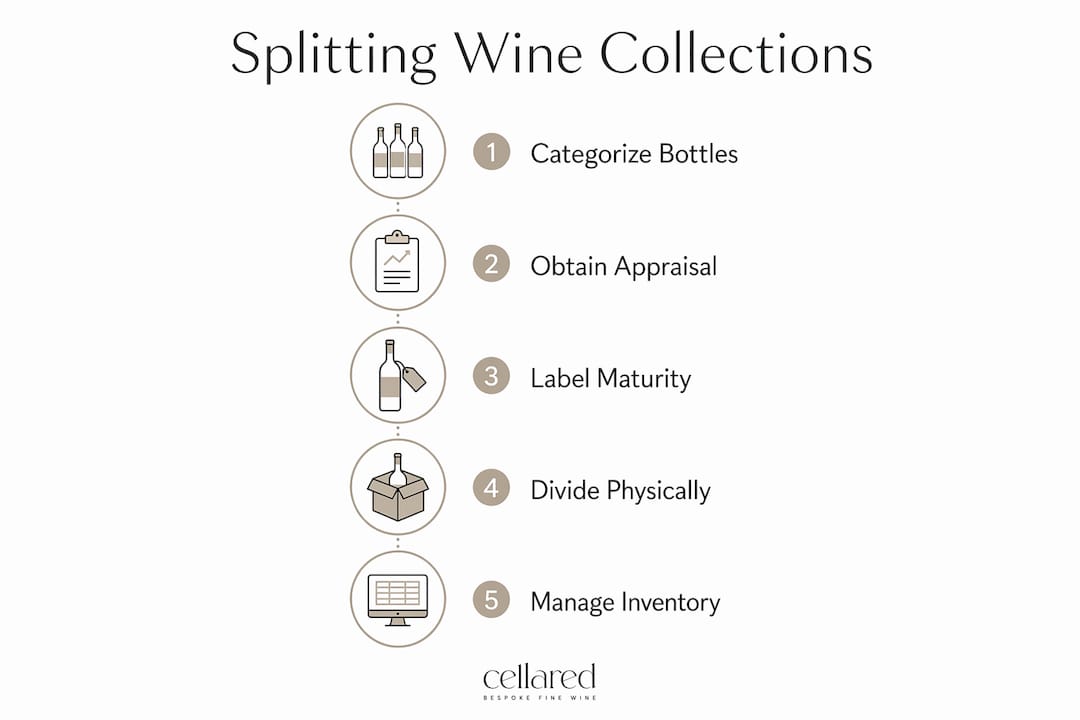
Splitting a wine collection is defined as the structured process of equitably dividing a shared or jointly owned cellar into two or more independent, self-sustaining collections. Whether the division arises from a separation, estate settlement, or the dissolution of a shared investment, knowing how to split wine collections correctly protects both financial value and drinking utility. The process requires three core disciplines: organising bottles by maturity horizon, obtaining independent market valuations, and maintaining a verified digital inventory at the point of division. Done well, a split is not a loss. It is a reorganisation that gives each party a coherent, balanced cellar to enjoy and manage with confidence.
How to split wine collections using maturity zones
The most overlooked element in dividing wine collections is drinking utility. Treating all bottles as equal financial assets ignores the fact that a case of 2010 Barolo Riserva and a case of 2022 Pinot Grigio represent entirely different propositions for the person who receives them.
Professional inventory audits classify every bottle into one of three maturity zones. Understanding these zones is the foundation of any fair split:
- Drinking Zone (0–3 years): Bottles ready to open now. These carry immediate utility and are the most liquid assets in a cellar. Examples include young whites, entry-level Burgundy, and approachable New World reds.
- Development Zone (3–10 years): Bottles that need time but are approaching their window. Mid-tier Bordeaux, aged Riesling, and structured Rhône reds typically sit here.
- Long-Hold Zone (10+ years): Bottles requiring patience. Grand Cru Burgundy, top-tier Barolo, and classified Bordeaux châteaux often fall into this category. They carry the highest future value but the lowest immediate usability.
Categorising bottles by maturity horizons prevents uneven splits where one party inherits only long-term storage assets while the other walks away with all the drinking pleasure. A split that ignores this dynamic is rarely perceived as fair, regardless of what the numbers say.
A practical allocation model is the 1:1:2 ratio of long-hold, development, and drinking zone bottles respectively. This ratio gives each new collection a self-sustaining pipeline: bottles to open now, bottles maturing toward readiness, and bottles building long-term value.
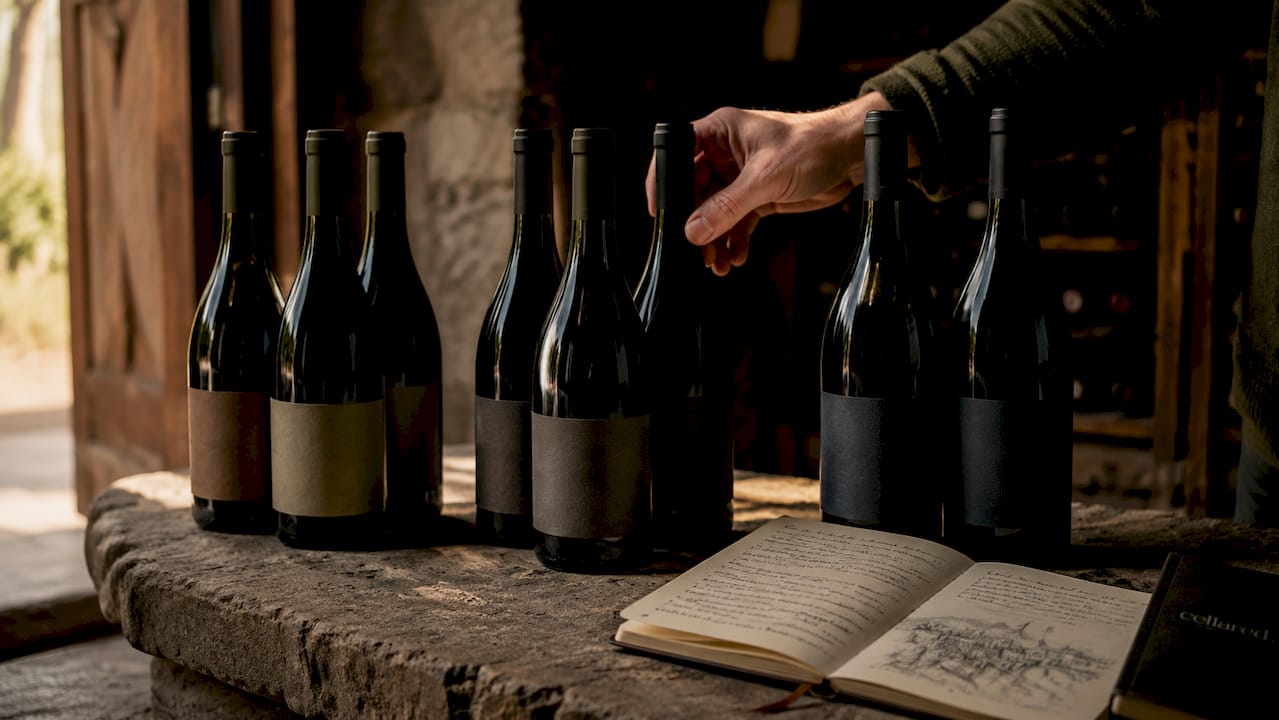
Pro Tip: Label each bottle or bin with its maturity zone before the split begins. A simple colour-coded sticker system applied during the audit phase saves hours of confusion during physical division.
Organising your cellar by maturity zones also makes the physical logistics far cleaner. When bottles are grouped by zone rather than by region or producer, each party can see at a glance what they are receiving across the full drinking spectrum.
Why professional appraisal is non-negotiable before dividing
The original purchase price of a bottle is almost never its current market value. For a 2005 Pétrus or a magnum of DRC Romanée-Conti, the gap between what was paid and what the market will bear today can be extraordinary. Independent market valuations supersede purchase price or emotional value for legal and personal fairness in splitting collections.
Follow these steps to obtain a credible appraisal before any division proceeds:
- Commission an independent appraiser. Select a specialist with demonstrable fine wine market knowledge and no financial interest in the outcome. Cellared Fine Wine provides court-ready wine valuations based on current market replacement values, which are accepted in family law, probate, and private advisory contexts.
- Request a full written report. The report should list every bottle by producer, vintage, format, condition, and current market value. Verbal estimates are not sufficient for legal or contested divisions.
- Distinguish replacement value from auction estimate. Replacement value reflects what it would cost to buy the same bottle today. Auction estimate reflects what it might fetch at sale. These figures differ, and the correct metric depends on the purpose of the split.
- Freeze consumption and movement before appraisal begins. Any bottle removed from the cellar between the decision to split and the completion of the appraisal creates a discrepancy that is difficult to resolve fairly.
Emotional or historical prices cause disputes in contested cases. An independent, market-led appraisal removes subjective attachment from the equation and gives both parties a shared factual foundation.
Pro Tip: Ask your appraiser to note the provenance and storage history of significant bottles. Provenance directly affects market value, and a well-documented collection commands a premium at resale.
Managing digital inventories when splitting wine collections
A verified digital inventory is the paper trail that protects both parties after a split. Platforms like CellarTracker and BinWise allow collectors to track bottles by producer, vintage, bin location, purchase price, and drinking window. The critical step is capturing a point-in-time export at the exact moment of division.
Key practices for managing digital inventories during a split:
- Export a complete CSV or Excel snapshot of the entire collection before any bottles move. This creates an unalterable record that both parties can reference if disputes arise later.
- Do not rely on shared account access post-division. Sharing a master digital cellar account after the split risks data contamination. If one party adds, removes, or edits entries, the shared record becomes unreliable for both.
- Reconcile physical bottles against digital records before the export is finalised. Ghost bottles, those listed in the system but no longer physically present, are a common source of conflict.
- Archive the snapshot permanently. Both parties should retain a copy of the original export in a format that cannot be edited, such as a PDF printout or a locked spreadsheet.
The table below summarises the key digital inventory steps and their purpose:
| Step | Tool or Method | Purpose |
|---|---|---|
| Full inventory export | CellarTracker, BinWise (CSV/Excel) | Creates unalterable division record |
| Physical reconciliation | Manual audit against digital list | Eliminates ghost bottles |
| Consumption freeze | Agreed protocol between parties | Prevents inventory discrepancies |
| Separate account creation | New CellarTracker or BinWise accounts | Maintains clean post-split data |
| Permanent archive | PDF or locked spreadsheet | Legal and personal reference |
Using professional inventory software such as BinWise improves accuracy and control as collections grow. Manual systems fail at scale, and a split is precisely the moment when accuracy matters most.
How to physically divide and transport a wine collection safely
Physical handling is where value is most easily lost. A bottle of aged Burgundy that travels without proper packaging or arrives at a facility without climate control can lose a significant portion of its market value within a single season.
Follow this sequence to manage the physical division with care:
- Assess storage conditions at each new location first. Maintaining storage stability at 13°C (55°F) and 60–70% humidity is the baseline requirement. If either new location cannot meet this standard, arrange professional storage before any bottles move.
- Use specialist wine transport. Standard removal companies are not equipped for fine wine. Use a temperature-controlled vehicle and purpose-built wine shipping cartons with individual bottle dividers.
- Move bottles during cooler months where possible. Heat is the primary enemy of wine in transit. If a summer move is unavoidable, schedule transport for early morning and use refrigerated vehicles.
- Maintain provenance documentation through the move. Each bottle's storage history should travel with it. A gap in provenance records reduces the bottle's credibility at resale or auction.
- Rebuild the digital inventory in each new location immediately after arrival. Update bin locations and storage details in CellarTracker or BinWise before any consumption begins.
Pro Tip: Photograph each case before it leaves the original cellar and again upon arrival at its new location. This photographic record protects against transit damage claims and supports provenance documentation.
Collectors consistently underestimate the management overhead of dividing collections across new locations. Planning the physical move with the same rigour applied to the valuation phase is what separates a successful split from a costly one.
What are the most common mistakes when dividing wine collections?
Most errors in splitting wine collections are not financial. They are procedural. The following pitfalls account for the majority of disputes and value losses:
- Emotional attachment distorting value perception. A bottle gifted by a mentor or purchased on a memorable trip carries personal significance that has no bearing on its market value. Allowing sentiment to drive allocation decisions produces splits that feel unfair to both parties.
- Ignoring drinking utility in favour of bottle count or dollar value. A split that gives one party 50 bottles of aged Barolo and the other 50 bottles of young Champagne may be equal on paper but deeply unequal in practice.
- Failing to freeze consumption during the division phase. Implementing a freeze period on consumption and movement during division is the single most effective way to prevent inventory discrepancies. Without it, bottles disappear and disputes follow.
- Neglecting storage environment at the receiving location. A collection that has been stored impeccably for a decade can be compromised in weeks if the new storage environment is inadequate.
- Rushing the process. A thorough split of a significant collection takes time. Compressing the timeline to meet an arbitrary deadline introduces errors at every stage.
"The most costly mistakes in wine collection splits are not made at the negotiating table. They are made in the weeks before and after, when no one is paying attention to the cellar."
Treating the division as a cellar reorganisation project rather than a liquidation event reframes the entire process. The goal is not to end a collection. It is to create two collections that are each capable of sustaining enjoyment and value over time.
Key takeaways
Splitting a wine collection equitably requires organising bottles by maturity zone, obtaining independent market valuations, and exporting a verified digital inventory at the point of division.
| Point | Details |
|---|---|
| Organise by maturity zone | Classify every bottle into drinking, development, or long-hold zones before any division begins. |
| Commission independent appraisal | Use current market replacement values, not purchase prices, to establish a fair and defensible basis for division. |
| Export a digital snapshot | Generate a complete CSV or Excel inventory export at the moment of division to create an unalterable record. |
| Freeze consumption immediately | Stop all bottle movement and consumption as soon as a split is agreed to prevent inventory discrepancies. |
| Protect physical handling | Use specialist wine transport and confirm climate-controlled storage at each new location before bottles move. |
A split is a beginning, not an ending
I have worked with collectors at every stage of a cellar's life, and the ones who approach a split with dread almost always share the same misconception. They see division as dismantling something they built. The collectors who navigate it well see it differently. They treat it as the moment two coherent, purposeful collections are born from one.
The most common error I observe is the rush to resolve the financial question while ignoring the drinking utility question entirely. A party who receives $200,000 worth of bottles that will not be ready to drink for a decade has received something very different from a party who receives $200,000 worth of bottles they can open tonight. Both figures are accurate. Neither split is fair without accounting for that distinction.
The second error is underestimating how much the process depends on documentation. Collectors who have managed their cellars through CellarTracker or BinWise for years sometimes assume their digital records are sufficient. They are a starting point, not a finish line. A physical reconciliation, a consumption freeze, and a permanent export are what transform a good digital record into a legally defensible one.
My advice is always the same: slow down, document everything, and bring in professionals for the appraisal and the physical move. The cost of doing it properly is a fraction of the cost of doing it twice.
— David
How cellared fine wine supports wine collection splits
Cellared Fine Wine works with collectors, investors, and estates navigating the full complexity of collection division. From professional wine appraisals based on current market replacement values to bespoke cellar management that keeps both new collections performing after the split, the team brings deep market knowledge to every stage of the process.
Whether you need a court-ready valuation for a family law matter, a comprehensive inventory audit before division, or ongoing cellar management services to protect the value of your new collection, Cellared Fine Wine provides the expertise and personal attention the process demands. Contact the team at Cellared Fine Wine to discuss your situation and arrange a consultation.
FAQ
What does it mean to split a wine collection fairly?
A fair split accounts for both the current market value and the drinking utility of each bottle. Dividing by bottle count or dollar value alone ignores the critical difference between bottles ready to drink now and those requiring a decade of further ageing.
How do maturity zones help when dividing wine collections?
Maturity zones classify bottles into drinking, development, and long-hold categories. Allocating proportionate quantities from each zone to both parties ensures neither receives a collection that is all investment and no enjoyment, or vice versa.
Do i need a professional appraisal to split a wine collection?
A professional appraisal based on current market replacement value is the only reliable basis for a fair and legally defensible split. Original purchase prices are almost always inaccurate reflections of what a collection is worth today.
What is a consumption freeze and why does it matter?
A consumption freeze is an agreed halt on all bottle movement and consumption from the moment a split is decided until the inventory is finalised. Without it, bottles disappear from the record and create disputes that are difficult to resolve.
Can i use CellarTracker to manage a wine collection split?
CellarTracker supports data exports and account sharing, but sharing a master account post-division risks data contamination. The correct approach is to export a complete CSV snapshot at the point of division and create separate accounts for each party going forward.