A fine wine collection is not simply a cellar stocked with expensive bottles. It is an exercise in strategic thinking, meticulous record-keeping, and a deep understanding of how markets, provenance, and sentiment interact to shape real-world value. Many collectors enter this world with enthusiasm, only to discover that the most costly mistake is not buying the wrong wine but managing it poorly once it arrives. This guide cuts through the misconceptions, clarifying how collections are valued, why provenance is as vital as the wine itself, and how to build and maintain a portfolio that commands genuine market confidence.
Table of Contents
- What truly makes a wine collection valuable?
- How wine collections are valued: Key methods and frameworks
- Why provenance is non-negotiable: The foundation of trust
- Smart strategies for sourcing, acquiring, and managing rare bottles
- The overlooked realities of collecting: Why passion and precision both matter
- Get expert help to maximise your collection's potential
- Frequently asked questions
Key Takeaways
| Point | Details |
|---|---|
| Provenance drives value | A bottle's origin, storage, and history are as crucial as its label or vintage. |
| Valuation is both art and science | Market data matters, but collector sentiment and market fashion often shift final pricing. |
| Good records mean better sales | Collections with complete documentation and storage audit trail command higher prices. |
| Strategic sourcing protects investment | Vetting sources and using brokers help you avoid fakes and secure true rarity. |
What truly makes a wine collection valuable?
With the stage set, let us clarify exactly what turns a group of bottles into a collection with real, lasting value.
Most collectors instinctively associate value with price. A bottle of 1996 Petrus or a case of Penfolds Grange from a celebrated vintage feels valuable simply because it carries a high market tag. But professional valuers, auction specialists, and serious buyers look far beyond the label. They are assessing a constellation of factors that together determine what a collection is actually worth in the market, and what it will continue to be worth over time.
The key drivers of rare wine value include the following core elements:
- Provenance: The verifiable history of a bottle, from producer to purchaser, including every point of custody in between.
- Storage conditions: Whether the wine has been kept at consistent temperature and humidity, free from light and vibration, in appropriate cellaring environments.
- Rarity: Limited production volumes, single-vineyard designations, aged library releases, and discontinued labels all restrict supply and elevate desirability.
- Market depth: How liquid a particular wine is across auction platforms, private sales, and secondary markets.
- Cultural status: The prestige accorded to a region, producer, or vintage by critics, collectors, and the broader fine wine community.
- Collector sentiment: The emotional and reputational weight attached to particular bottles, which can shift quickly with changing tastes.
"When sourcing rare bottles, provenance and storage history are repeatedly treated as key drivers of buyer confidence and hence saleability and value."
What this means in practice is that a well-stored, fully documented case of a moderately priced Burgundy can outperform, at sale, a poorly documented case of a celebrated Napa Cabernet. Saleability hinges on trust, and trust is built through evidence. Even the most coveted wines in the world suffer discounts when provenance is absent or incomplete, because buyers cannot confirm that what is in the bottle matches what is on the label or that the wine has been cared for as it deserves.
Value is also not static. Markets breathe. Collector sentiment towards particular regions, grape varieties, and even vintages ebbs and flows with critical opinion, cultural trends, and economic cycles. A collection assembled purely for its perceived prestige today may not command the same enthusiasm a decade from now, which is why a clear-eyed view of both objective metrics and shifting sentiment is essential for every serious collector.
How wine collections are valued: Key methods and frameworks
Now that we know what shapes value, it is time to see how professionals actually calculate and justify those numbers.
Wine valuation is part science, part art. It draws on structured methodologies and yet remains responsive to nuance and context in ways that distinguish it from conventional asset appraisal. Understanding current valuation standards equips collectors to prepare their collections properly and to interrogate any appraisal they receive.
The primary valuation methods
| Method | What it measures | Best used for |
|---|---|---|
| Auction comparables | Recent hammer prices for identical or similar bottles | Broadly traded wines with active secondary markets |
| Market index data | Price trends across tracked fine wine categories | Portfolio-level trend analysis and insurance |
| Private sale data | Negotiated prices between collector and buyer | Rarer bottles with limited auction history |
| Replacement value | Current retail cost to re-acquire | Insurance appraisals |
| Liquidation value | Achievable price in a forced or rapid sale | Estate and probate purposes |
The choice of method matters enormously depending on the purpose. An insurance appraisal requires a different lens to a probate valuation, and a private advisory assessment for a potential sale is different again. Valuation is not purely objective: even when professionals apply indices and auction comparables, collector sentiment and cultural status can shift what buyers will pay for scarce bottles.
Preparing your collection for appraisal
A thorough valuation checklist makes the entire process smoother and more accurate. Follow these steps before engaging a valuer:
- Compile all purchase documentation, including original invoices, receipts, and any certificates of authenticity.
- Record storage history, noting the type of facility used, temperature logs where available, and any movements or transport events.
- Photograph labels, capsules, and fill levels, as these influence condition assessments.
- Note drinking windows for each wine, since maturity relative to peak consumption directly affects current market interest.
- Research recent auction results for your key bottles to arrive with a working understanding of prevailing market prices.
- Identify any bottles with incomplete records, and prepare to be transparent about gaps, since an honest appraisal accounts for these rather than ignoring them.
Pro Tip: Track market index movements in your specific categories over at least six months before scheduling a valuation. Timing an appraisal during a period of strong demand for your key producers can meaningfully influence the assessed value, particularly for insurance or advisory purposes.
The quality of documentation you bring to an appraisal directly determines how confidently a valuer can support their assessment in court, before insurers, or in a private negotiation. A professionally presented collection with complete records is a stronger asset in every sense.
Why provenance is non-negotiable: The foundation of trust
Understanding value on paper is one thing. Building buyer trust often comes down to the details that only provenance provides.
Provenance in fine wine refers to the complete, verifiable history of a bottle or case from the moment it left the producer. It encompasses not just who originally purchased the wine but how it was transported, where it has been stored, under what conditions, and through whose hands it has passed. For collectors and investors, provenance is not merely a bureaucratic nicety. It is the single most powerful factor determining whether a wine sells confidently and at full value.
The role of provenance becomes especially clear when you compare two hypothetical bottles of the same wine:
| Factor | Bottle A: Full provenance | Bottle B: Incomplete record |
|---|---|---|
| Purchase documentation | Original invoice, dated and itemised | Unknown |
| Storage conditions | Professional cellar, temperature-logged | Home storage, undocumented |
| Transport records | Climate-controlled freight, documented | Unknown |
| Current fill level | Excellent | Acceptable |
| Market confidence | High; commands full or premium price | Moderate; subject to discount |
| Saleability | Immediate, multiple buyers | Slower, fewer buyers |
The contrast is stark. Provenance, including storage history and documentation, maturity relative to the drinking window, and market depth are among the most carefully scrutinised valuation components in every professional assessment.
Essential provenance records every collector should maintain
- Original purchase invoices from the producer, négociant, auction house, or retailer
- Shipping documentation, especially for wines imported from overseas, noting transport method and temperature controls
- Storage facility records, including entry and exit dates, temperature and humidity logs, and any third-party audit reports
- Tasting notes or drinking window assessments from recognised critics, particularly for aged wines approaching peak maturity
- Photographic records of labels, capsules, cork conditions (where applicable), and fill levels at key intervals
Pro Tip: If you are using wine storage strategies at a professional facility, request annual condition reports and keep digital copies alongside your purchase documentation. This single habit can protect and enhance collection value significantly over time.
Verification is the final piece. Third-party audits, specialist storage with tracking systems, and the involvement of reputable brokers in the acquisition process all reinforce provenance claims. In a market where counterfeiting, mislabelling, and undisclosed re-corking remain genuine concerns, independent verification carries real weight.
Smart strategies for sourcing, acquiring, and managing rare bottles
Armed with this understanding of value and trust, collectors can translate knowledge into practical steps that grow and protect their collection.
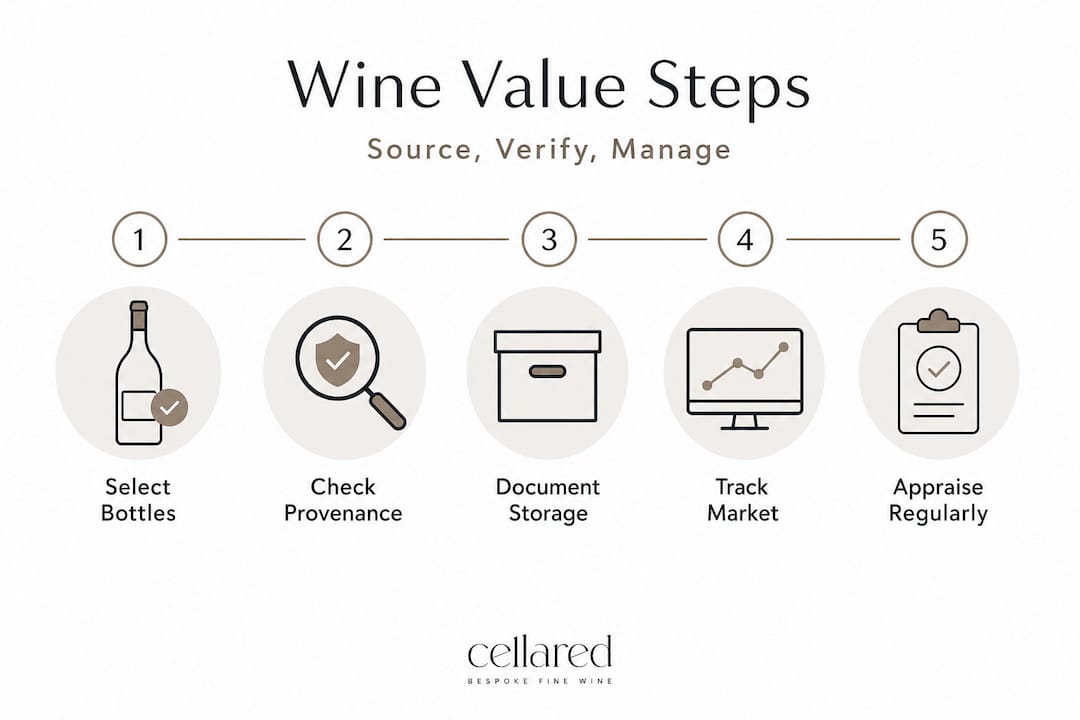
Sourcing rare wine is not merely a matter of finding what you want. It is a disciplined process of identifying, vetting, and integrating bottles that add genuine depth and value to an existing collection. The following steps reflect best practice for serious collectors.
A step-by-step approach to acquiring rare bottles
- Define your acquisition criteria clearly before approaching the market. Know which producers, regions, vintages, and formats align with your collection's direction.
- Engage reputable sources: established auction houses, specialist brokers, and licensed retailers with transparent provenance records. Buying rare wine through verified channels reduces the risk of acquiring undocumented or compromised stock.
- Request full provenance documentation as a condition of purchase. If a seller cannot provide a credible chain of custody, treat this as a serious red flag regardless of the label's appeal.
- Inspect condition independently where possible, paying attention to fill levels, label integrity, capsule condition, and any evidence of seepage or heat damage.
- Integrate new acquisitions into your storage and record-keeping systems immediately, assigning catalogue entries with acquisition date, source, cost, and condition notes.
- Review your portfolio building strategy regularly, assessing whether new acquisitions complement existing holdings or introduce redundancy.
Common mistakes that cost collectors value
- Skipping provenance verification because the seller is known or trusted informally
- Storing newly acquired bottles alongside existing stock before confirming condition and provenance
- Neglecting to update insurance valuations after significant acquisitions or after market shifts
- Over-concentrating a collection in a single region or producer without considering market liquidity
- Failing to account for drinking windows, which affect both current value and the urgency of any sale or consumption decision
Pro Tip: For bottles that are genuinely difficult to source through standard channels, specialist brokers with established networks among private collectors, estates, and international producers can access stock that simply does not reach the open market. Their expertise in verification also adds a valuable layer of due diligence that independent buyers rarely achieve alone.
Smart management is an ongoing discipline, not a one-time arrangement. Quarterly cellar audits, annual valuation updates, and routine review of drinking windows ensure that a collection remains purposeful, well-documented, and positioned for maximum realisable value at any point in time.
The overlooked realities of collecting: Why passion and precision both matter
After exploring the practical dimensions of wine collecting, it is worth pausing to reflect on what most conventional guides quietly overlook.
Much of the advice available to collectors focusses, rightly, on methodology: document everything, store correctly, buy from reputable sources. These principles are sound and non-negotiable. But they address only part of what makes a wine collection genuinely significant and enduring. The other part is harder to quantify but no less real. It is the collector's own vision, formed through years of tasting, reading, and relationship-building within the fine wine world.
The most valuable collections we encounter are rarely the ones assembled by following a formula. They are the ones that reflect a coherent point of view. A collector who has deeply studied a particular region or producer, who understands what sets collectible wines apart from the merely expensive, and who has assembled their cellar with both rigour and personal conviction brings something to that collection that no market index can replicate.
What most guides also underplay is how rapidly sentiment can shift, even around wines with impeccable credentials. The fine wine market is not immune to fashion. Regions that commanded extraordinary premiums a decade ago have cooled, while others have risen dramatically on the back of critical attention and changing collector demographics. A collection built with methodical record-keeping and genuine passion will weather these cycles far better than one assembled on price alone, because it is grounded in an understanding that transcends the current moment.
Discipline and feeling are not opposites in this world. The most successful collectors hold both in careful balance, and that balance is precisely where lasting value lives.
Get expert help to maximise your collection's potential
To take the next step in building, valuing, or safeguarding your collection, expert support can accelerate your knowledge and amplify results.
Managing a fine wine collection at the level it deserves requires more than enthusiasm and good intentions. It requires access to professional expertise, independent market knowledge, and the kind of meticulous documentation that gives collectors and their advisers real confidence.
Cellared Fine Wine offers professional wine appraisals that are market-led, court-ready, and tailored to the specific purpose, whether for insurance, probate, family law, or private advisory needs. Our bespoke cellar management service ensures that every bottle in your care is catalogued, stored, and reviewed with the rigour your collection merits. If you are looking to source rare and hard-to-find bottles, or simply want a clearer picture of what your collection is worth today, we are here to help you buy well, value accurately, and manage with confidence.
Frequently asked questions
How important is documentation for selling my wine collection?
Thorough documentation proving provenance and storage conditions can significantly increase sale price and buyer confidence, as provenance and storage history are key drivers of value in every professional assessment.
What are the most common mistakes new collectors make?
Failing to verify provenance and using improper or undocumented storage are the top pitfalls, since buyer confidence hinges directly on these two factors above all others.
How often should a wine collection be revalued?
Best practice is to revalue your collection annually or whenever significant market shifts occur, particularly for rare or high-value bottles whose pricing is most sensitive to market movements.
Is there a minimum size to start a valuable wine collection?
No, even a small, carefully curated collection with impeccable provenance and professional storage can command strong market interest and significant value relative to its size.
What steps improve a collection's saleability the most?
Maintaining detailed provenance records and investing in professional, documented storage deliver the greatest impact on saleability, as storage and provenance history are the factors buyers and auction specialists scrutinise most closely before committing to a purchase.