Proper wine storage is the single most decisive factor in determining whether a fine wine appreciates or deteriorates as an investment. The industry term for this discipline is cellaring, and it encompasses every environmental and logistical decision made from the moment a bottle leaves the producer. Temperature, humidity, light, vibration, closure type, and provenance documentation all shape a wine's chemical evolution and its eventual market value. For collectors and investors who understand the role of storage in wine returns, the cellar is not merely a holding space. It is where value is either built or quietly destroyed.
What are the optimal environmental conditions for wine storage?
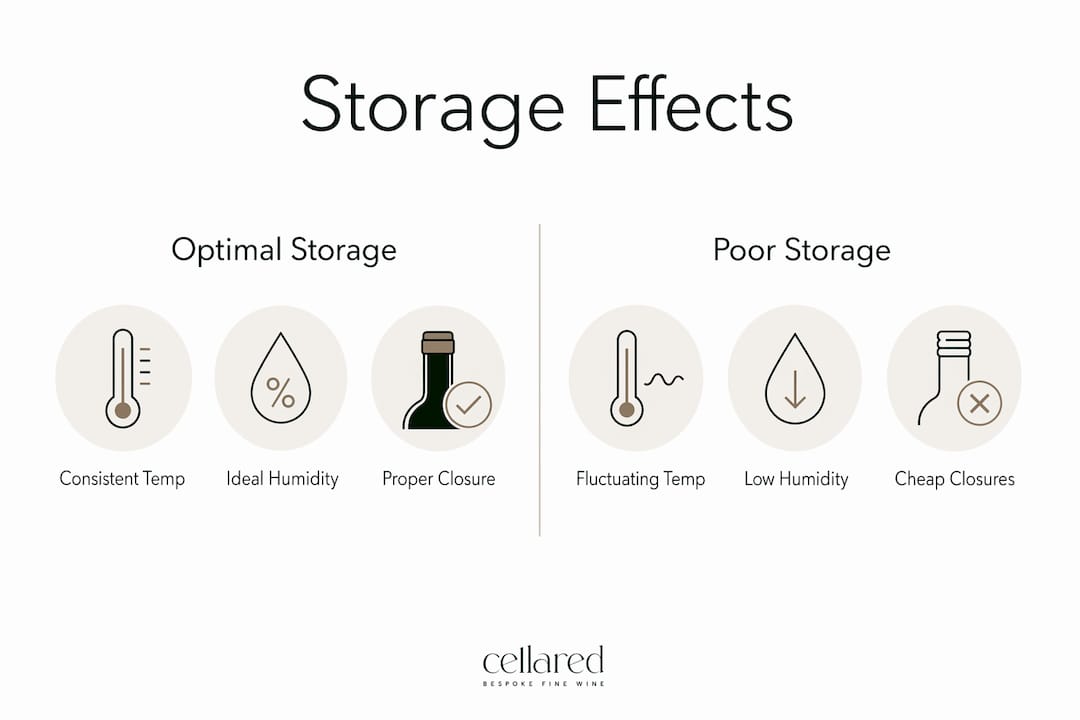
The single most critical variable in wine storage is temperature. Optimal storage temperature sits at approximately 13°C (55°F), and temperatures above 21°C cause premature ageing and irreversible flavour degradation. The chemistry behind this is unambiguous: chemical reaction rates in wine double with every 10°C rise in temperature. A bottle stored in a warm kitchen ages at twice the speed of one held in a proper cellar.
Humidity matters almost as much. Ideal relative humidity for long-term storage falls between 50% and 80%. Below 50%, corks dry out and shrink, allowing oxygen to enter the bottle unchecked. Above 80%, mould forms on labels and cork surfaces, which does not affect the wine directly but destroys the presentation and provenance record that collectors rely on at auction.
Light and vibration are less discussed but equally damaging. Ultraviolet light accelerates oxidation by triggering photochemical reactions in the wine. Vibration disturbs the sediment in aged reds and disrupts the slow, delicate chemical processes that build complexity over time. A cellar that eliminates all four threats simultaneously is the foundation of any serious collection.
Key conditions to maintain for long-term cellaring:
- Temperature: 12°C–14°C, held constant without fluctuation
- Humidity: 55%–75%, monitored with a calibrated hygrometer
- Light: zero UV exposure; use LED lighting without UV output
- Vibration: isolate bottles from appliances, foot traffic, and mechanical sources
- Orientation: store bottles horizontally to keep corks moist and sealed
Pro Tip: Consistency matters more than perfection. A cellar held steadily at 15°C causes less damage than one that swings between 10°C and 18°C seasonally. Temperature fluctuations cause cork seals to expand and contract, accelerating micro-oxygen ingress and oxidative spoilage.
How does storage shape the chemistry of an ageing wine?
Oxygen is the architect of wine maturation, and its management inside a sealed bottle is extraordinarily complex. Oxygen exposure inside bottles occurs in stages: an immediate post-bottling equilibration, slow diffusion through the cork, and long-term permeation from the exterior environment. Each stage influences the pace and character of ageing. A wine stored in a cool, stable environment ages slowly and builds layered complexity. One stored in warmth or fluctuating conditions ages rapidly and unevenly.
The closure type is not a passive detail. Closures actively modulate the oxidative-reductive balance inside the bottle, shaping the chemical and sensory trajectory of the wine over time. A medium-term study comparing natural cork, microagglomerated cork, and screw caps found that natural cork tends to maintain aromatic complexity better over 30 months of storage. Screw caps, while excellent for wines intended for early drinking, restrict oxygen ingress so tightly that they can produce reductive off-notes in wines designed for extended cellaring.
The storage environment itself alters the aromatic profile in measurable ways. Research on Marselan wines stored in natural geothermal caves found a 1.3-fold increase in ethyl acetate and a 1.57-fold increase in isoamyl acetate compared to conventional storage. These esters are the compounds responsible for fruity, floral aromatic complexity. The cave's consistent temperature and humidity created conditions that conventional climate-controlled rooms approximated but did not fully replicate.
"Bottle ageing dynamics differ significantly from bulk ageing. Collectors must consider closure type and storage environment as unique, interacting variables rather than independent choices." Applied Sciences Journal, 2026
This insight reframes how serious collectors should approach their cellars. The bottle, the closure, and the environment form a system. Optimise one element while neglecting the others and the result is unpredictable.
What are the practical benefits of professional offsite wine storage?
Professional offsite storage delivers four advantages that home cellaring cannot reliably replicate: environmental consistency, physical security, insurance coverage, and documented provenance. Each of these factors directly supports the financial returns a collector can expect at resale or auction.
The practical benefits of professional storage, ranked by investment impact:
- Provenance documentation. Certified provenance from a professional facility correlates with higher hammer prices at auction compared to undocumented home storage. Buyers pay a premium for certainty. A bottle with a complete, traceable care history commands more than an identical bottle whose storage conditions are unknown.
- Environmental consistency. Professional facilities maintain temperature and humidity within tight tolerances year-round, regardless of seasonal variation. This consistency is the single factor most difficult to achieve in a home cellar.
- Security and insurance. Fine wine collections held in professional facilities carry specialist insurance coverage and physical security that home environments cannot match. This protects the financial value of the collection against theft, fire, and flood.
- Inventory management. Professional facilities provide digital inventory tools that track each bottle's location, condition, and drinking window. For collectors managing fine wine portfolios across multiple vintages and producers, this visibility is indispensable.
Statistic callout: Sophisticated inventory management strategies, applied to wine ageing and sale timing, can increase profits by up to 1.31% across a portfolio. That figure, drawn from a study evaluating 11 wine brands across 86 markets, reflects the compounding value of knowing precisely when to sell. Timing the market correctly requires knowing the condition of every bottle, which professional storage makes possible.
For collectors who want to understand the full financial picture of professional versus home storage, a detailed breakdown of wine storage costs is worth reviewing before committing to either path.
How does storage quality affect financial returns and investment risk?
Storage quality is a direct financial variable, not a peripheral concern. Wine stored under suboptimal conditions loses value in two ways: the wine itself degrades, and the absence of documented care history reduces buyer confidence at resale. Both effects compound over time, and both are largely irreversible once the damage is done.
| Storage condition | Effect on wine | Effect on investment value |
|---|---|---|
| Consistent 13°C, 60–70% humidity | Slow, structured maturation | Maximum value retention and appreciation |
| Fluctuating temperature (10°C–18°C) | Accelerated oxidation, cork pumping | Significant value reduction at resale |
| High heat (above 21°C) | Premature ageing, cooked flavours | Near-total loss of investment-grade status |
| Home storage, undocumented | Variable quality, unknown provenance | Auction discount versus certified storage |
| Professional offsite, documented | Consistent quality, full provenance | Premium pricing and buyer confidence |
The risks of poor storage extend beyond the individual bottle. A collection with inconsistent storage history carries reputational risk at auction. Buyers and auction houses scrutinise provenance records, and a gap in the care history of a significant bottle can suppress the hammer price across an entire lot. For collectors managing fine wine investment risks, storage quality is one of the few variables entirely within their control.
Pro Tip: When acquiring bottles for investment, ask the seller for storage records before the purchase, not after. A bottle with a clean provenance chain from producer to professional cellar is worth paying a premium for. One without documentation carries hidden risk that no price discount fully compensates.
For collectors building or refining their cellar systems, the collector's guide to inventory management offers practical frameworks for tracking condition and optimising sale timing.
Key takeaways
Proper storage is the foundation of wine investment returns, because environmental consistency, closure selection, and documented provenance together determine both the quality and the market value of every bottle in a collection.
| Point | Details |
|---|---|
| Temperature consistency is paramount | Hold storage at 12°C–14°C without fluctuation to prevent oxidative spoilage and cork damage. |
| Closure type shapes ageing | Natural cork supports aromatic complexity over medium to long-term cellaring better than screw caps. |
| Provenance documentation lifts resale value | Certified storage records correlate with higher auction prices and stronger buyer confidence. |
| Professional storage protects financial returns | Offsite facilities deliver environmental control, security, insurance, and inventory tools home cellars cannot match. |
| Inventory timing increases profit | Sophisticated tracking of ageing windows and sale timing can meaningfully improve portfolio returns. |
What I have learned from years of watching collections succeed and fail
The collectors who achieve the best returns are rarely those with the most expensive wines. They are the ones who treat storage as a discipline rather than an afterthought. I have seen exceptional bottles from celebrated vintages sell at a fraction of their potential because the seller could not produce a credible storage history. And I have seen modest bottles from less fashionable producers command strong prices simply because their provenance was impeccable and their condition was verifiable.
The most common mistake I observe is prioritising the acquisition of great wine while treating storage as a cost to be minimised. The logic inverts itself over time. A bottle of first-growth Bordeaux stored in a temperature-stable professional facility for fifteen years will almost always outperform the same bottle stored in a domestic wine fridge that cycles between 12°C and 19°C with the seasons. The difference in storage cost is real. The difference in outcome is larger.
Closure selection is the other factor collectors consistently underestimate. When purchasing wines for extended cellaring, the closure type deserves the same scrutiny as the vintage and the producer. Natural cork, for all its variability, remains the preferred closure for wines intended to age beyond a decade. The oxidative-reductive balance it provides is not perfectly controllable, but it is the balance that fine wine maturation has been built around for centuries.
My strongest advice is this: document everything, store professionally from the outset, and treat provenance as an asset in its own right. The cellar is not where wine waits. It is where value is made.
— David
How Cellared supports your wine investment through expert cellar management
Cellared Fine Wine works with collectors and investors who understand that the quality of their storage decisions shapes the quality of their returns. The team at Cellared brings deep market knowledge to every aspect of collection management, from sourcing exceptional bottles to maintaining the environmental and documentary standards that protect long-term value.

Cellared's private cellar management service covers environmental monitoring, inventory tracking, and condition reporting, giving collectors the visibility and control that professional storage demands. For those seeking an independent, market-led assessment of their collection's current worth, Cellared's wine appraisals and valuations service provides court-ready documentation suitable for insurance, probate, and private advisory purposes. Both services are built around the principle that well-stored wine, accurately valued, is the foundation of a collection that performs.
FAQ
What temperature is best for long-term wine storage?
The optimal storage temperature is approximately 13°C (55°F). Temperatures above 21°C accelerate chemical reactions and cause irreversible flavour degradation.
Does humidity affect wine investment value?
Humidity between 55% and 75% protects cork integrity and label condition. Levels below 50% dry out corks, allowing oxygen ingress that degrades both the wine and its provenance record.
Why does provenance documentation matter at auction?
Certified storage records authenticate a wine's care history and correlate with higher hammer prices. Undocumented home storage creates uncertainty that buyers discount at resale.
How does closure type affect a wine's ageing potential?
Natural cork supports a balanced oxidative-reductive environment that promotes aromatic complexity over medium to long-term storage. Screw caps restrict oxygen so tightly that they can produce reductive off-notes in wines designed for extended cellaring.
Can better storage management improve financial returns?
Sophisticated inventory management tied to storage conditions and ageing windows can increase portfolio profits by up to 1.31%, based on research across 11 wine brands and 86 markets. Knowing when to sell requires knowing the condition of every bottle.