
Fine wine occupies a rarified space among alternative assets, offering the tantalising combination of aesthetic pleasure, cultural prestige, and genuine wealth preservation. Yet unlike equities or property, its risk landscape is governed by criteria most investors have never encountered: provenance documentation, climate-controlled storage chains, shifting index benchmarks, and the ever-present spectre of sophisticated counterfeits. Fine wine is a passion asset driven by scarcity, desirability, and time dynamics rather than cash flow or earnings multiples, and that distinction reshapes every aspect of how risk should be understood and managed.
Table of Contents
- Understanding the core risk factors in wine investment
- Operational risk: Why storage, provenance, and fraud matter
- Market risk: Price cycles, liquidity, and transaction costs
- Benchmark, macro, and regional risks: Invisible market drivers
- Summary: Comparing fine wine risk factors at a glance
- Our perspective: What most experts miss about wine investment risk
- Partnering for better wine investment outcomes
- Frequently asked questions
Key Takeaways
| Point | Details |
|---|---|
| Operational risk is central | Secure storage and verified provenance are non-negotiable for preserving wine value. |
| Liquidity and costs matter | Wine is an illiquid asset with real transaction, storage, and insurance fees to account for. |
| Market cycles drive returns | Wine prices can swing for years with global cycles, so expect uneven recovery by region. |
| Benchmark and regional risks | Where you invest and what index you follow can change your exposure to regime, currency, or political shocks. |
| Expert guidance reduces risk | Partnering with specialists in buying, valuation, and cellar management helps mitigate major pitfalls. |
Understanding the core risk factors in wine investment
Fine wine's appeal as an investment lies precisely in its distinctiveness. It appreciates through scarcity, reputation, and the irreversible passage of time rather than through dividends or contractual obligations. That same distinctiveness, however, creates a risk profile that traditional portfolio frameworks are poorly equipped to address.
Wine's value depends on scarcity, desirability, and time rather than cash flow, which means conventional valuation tools such as discounted cash flow analysis or price-to-earnings ratios offer no meaningful guidance. Instead, investors must master a distinct set of risk categories:
- Value driver risk: Prices are set by collector demand, critical scores, and vintage reputation, all of which can shift unpredictably with changes in taste or the wine press.
- Operational risk: Physical deterioration through poor storage, breaks in provenance chains, and fraudulent bottles are ever-present threats to capital.
- Liquidity risk: Fine wine is an illiquid asset. Converting a cellar to cash can take months, and finding the right buyer at the right price requires patience and market access.
- Price cycle risk: Like property, wine markets move through extended cycles of appreciation and correction, with downturns that can persist for several years.
- Benchmark risk: The index chosen to track performance can paint very different pictures of the same market, depending on which regions and styles are included.
- Macro risk: Currency movements, interest rate cycles, and broader economic sentiment all influence the purchasing power of collectors across different markets.
- Regional and regulatory risk: Tariff changes, import restrictions, and regional production shocks can affect specific wine styles or producing countries disproportionately.
- Fraud risk: Counterfeit bottles and falsified documentation remain a persistent challenge, particularly for older vintages from prestigious estates.
Not all wines carry the same risk profile. A case of a well-documented Burgundy Grand Cru stored in a professional facility since release carries fundamentally different risks from a case of mixed Bordeaux with an uncertain trading history. Understanding where a specific bottle sits within this risk matrix is the foundation of sound investment discipline. Our guide to buying rare bottles offers a practical framework for beginning that evaluation.
Operational risk: Why storage, provenance, and fraud matter
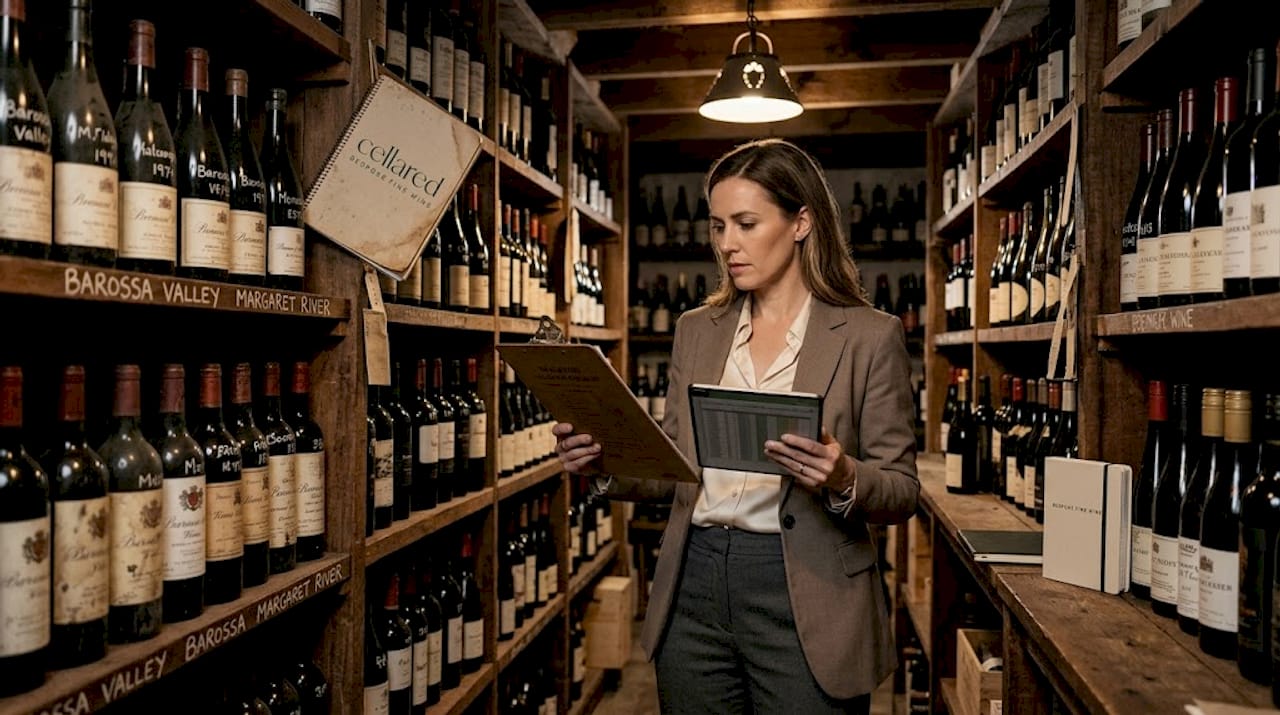
Of all the risks confronting wine investors, operational risk is simultaneously the most controllable and the most frequently underestimated. A bottle of first-growth Bordeaux that has spent its life in a professionally managed, temperature-controlled warehouse is a fundamentally different asset from an identical label that has passed through a succession of private hands in varying conditions.
Key operational risks include storage problems, provenance gaps, and fraud, all of which can erode returns silently and decisively. Here is a structured way to assess and manage each:
-
Storage integrity: Wine requires consistent temperatures between 12°C and 14°C, controlled humidity between 60% and 75%, and protection from light and vibration. A single warm summer in an inadequately insulated cellar can push a case from investment grade to undrinkable without any visible external sign.
-
Provenance verification: Every link in the chain of custody, from the producer to the négociant to the auction house to your cellar, must be verifiable. Gaps in documentation do not just create legal complexity; they destroy resale value. A case with complete, original paperwork will consistently command a premium over an identical case with incomplete records.
-
Fraud and counterfeiting: Fraud and counterfeiting risk is persistent and directly linked to poor provenance verification, particularly for prestigious labels from celebrated vintages. The celebrated cases of fraudulent Burgundy and Bordeaux that surfaced in global auctions over the past two decades are not historical curiosities. They are cautionary illustrations of what happens when buyers prioritise price over documentation.
-
Platform and vendor selection: Choosing to buy through reputable, established channels with transparent provenance policies is the single most effective mitigation available. Auction houses with rigorous consignment vetting and specialist merchants who offer complete documentation substantially reduce these risks.
-
Insurance and documentation: Maintaining accurate valuations for insurance purposes, particularly as collections grow in value, is an operational essential rather than an optional refinement.
Pro Tip: Before purchasing any bottle with a trading history, request the complete chain-of-custody documentation as a non-negotiable precondition. If a seller cannot provide it without hesitation, treat that absence as a material risk signal.
A thorough wine valuation checklist and the ability to secure rare bottles with confidence are practical starting points for investors who wish to take operational risk seriously.
Market risk: Price cycles, liquidity, and transaction costs
Fine wine markets do not move in straight lines. They breathe through multi-year cycles of enthusiasm, correction, and consolidation, shaped by the same forces of credit availability, consumer confidence, and institutional appetite that drive other collectible markets.
Fine wine is a selective, illiquid market with real trading, storage, and insurance costs that must be factored into any honest return calculation. Consider the typical cost structure around a transaction:
| Cost category | Typical range |
|---|---|
| Auction buyer's premium | 18% to 25% |
| Auction seller's commission | 10% to 15% |
| Professional storage per case per year | $15 to $40 |
| Insurance (percentage of value per year) | 0.5% to 1.5% |
| International shipping and duties | Variable, often 5% to 15% |
These costs compound over time. A wine that appreciates by 30% over five years may return considerably less after accounting for storage, insurance, and transaction fees at the point of sale. Many first-time investors fail to model this accurately, which is why transparent cost accounting matters as much as selecting the right labels.
Price risk is cyclical, and market corrections can persist for years before sentiment recovers. The fine wine market experienced a significant correction through 2023 and 2024, following the exceptional appreciation period of 2020 to 2022. As of early 2026, the market appears to be stabilising, but the recovery path is uneven across different regions and styles. Some Burgundy producers continue to hold value firmly, while broader Bordeaux indices have moved more modestly.
Liquidity deserves particular scrutiny. Unlike shares that can be sold in seconds, a fine wine position may take weeks or months to convert. The depth of the buyer's market for a specific wine, the timing of major auction calendars, and the current state of collector sentiment all influence how quickly and at what price a sale can be completed. Investors who may need to realise capital rapidly should size their wine positions accordingly and maintain sufficient liquid reserves elsewhere.
Thinking carefully about building a fine wine portfolio with diversification across regions and price points is one of the more effective ways to manage market risk over time.
Benchmark, macro, and regional risks: Invisible market drivers
Some of the most consequential risks in fine wine investment are the least visible in day-to-day collection management. Benchmark selection, currency dynamics, and regional regulatory shocks operate quietly until, suddenly, they do not.
The Liv-ex indices are the closest equivalent fine wine has to a stock market index, but the choice of which index to track matters enormously. The Liv-ex Fine Wine 100, which focuses on Bordeaux First Growths, tells a different story from the Liv-ex 1000, which spans multiple regions and styles. An investor benchmarking against the wrong index may misread their portfolio's relative performance by a significant margin.
"The convergence of fine wine's behaviour with property-like dynamics means that regime shifts in credit availability and currency strength are now primary drivers of value cycles, not just collector enthusiasm." The argument that fine wine is more like property than a collectible asset is gaining serious traction among analysts, with direct implications for how macro risk should be assessed.
For Australian and APAC investors, the currency dimension is especially pronounced. Wine is priced and traded predominantly in pounds sterling and euros. A strengthening Australian dollar can erode the local-currency value of an internationally priced collection, while a weakening dollar inflates the apparent gains without any underlying improvement in the wine's market position.
Australia-specific tariffs and regulatory changes have demonstrated with uncomfortable clarity just how abruptly regional shocks can materialise. The tariff dispute affecting Australian wine exports to China between 2021 and 2023 devastated the revenues of major producers and redirected significant volumes to alternative markets at suppressed prices. Even investors holding European labels felt secondary effects as Australian market sentiment cooled.
Pro Tip: When assessing regional exposure, consider not only which wines you hold but which collector markets provide your exit liquidity. A wine with strong demand in Hong Kong and Singapore carries different risk characteristics than one whose primary buyers are concentrated in a single market vulnerable to regulatory disruption.
| Risk type | Visibility | Controllability | Key mitigation |
|---|---|---|---|
| Benchmark selection | Low | High | Choose index matching portfolio |
| Currency exposure | Medium | Medium | Currency-aware position sizing |
| Regional tariff shocks | Low | Low | Geographic diversification |
| Credit and liquidity cycles | Medium | Low | Long investment horizon |
A considered approach to enhancing your portfolio strategy with regional diversification directly addresses these often-overlooked drivers of risk.
Summary: Comparing fine wine risk factors at a glance
To assist with practical decision-making, the full spectrum of wine investment risks can be mapped from most controllable to least, giving investors a clear framework for prioritising due diligence and mitigation efforts.
| Risk factor | Controllability | Primary mitigation strategy | Investor action required |
|---|---|---|---|
| Storage conditions | Very high | Professional bonded storage | Verify facility standards |
| Provenance documentation | High | Full chain-of-custody records | Demand documentation upfront |
| Fraud and counterfeiting | High | Reputable, vetted vendors | Never skip provenance checks |
| Transaction costs | Medium | Competitive platform selection | Model all costs before purchase |
| Benchmark selection | Medium | Index alignment with portfolio | Review benchmarking regularly |
| Liquidity | Low to medium | Diversified holdings, long horizon | Size positions with patience |
| Currency exposure | Medium | Hedging or diversification | Monitor FX against portfolio |
| Price cycle risk | Low | Long holding periods | Accept multi-year horizons |
| Macro and credit cycles | Very low | Asset class diversification | Maintain broader portfolio balance |
| Regulatory and tariff shocks | Very low | Regional diversification | Spread exposure across markets |
The pattern that emerges from this comparison is instructive. The risks most investors discuss most often, chiefly price cycles and macro conditions, are precisely those over which investors have the least control. The risks that can genuinely be managed with care and expertise, storage, provenance, fraud, and benchmark choice, receive comparatively little attention. Directing attention toward diversifying with wine investment across regions and styles is a practical step toward reducing exposure at the controllable end of this spectrum.
Our perspective: What most experts miss about wine investment risk
The conventional discourse around fine wine risk is dominated by price charts and index movements. Analysts debate whether Burgundy is overvalued relative to Bordeaux, whether Champagne investment represents the next cycle, or whether the Liv-ex correction has further to run. These are legitimate questions, but they risk distracting serious investors from a more fundamental truth.
The greatest threats to wine investment capital are not market corrections. They are the slow, invisible erosions of value that occur through inadequate storage, undocumented provenance, and fraudulent bottles that pass undetected through careless hands. A bottle that spoils in a poorly managed cellar is a total loss. A counterfeit that survives discovery until the point of sale is a reputational and financial catastrophe. Neither of these outcomes appears on a price chart until it is too late.
We also observe a persistent and somewhat lazy assumption among APAC investors that fine wine automatically provides portfolio diversification. It can, certainly. But correlation is not constant. During periods of broad financial stress, liquidity constraints across asset classes can cause passion assets to move in unexpected alignment with equities, as collectors in financial difficulty liquidate across their holdings simultaneously. The wine liquidation insights that emerge from those moments are sobering.
True mastery of wine investment risk lies not in predicting where the Liv-ex 100 will be in eighteen months but in controlling what can genuinely be controlled: where bottles live, who has touched them, how they are documented, and against which benchmarks they are evaluated. That discipline, applied consistently and with genuine expertise, is what separates investors who preserve capital from those who learn expensive lessons.
Partnering for better wine investment outcomes
Understanding wine investment risk at this level of depth is one thing. Having the expert infrastructure to act on that understanding is another entirely.

Cellared Fine Wine works with collectors, investors, and private clients across Australia and APAC to address precisely the risk factors explored in this article. From independent, court-ready wine valuations that provide accurate insurance and advisory baselines, to bespoke sourcing that guarantees verified provenance from the outset, every service is designed to place expert discipline at the foundation of your collection. Our wine cellar management solutions ensure your holdings are stored, tracked, and documented to the highest professional standards. And when it comes to identifying the right bottles from the world's finest wine regions, our market knowledge and network provide access that is both rare and rigorously verified. Because in fine wine, confidence is not a luxury. It is the foundation of every sound investment.
Frequently asked questions
What is the single greatest risk in fine wine investment?
Storage and provenance issues are the central risks for investors, as poor physical conditions or undocumented chain-of-custody can silently destroy a bottle's value long before any market correction becomes relevant.
How can Australian investors avoid counterfeit wine scams?
Fraud is a persistent risk, but insisting on complete provenance documentation and purchasing only through reputable, vetted channels with rigorous consignment standards offers meaningful protection.
Are fine wine prices likely to recover in 2026?
The 2026 market is stabilising after prior corrections, but recovery paths differ markedly across regions and styles, with some premium Burgundy holdings performing more robustly than broader Bordeaux indices.
Do tariff or political shocks affect wine investment outcomes?
Tariff shocks have directly impacted Australian wine producers and markets, demonstrating that sudden regulatory or geopolitical disruptions can influence regional values, export volumes, and broader investor sentiment rapidly and severely.
What makes fine wine different from other alternative assets?
Wine investment value is driven by scarcity, reputation, and the passage of time rather than cash flow, making it a passion asset whose risk profile demands a fundamentally different framework from equities, bonds, or even other collectibles.