
A wine exchange is defined as an electronic marketplace where professional wine merchants buy, sell, and trade fine wines through standardised contracts and transparent pricing. Unlike a bottle shop or an online retail platform, a wine exchange operates much like a stock exchange, matching bids and offers through a central order book. The most prominent example is Liv-ex (the London International Vintners Exchange), a global B2B marketplace serving over 600 members across 47 countries. Understanding how these platforms function gives wine enthusiasts a powerful lens for reading the market, benchmarking their collections, and making better buying decisions.
What is a wine exchange and how does it differ from retail?
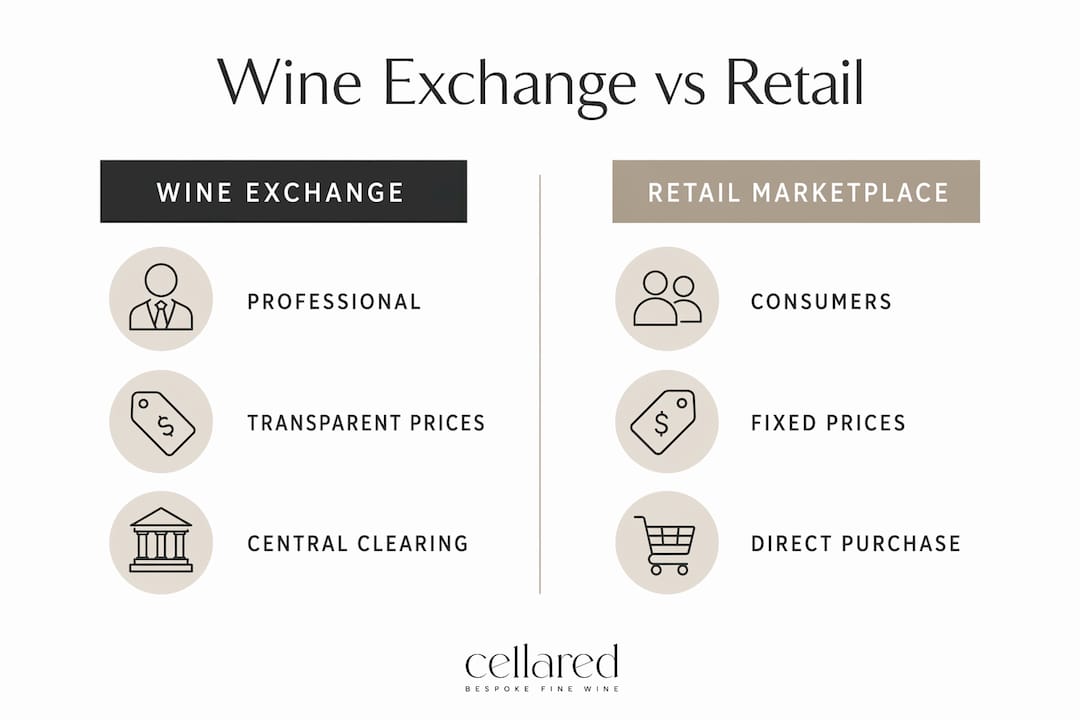
A wine exchange is a structured trading platform designed for professional wine merchants, not individual consumers. The distinction matters enormously. Retail wine platforms let you click and buy a bottle for delivery to your door. A wine exchange, by contrast, operates on an anonymous order-book model where vetted members post bids and offers, and the exchange itself facilitates settlement. Price transparency is the defining feature: before exchanges like Liv-ex existed, the fine wine market was fragmented and opaque, with significant information asymmetry favouring insiders.
The exchange model removes that asymmetry. Every transaction contributes to a published price record, which feeds into indices that the broader market can read and use. This is why wine exchanges matter even to collectors who will never hold a membership.
How does a wine exchange platform work?
The mechanics of a wine exchange platform mirror those of a financial exchange more closely than any retail model. Liv-ex, for instance, lists over 16,000 distinct wines and provides real-time price discovery alongside central counterparty settlement. Each wine is listed under standardised conditions, so every participant knows exactly what they are trading.
The core process works as follows:
- Standardised listings. Each wine entry specifies the producer, vintage, format, and storage condition. There is no ambiguity about what is being traded.
- Order book matching. Members post bids (buy orders) and offers (sell orders). When a bid meets an offer, the exchange matches the trade automatically.
- Central counterparty settlement. The exchange stands between buyer and seller, guaranteeing settlement and eliminating the need for either party to vet the other's creditworthiness.
- Physical logistics. All wine physically passes through a bonded London warehouse, where it undergoes temperature-controlled storage, inspection, and authentication before transfer.
- Price indices. Completed trades feed into published benchmarks like the Liv-ex Fine Wine 100, which tracks the performance of the 100 most traded fine wines globally.
The central counterparty model is the most consequential feature. It is analogous to traditional financial markets and critical to market integrity. Buyers and sellers never interact directly, which removes the friction and risk inherent in private trades.
Pro Tip: The Liv-ex Fine Wine 100 index is freely referenced in financial and wine media. Tracking it monthly gives you a reliable read on where the fine wine market is heading, even without exchange membership.

How does a wine exchange differ from retail and informal swaps?
The confusion between wine exchanges, retail marketplaces, and informal bottle swaps is understandable. Each serves a different purpose and a different audience.
Retail wine platforms allow click-to-buy convenience but lack the standardised transparent pricing and settlement mechanisms of exchanges. A consumer browsing a retail site sees a fixed price set by the merchant. On an exchange, that price is determined by live supply and demand, updated in real time.
| Feature | Wine exchange | Retail marketplace |
|---|---|---|
| Participant type | Professional merchants only | Open to consumers |
| Pricing model | Live order book, bid and offer | Fixed merchant price |
| Settlement | Central counterparty clearing | Direct buyer-to-merchant |
| Anonymity | Full anonymity between parties | Buyer identity known |
| Price transparency | Published indices and trade data | Merchant sets price independently |
Informal wine swaps, sometimes called "wine exchange parties," sit at the opposite end of the spectrum entirely. These are social arrangements where enthusiasts trade bottles by mutual agreement, with no standardised contracts, no authentication, and no price discovery. They are enjoyable and community-driven, but they share nothing structurally with a professional wine exchange platform.
Pro Tip: When a merchant quotes you a price for a fine wine, ask whether they reference Liv-ex data. A merchant who uses exchange indices is giving you a market-grounded price, not an arbitrary margin.
How can enthusiasts engage with the wine trading system?
Individual collectors cannot trade directly on Liv-ex or similar exchanges. Membership is restricted to professional wine merchants. That said, the wine trading system still offers substantial value to serious enthusiasts through indirect channels.
The most effective pathways are:
- Work with exchange-connected merchants. Specialist merchants who hold exchange membership can source wines at exchange prices and pass that market intelligence to their clients. Cellared Fine Wine operates with this kind of market-led approach, using current data to inform bespoke buying decisions.
- Use exchange indices to benchmark your collection. The Liv-ex Fine Wine 100 and related indices give collectors a professional-grade reference point for assessing whether their holdings are appreciating, plateauing, or declining.
- Participate in auctions alongside exchange data. Auction results and exchange prices together paint a complete picture of secondary market value. Reviewing both before selling or buying a significant bottle is standard practice among serious collectors. A collector's auction guide can help you navigate this channel effectively.
- Prioritise provenance and storage. Wines that meet exchange-grade provenance standards, meaning documented ownership history and bonded storage, command higher prices across all channels, not just on exchanges. This is the single most controllable factor in resale value.
- Diversify your channels. Serious collectors rarely rely on one trading channel. Integrating merchants, auctions, and digital marketplaces builds both access and liquidity.
Understanding your wine collection exit strategies before you buy is equally important. Knowing how you plan to sell shapes which wines you acquire and how you store them.
Pro Tip: Before selling a significant bottle, cross-reference the most recent Liv-ex trade price for that wine with recent auction hammer prices. The gap between the two often reveals where the best opportunity lies.
Key challenges and logistics in wine exchange trading
Trading on a wine exchange is not simply a matter of placing an order. The physical and contractual requirements are demanding, and they exist for good reason.
-
Standard-In-Bond contracts. The Standard-In-Bond contract is the foundation of exchange trading. It specifies that wines must be held in bonded storage, meaning they have not cleared customs and no duty has been paid. This keeps wines in a legally clean state for transfer between parties.
-
Bonded warehouse requirements. All wine traded on Liv-ex must be stored in climate-controlled, bonded facilities. Temperature, humidity, and security standards are non-negotiable. Wines stored outside these conditions cannot be listed on the exchange without remediation.
-
Inspection and authentication. Every wine physically passes through the exchange's bonded London warehouse for inspection. Capsule condition, label integrity, fill level, and packaging are all assessed. A bottle that fails inspection cannot complete settlement.
-
Logistics costs and timing. Physical handling takes time. Sellers must deliver wine to the warehouse within two weeks of a completed trade. Freight, insurance, and handling fees add to the cost of every transaction. These are not trivial amounts for high-value cases.
-
Counterparty risk mitigation. The central clearing model means neither buyer nor seller is exposed to the other's default risk. The exchange guarantees settlement, which is why the model has proven so durable since Liv-ex introduced central clearing in 2002.
These requirements explain why direct exchange participation is reserved for professional merchants. The infrastructure, capital, and compliance demands are substantial. For individual collectors, the lesson is clear: the provenance and storage standards that exchanges demand are the same standards that maximise value across every other channel.
Key takeaways
A wine exchange is a professional B2B trading platform that creates price transparency and market integrity through standardised contracts, central clearing, and authenticated physical logistics.
| Point | Details |
|---|---|
| Wine exchanges are B2B platforms | Only professional merchants can trade directly; individual collectors access the market indirectly. |
| Central clearing removes counterparty risk | The exchange guarantees settlement, so buyers and sellers never need to vet each other. |
| Exchange indices benefit all collectors | Benchmarks like the Liv-ex Fine Wine 100 give collectors professional-grade market data without membership. |
| Provenance and storage are non-negotiable | Exchange-grade storage standards maximise resale value across all channels, not just on exchanges. |
| Diversified channels outperform single-channel strategies | Combining merchants, auctions, and digital platforms builds access, liquidity, and better pricing outcomes. |
The transparency revolution that changed fine wine
The fine wine market I observed a generation ago was built on relationships and opacity. Prices were negotiated over the phone between merchants who had spent years cultivating trust. If you were outside that network, you paid whatever you were told and hoped it was fair.
Liv-ex changed that fundamentally. The shift to a transparent, order-book-driven model did not just benefit merchants. It created a public record of what fine wine actually trades for, and that record is now the foundation of every serious valuation, every insurance assessment, and every investment decision I see clients make.
What I find most interesting is how exchange data has filtered down to collectors who will never hold a membership. The Liv-ex Fine Wine 100 is cited in financial media, used by auction houses, and referenced by specialist merchants in client conversations. The exchange created a shared language for the market, and that language is now available to anyone willing to learn it.
My advice to serious enthusiasts is to treat exchange indices the same way a property investor treats comparable sales data. You may not be trading on the exchange, but you are operating in a market shaped by it. The collectors who understand this, and who build fine wine portfolios with that awareness, consistently make better decisions than those who rely on a single merchant's word.
The future of wine trading will bring greater digitisation and broader global access to exchange data. That is a development worth watching closely.
— David
Cellared Fine Wine: market-informed buying and cellar management
Cellared Fine Wine brings exchange-level market intelligence to private collectors, investors, and estates who want professional guidance without navigating the complexity of B2B platforms directly.
Cellared's bespoke wine buying service draws on current market data to source exceptional bottles at prices grounded in real trade activity. The team provides independent wine appraisals and valuations referenced against exchange benchmarks, making them suitable for insurance, probate, and private advisory purposes. Cellared also offers wine cellar management that maintains the provenance and storage standards required to protect and grow collection value. Contact Cellared Fine Wine for a personalised consultation.
FAQ
What is a wine exchange in simple terms?
A wine exchange is an electronic marketplace where professional wine merchants trade fine wines through standardised contracts, live pricing, and central counterparty settlement. It operates like a stock exchange for wine rather than a retail shop.
Can individuals buy wine directly on a wine exchange?
No. Platforms like Liv-ex restrict membership to professional wine merchants. Individual collectors access exchange benefits indirectly through specialist merchants, brokers, and by using published exchange indices.
What is the Liv-ex Fine Wine 100?
The Liv-ex Fine Wine 100 is a price index tracking the 100 most traded fine wines on the Liv-ex exchange. It is widely used by collectors and merchants to benchmark collection values and assess market trends.
How does central clearing work on a wine exchange?
The exchange acts as the counterparty to both buyer and seller, guaranteeing settlement regardless of either party's default risk. This model, introduced by Liv-ex in 2002, removes the trust barriers that previously made private wine trades risky.
Why does provenance matter for wine exchange trading?
Exchange contracts require wines to have documented ownership history and bonded storage. Wines that meet these standards command higher prices across all channels, including auctions and private sales, not just on the exchange itself.