
Fine wine is defined as a tangible luxury asset that delivers portfolio diversification, low volatility, and long-term capital appreciation driven by scarcity, global demand, and irreversible consumption. The industry term for this category is "alternative assets," and fine wine sits alongside art, rare whisky, and classic cars within that classification. What separates wine from its peers is a quality that sophisticated investors increasingly prize: it behaves less like a speculative collectible and more like a defensive store of value. The WineCap Wealth Report 2026 records that 97% of wealth managers expect fine wine demand to rise in 2026, the highest confidence recorded in four years. That near-unanimous optimism signals a structural shift, not a passing trend.
Why does wine suit wealthy portfolios as a luxury asset?
Fine wine's appeal to high-net-worth investors rests on one foundational quality: it does not move in step with equities or traditional luxury collectibles. Since 2011, correlations with equities and luxury collectibles have decreased, giving wine a profile closer to residential property than to a Basquiat painting or a vintage Rolex. That decoupling matters enormously during periods of market stress, when correlated assets fall together and diversification fails precisely when investors need it most.
Three structural forces drive wine's long-term appreciation:
- Scarcity. Each vintage is finite. Once consumed, those bottles are gone permanently, and supply contracts while demand from collectors in Asia, North America, and Europe continues to grow.
- Consumption. Unlike gold or art, wine is literally consumed. This steady removal from the secondary market tightens supply and supports prices over time.
- Global demand. Emerging wealth in China, Singapore, and the United States has broadened the buyer base for First Growth Bordeaux, Grand Cru Burgundy, and prestige Champagne beyond its traditional European heartland.
Fine wine also delivers compound annual growth near 10% over the last decade, outperforming gold and many luxury assets. That figure reflects a measured, patient asset class rather than a speculative one.
Pro Tip: Treat fine wine as the defensive pillar of your alternative asset allocation, not as a growth play. Its strength is stability and non-correlation, not short-term price spikes.

How does investing in fine wine work in practice?
The mechanics of fine wine investment are more structured than most first-time investors expect. Entry points are accessible for serious investors: the minimum initial managed investment is approximately £5,000, while the average client portfolio sits around £65,000. That range places fine wine firmly within reach of high-net-worth individuals building a diversified alternative asset allocation.
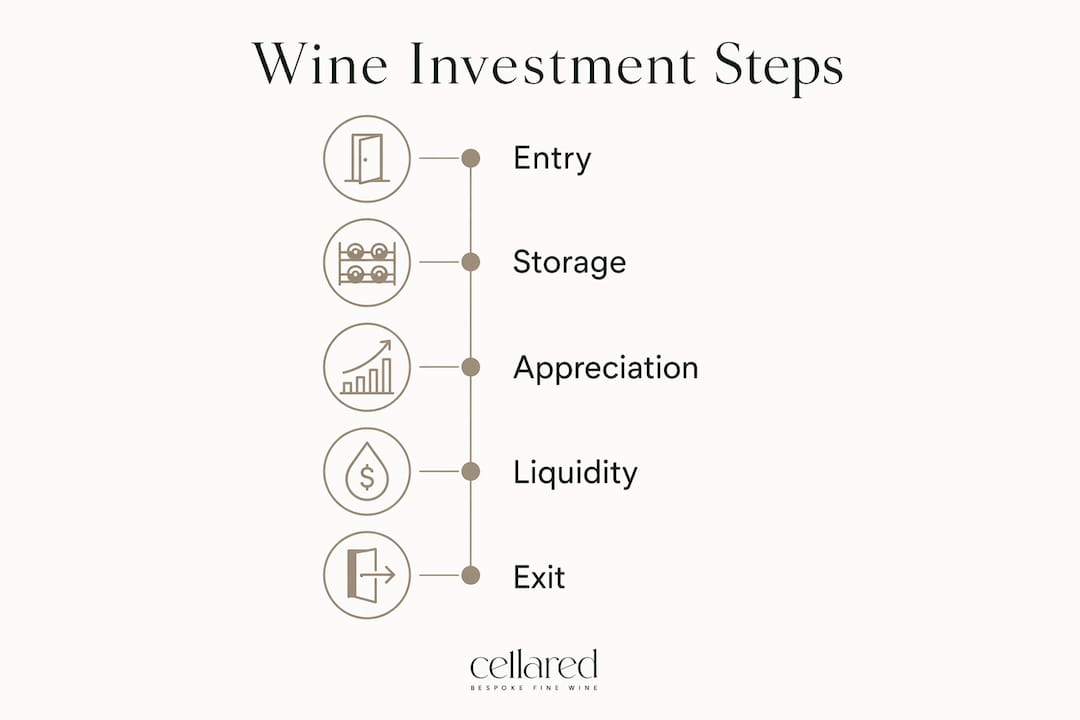
A well-constructed fine wine portfolio typically follows this progression:
- Establish a foundation in liquid Bordeaux. Châteaux such as Lafite Rothschild, Mouton Rothschild, and Pétrus offer the deepest secondary market liquidity and the most transparent pricing. They are the bedrock of most serious collections.
- Add Burgundy and Champagne for prestige and scarcity. Domaine de la Romanée-Conti and Krug Clos du Mesnil command extraordinary premiums precisely because production volumes are tiny and global demand is vast.
- Allocate to storage from day one. Serious investors rarely handle physical bottles directly. Climate-controlled bonded storage facilities maintain provenance, provide insurance-grade custody, and simplify future resale. Home storage destroys both condition and credibility with buyers.
- Plan for a 5–10 year horizon. Fine wine requires patience to realise meaningful appreciation. Liquidity is lower than stocks or gold, and market cycles reward those who hold through short-term fluctuations.
- Monitor valuations annually. Market-led appraisals track your portfolio's current worth and inform decisions about when to sell, hold, or reinvest.
| Practical factor | Detail |
|---|---|
| Minimum entry | Approximately £5,000 for a managed portfolio |
| Average portfolio size | Around £65,000 across diversified regions and vintages |
| Storage | Climate-controlled bonded facilities with insurance and provenance records |
| Investment horizon | 5–10 years for meaningful capital appreciation |
| Liquidity | Lower than equities; secondary market sales require planning |
Pro Tip: Never store investment-grade wine at home. Bonded storage is not a luxury. It is the single most important factor in preserving both the wine's condition and its resale value.
What types of wines and regions are best for luxury investment?
Not all fine wine appreciates equally. Region, producer reputation, vintage quality, and secondary market depth all determine whether a bottle becomes a sound investment or an expensive disappointment.
Core legacy regions
| Region | Key producers | Investment strength |
|---|---|---|
| Bordeaux | Lafite, Mouton, Pétrus, Haut-Brion | Deepest liquidity, most transparent pricing |
| Burgundy | Domaine de la Romanée-Conti, Leroy | Extreme scarcity, exceptional price growth |
| Champagne | Krug, Dom Pérignon, Salon | Prestige and global brand recognition |
| Tuscany | Sassicaia, Ornellaia, Masseto | Strong demand from US and Asian collectors |
| Piedmont | Giacomo Conterno, Bruno Giacosa | Barolo's ageing potential drives long-term value |
| Napa Valley | Screaming Eagle, Harlan Estate | Cult status and limited production |
Emerging regions gaining traction
South Africa and Spain are attracting serious investor attention as secondary market liquidity improves and critical acclaim builds. Producers such as Eben Sadie in South Africa and Vega Sicilia in Spain demonstrate that world-class terroir outside the traditional heartlands can generate compelling returns.
The wisest approach is to build a fine wine portfolio anchored in Bordeaux for liquidity, then diversify progressively into Burgundy, Piedmont, and emerging regions for growth. Concentration in a single region amplifies risk. Spreading across geography and vintage manages it.
What are the risks and challenges of wine as an investment asset?
Fine wine rewards disciplined investors and punishes impatient ones. Understanding the risks before committing capital is not optional. It is the difference between a sound allocation and an expensive lesson.
The principal risks are:
- Liquidity constraints. Wine cannot be sold at the press of a button. Secondary market transactions through platforms, merchants, or auction houses take time, and prices depend on current market sentiment.
- Storage and insurance costs. Bonded storage fees and insurance premiums reduce net returns. These costs must be factored into any return calculation from the outset.
- Market cycles and valuation fluctuations. Fine wine markets move in cycles. Bordeaux experienced a significant correction after its 2011 peak, and investors who bought at the top and sold at the bottom realised losses rather than gains.
- Provenance risk. Wine purchased outside reputable channels carries the risk of poor storage history, counterfeit bottles, or missing documentation. Provenance is everything in the secondary market.
- Speculative hype. Certain wines attract short-term speculative interest that inflates prices beyond their fundamental value. Chasing hype rather than quality is a reliable path to underperformance.
The fine wine investment risks that catch investors off guard most often are storage costs and liquidity timelines. Both are predictable and manageable with proper planning.
Pro Tip: Avoid buying wine purely because it is fashionable. The wines that perform over a decade are those with genuine scarcity, critical acclaim, and a proven secondary market. Fashion fades. Quality endures.
How can investors integrate fine wine into their overall wealth strategy?
Fine wine works best as a deliberate allocation within a broader alternative asset strategy, not as an impulse purchase or a standalone bet. The 2026 market trends confirm that sophisticated investors are treating wine as a defensive pillar alongside property, infrastructure, and other tangible assets.
A structured integration approach follows these steps:
- Define your allocation size. Most advisors suggest allocating 5%–10% of an alternative asset portfolio to fine wine. This provides meaningful exposure without over-concentrating in an illiquid asset class.
- Work with a specialist broker or platform. Platforms such as WineCap and specialist advisors like Cellared Fine Wine provide market intelligence, sourcing, and portfolio management that individual investors cannot replicate alone.
- Build foundational positions first. Start with liquid, well-documented Bordeaux wines before moving into more specialist or emerging regions. Liquidity is your safety net.
- Diversify by vintage and geography. A single exceptional vintage from a single region concentrates risk. Spreading across multiple years and regions smooths performance over time.
- Commission regular valuations. Annual wine appraisals keep your portfolio's current market value accurate for insurance, estate planning, and informed sell decisions.
Sustainability and improved secondary-market liquidity are increasingly prioritised by investors alongside return potential. Technology and AI are enhancing market transparency, making it easier to track valuations and identify buying opportunities with greater confidence.
Key takeaways
Fine wine is a proven alternative asset that rewards patient, disciplined investors with low volatility, genuine scarcity, and long-term capital appreciation when managed with professional expertise.
| Point | Details |
|---|---|
| Defensive diversification | Fine wine's low correlation to equities makes it a stabilising force in alternative portfolios. |
| Accessible entry points | Managed portfolios begin around £5,000, with average holdings near £65,000 across diversified regions. |
| Storage is non-negotiable | Climate-controlled bonded storage protects provenance, condition, and resale value. |
| Patience is the strategy | A 5–10 year horizon is required to realise meaningful appreciation from fine wine. |
| Start with Bordeaux | Bordeaux offers the deepest secondary market liquidity and is the foundation of most serious collections. |
Why I believe fine wine has earned its place as a core asset class
Fine wine's transition from passion asset to strategic portfolio holding is one of the more significant shifts I have observed in the alternative asset space over the past decade. For a long time, wine was treated as the indulgence that happened to appreciate. Collectors bought what they loved and were pleasantly surprised when the value climbed. That era is largely over.
The investors I work with today approach fine wine with the same rigour they apply to property or private equity. They ask about liquidity timelines, storage costs, regional diversification, and exit strategies before they ask about flavour profiles. That discipline is exactly right, and it is producing better outcomes.
The mistake I see most often is impatience. Investors who enter the market expecting two or three years of strong returns and then exit are almost always disappointed. Fine wine is not a trade. It is a long-term holding that compounds quietly while the rest of the portfolio absorbs volatility. The wines that have generated the most impressive returns for clients are invariably those held through at least one full market cycle.
The other mistake is conflating enjoyment with investment. The bottles you open at dinner are not the bottles in your investment portfolio. Keeping those two categories separate sounds obvious, but the temptation to drink your best holdings is real. The investors who resist it are the ones who call me a decade later with a very satisfying story to tell.
— David
Cellared Fine Wine: bespoke wine investment for serious collectors

Cellared Fine Wine works with collectors, investors, and private clients across Australia to build, manage, and value fine wine portfolios with the care and precision the asset class demands. Whether you are entering the fine wine market for the first time or managing an established collection, Cellared provides bespoke wine buying, professional cellar management, and independent, court-ready valuations for insurance, probate, and private advisory purposes. The team sources rare and hard-to-find bottles from the world's finest regions, from Bordeaux and Burgundy to Piedmont and Napa Valley, and manages each portfolio with deep market knowledge and a highly personal approach. Visit Cellared Fine Wine to speak with a specialist about your wine investment goals.
FAQ
What is fine wine as a luxury asset?
Fine wine as a luxury asset is a tangible alternative investment that appreciates through scarcity, consumption, and global demand. It sits within the broader alternative asset class alongside art, rare whisky, and classic cars.
Is wine a good investment for high-net-worth individuals?
Fine wine has delivered compound annual growth near 10% over the last decade, outperforming gold and many luxury assets. Its low correlation to equities makes it particularly suited to diversified high-net-worth portfolios.
How much do I need to start investing in fine wine?
The minimum initial managed fine wine investment is approximately £5,000, with the average client portfolio sitting around £65,000 across diversified regions and vintages.
How long should I hold fine wine as an investment?
Fine wine requires a 5–10 year investment horizon to realise significant appreciation. Liquidity is lower than stocks or gold, and the asset rewards patient, long-term holders.
Which wine regions offer the strongest investment potential?
Bordeaux offers the deepest secondary market liquidity and is the foundation of most serious portfolios. Burgundy, Champagne, Tuscany, and Piedmont provide strong growth potential, while South Africa and Spain are emerging as credible alternatives for diversification.