Wine ownership disputes are defined as legal conflicts over the rights to wine-related assets, including vineyards, wine collections, trademarks, and associated business interests. These disputes arise in divorce proceedings, business dissolutions, estate settlements, and partnership breakdowns. The assets involved are rarely simple: a single winery may combine real property, living vines, bottled inventory, and a brand name, each governed by different legal principles. Understanding the legal aspects of wine collections and the frameworks that determine ownership is the first step toward protecting your interests.
Wine ownership disputes explained: the legal foundations
Wine ownership disputes, known formally as contested property rights proceedings, arise when two or more parties claim legal title to the same wine-related asset. The complexity stems from the mixed nature of wine assets. A vineyard is simultaneously real property, an agricultural business, and a source of intellectual property in the form of brand names and wine styles.
Community property law is the dominant framework in major wine-producing jurisdictions. In Texas, Texas Family Code §§3.002 and 3.003 presume that any asset acquired during a marriage belongs to both spouses equally. That presumption is powerful. Overturning it requires clear and convincing evidence, which is a higher standard than the balance of probabilities used in most civil matters.
California applies similar community property principles, though its asset protection rules differ. California's homestead exemption is capped at approximately $750,000 and excludes business assets such as vineyards and tasting rooms entirely. That gap leaves significant wine business value exposed in any dispute.
Documentation determines outcomes. Courts cannot award what they cannot verify. Collectors and business owners who maintain clear purchase records, storage logs, and financial separation between personal and business funds are far better positioned to assert their wine property rights.
What legal rights govern wine ownership?
The legal rights that govern who owns the wine depend on the type of asset, the jurisdiction, and the nature of the relationship between the parties.
Separate versus community property
The core distinction in most disputes is between separate property, which belongs to one individual, and community property, which belongs to both parties in a marriage or registered partnership. Proving separate ownership of a vineyard or wine collection requires tracing funds back to a pre-marriage source or a gift or inheritance received during the marriage. Commingling, where separate funds are mixed with community funds to purchase or improve an asset, erodes that claim significantly.
Written agreements versus oral deals
Courts treat oral agreements with deep scepticism. California and Texas courts have separately rejected ownership claims based on handshake deals, finding them unenforceable without written documentation. One prominent case saw a lawyer's claimed stake in a Napa Valley winery dismissed entirely because no written agreement existed. Courts have described litigation built on oral agreements as fundamentally without merit, reinforcing that formal contracts are not optional in wine business ownership.
Trademark and intellectual property rights
Wine brand names, labels, and proprietary blends carry significant commercial value and generate their own category of dispute. California's professional conduct rules, specifically Rule of Professional Conduct 3-300, require that any business transaction between an attorney and a client be fair, fully disclosed in writing, and independently consented to. Courts apply similar scrutiny to all parties claiming intellectual property rights in a wine business.
Pro Tip: Keep a dedicated ownership file for every wine asset you hold. Include the original purchase contract, proof of payment source, storage records, and any partnership or shareholder agreements. Courts reward preparation.
How are wine assets valued during ownership disputes?
Valuation is where many wine ownership disputes become genuinely contested. Two parties can agree on who owns an asset and still fight bitterly over what it is worth. A court-ready wine valuation must account for every component of value and withstand cross-examination by opposing counsel.
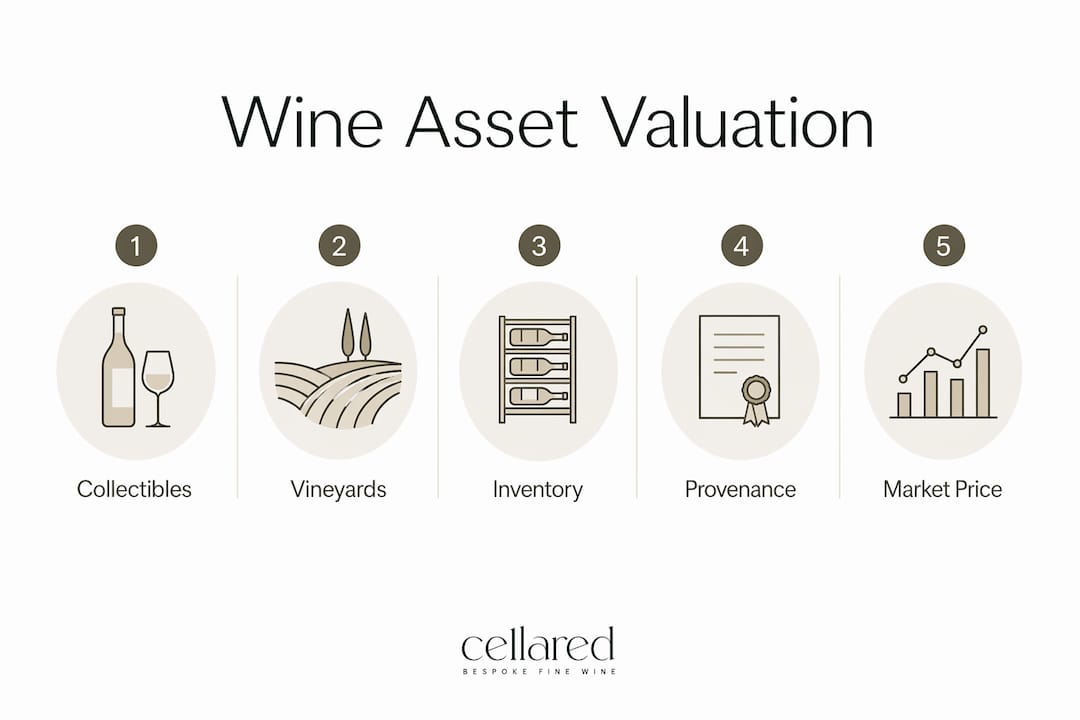
The components of a wine asset valuation
Accurate winery valuation requires specialist expertise across multiple asset classes. The components typically assessed include:
- Real property. The land, buildings, and infrastructure, valued by a licensed property valuer using comparable sales.
- Vineyard assets. The vines themselves, including age, variety, and yield history, assessed by a viticulture specialist.
- Wine inventory. Bottled stock valued by reference to current market prices, provenance, and storage conditions.
- Intellectual property. Brand names, trademarks, and proprietary wine styles, assessed by an IP specialist or business valuer.
- Goodwill. The commercial reputation and customer relationships of the business, often the most contested figure in a dispute.
Each component requires a different expert. Using a single generalist valuer for all five categories is a common and costly mistake.
How provenance affects wine bottle valuation
Provenance is the documented history of a wine bottle from production to present. It is the single most important factor in fine wine valuation. Wines with uncertain chain of custody are treated as compromised by collectors and insurers alike, even if the bottles are physically intact. A bottle recovered after theft, for example, loses market value because its storage conditions during the missing period cannot be verified. In a legal dispute, that uncertainty translates directly into a lower valuation and a weaker ownership claim.
| Valuation factor | Impact on disputed wine assets |
|---|---|
| Provenance documentation | Strong provenance supports higher valuations and clearer ownership claims |
| Storage history | Gaps in storage records reduce value and invite challenge |
| Chain of custody | Broken custody creates valuation uncertainty and legal risk |
| Market comparables | Recent auction results set the benchmark for bottled wine value |
| Condition and label integrity | Physical condition affects realised value at auction or private sale |
What dispute resolution options exist for wine ownership conflicts?
Resolving disputes over wine collections requires choosing the right mechanism for the complexity and value of the assets involved.
Litigation
Litigation is the most formal and most expensive path. Wine ownership cases can exceed seven years from filing to verdict, including multi-day jury trials. That timeline carries significant legal costs and emotional strain, particularly in disputes between family members or former business partners. Courts can order asset division, compel a sale, or award damages, but enforcement of those orders adds further complexity when the other party is uncooperative.
Mediation and arbitration
Mediation brings both parties together with a neutral facilitator to negotiate a settlement. It is faster, cheaper, and less adversarial than litigation. Arbitration is more formal than mediation but still private, and an arbitral award is legally binding. Both options preserve confidentiality, which matters when a wine brand's reputation is at stake. Engaging a legal counsel with specialist knowledge in wine and trademark law gives you a material advantage in either forum.
The key considerations when choosing a resolution path:
- Asset complexity. The more asset classes involved, the more litigation may be necessary to compel full disclosure.
- Relationship between parties. Mediation works best when both parties are willing to negotiate in good faith.
- Time and cost tolerance. Arbitration typically resolves in months rather than years.
- Enforcement needs. Court orders carry stronger enforcement mechanisms than mediated settlements.
Pro Tip: Request a joint valuation process early in any dispute. Agreeing on a single independent expert to value the wine assets reduces costs and removes valuation as a point of ongoing conflict.
How can you prevent wine ownership disputes?
Prevention is substantially less costly than resolution. The legal issues in wine ownership that generate the most protracted disputes share a common cause: inadequate documentation at the outset.
- Draft written agreements for every ownership arrangement. Verbal understandings between partners, family members, or investors have no legal force. A properly drafted shareholders' agreement or partnership deed defines each party's rights, responsibilities, and exit conditions before any conflict arises.
- Maintain separate financial records. Keep purchase records, storage invoices, and insurance documents for your wine collection entirely separate from household or business finances. This separation is the foundation of any separate property claim.
- Commission periodic independent valuations. A current, independent valuation of your wine assets gives you a defensible baseline if a dispute arises. Cellared Fine Wine provides market-led, court-ready valuations that serve this purpose precisely.
- Plan succession carefully. Vineyard succession planning must account for agricultural easements and tax rules, including Section 2032A of the IRC, which ties tax benefits to continued farming use. Changing the use of a vineyard can trigger significant back taxes, complicating any estate transfer.
- Consider fractional ownership structures. Fractional vineyard ownership separates wine allocation rights from operational control, giving each party a clearly recorded title to their interest. This structure reduces dispute risk by making ownership explicit from the start.
A collector's guide to splitting wine assets offers further practical guidance on dividing collections fairly when a dispute does arise.
Key takeaways
Wine ownership disputes are resolved most effectively when ownership is documented clearly, assets are valued by specialists, and parties choose the right resolution mechanism for the complexity involved.
| Point | Details |
|---|---|
| Documentation is decisive | Written contracts and purchase records are the strongest evidence in any ownership dispute. |
| Valuation requires specialists | Each asset class, from vines to trademarks, needs a different expert to produce a court-ready figure. |
| Provenance affects value | Gaps in a wine's chain of custody reduce its market value and weaken ownership claims in court. |
| Litigation is a last resort | Mediation and arbitration resolve disputes faster and at lower cost than a full court proceeding. |
| Prevention is the best strategy | Periodic valuations, written agreements, and succession planning prevent most disputes before they start. |
What I have learned from wine ownership disputes
Wine ownership disputes are rarely just legal problems. They are almost always personal ones. The cases that drag on longest are the ones where the parties once trusted each other completely, and that trust was never formalised in writing. A handshake between friends who start a winery together feels natural at the time. Years later, when the business is worth something and the relationship has changed, that handshake is worth nothing in court.
The most consistent pattern I observe is that the party with better records wins. Not always the party with the stronger moral claim, and not always the party who contributed more. The party who can produce a paper trail. I have seen collectors lose claims to bottles they genuinely purchased because they could not produce a receipt or a storage record. I have seen vineyard co-owners stripped of their interest because they could not trace their initial capital contribution to a separate source.
Choosing the right valuation expert matters as much as choosing the right lawyer. A valuer who understands wine provenance, auction market dynamics, and the difference between a bottle's insured value and its realisable value will produce a report that holds up under cross-examination. A generalist property valuer will not. If you are entering a dispute involving fine wine, engage someone who works in the wine market every day.
My strongest advice is to act before a dispute arises. Commission a valuation, review your agreements, and speak to a specialist. The cost is trivial compared to seven years of litigation.
— David
Professional wine valuation for dispute resolution
When ownership of a fine wine collection or vineyard is contested, the quality of your valuation evidence shapes the outcome.
Cellared Fine Wine provides independent, court-ready wine valuations for family law proceedings, probate, insurance, and private dispute resolution. Each valuation is grounded in current market data, documented provenance assessment, and a clear methodology that withstands legal scrutiny. Cellared also offers private cellar management to maintain the provenance and storage integrity of your collection, protecting its value before any dispute arises. For collectors, investors, and estates seeking clarity on their wine assets, Cellared Fine Wine offers the specialist knowledge that general valuers cannot provide. Contact Cellared Fine Wine to arrange a consultation.
FAQ
What is a wine ownership dispute?
A wine ownership dispute is a legal conflict over the rights to wine-related assets, including bottled collections, vineyards, wine businesses, or trademarks. These disputes arise most commonly in divorce, estate settlement, and business dissolution proceedings.
Who owns the wine in a divorce?
In community property jurisdictions such as Texas and California, wine assets acquired during a marriage are presumed to belong to both spouses equally. Proving separate ownership requires clear and convincing evidence tracing the asset to a pre-marriage or inherited source.
How is a wine collection valued for legal purposes?
A court-ready wine valuation assesses each bottle by reference to current market prices, provenance documentation, and storage history. Wines with gaps in their chain of custody are valued lower because their condition during the missing period cannot be verified.
Can an oral agreement establish wine business ownership?
Courts in California and Texas have rejected oral ownership claims in wine business disputes, finding them unenforceable without written documentation. Any ownership arrangement in a wine business must be recorded in a signed, written agreement to be legally binding.
How long do wine ownership disputes take to resolve?
Litigation over wine ownership can exceed seven years from filing to verdict, including multi-day trials. Mediation and arbitration typically resolve disputes in months, making them the preferred option when both parties are willing to negotiate.