
Fine wine investment is defined by a set of risks that no other asset class replicates quite so precisely: illiquidity, physical fragility, counterfeit exposure, and the slow, patient rhythm of a market that rewards discipline above all else. Effective wine portfolio risk management steps address each of these dimensions in sequence, from the moment you acquire a bottle to the day you sell it. Experts recommend allocating no more than 5–10% of total investable assets to fine wine, given its illiquid nature and the ongoing costs of storage and insurance, which typically consume 2–4% of gross annual returns. Counterfeit exposure adds another layer of complexity, with up to 20% of wines in secondary markets estimated to be fraudulent. A structured, multi-step approach is the only reliable way to protect capital and position a collection for genuine appreciation.
What are the wine portfolio risk management steps every investor needs?
Risk assessment in wine begins with a clear audit of what you hold, where it is stored, and how you acquired it. Without that baseline, every subsequent decision rests on uncertain ground.
The four primary risk categories in a fine wine portfolio are:
- Authenticity risk: The threat of counterfeit or misdescribed bottles entering the collection, particularly through unverified secondary market channels.
- Storage risk: Physical deterioration caused by temperature fluctuation, humidity imbalance, or light exposure, all of which degrade quality and erode value.
- Liquidity risk: The inability to sell holdings quickly at fair market value, a structural feature of fine wine that investors must plan around rather than ignore.
- Market and regional exposure: Concentration in a single appellation, producer, or vintage leaves a portfolio vulnerable to localised shocks, whether from poor harvest conditions, shifting consumer preferences, or geopolitical disruption.
Monitoring these risks requires more than intuition. Liv-ex indices, which track secondary market prices across major fine wine regions, provide a reliable benchmark for evaluating portfolio performance against broader market trends. Professional valuation reports, such as those offered by Cellared Fine Wine's valuation service, give investors an independent, market-led assessment of current holdings. Regular review of auction results from houses like Sotheby's and Christie's also reveals how specific producers and vintages are tracking in real time.
Pro Tip: Set a calendar reminder every six months to cross-reference your holdings against the Liv-ex 1000 index. Consistent tracking reveals drift in regional concentration before it becomes a structural problem.

Provenance documentation sits at the centre of any credible risk assessment. A documented chain of custody reduces buyer hesitation at resale and materially lowers fraud exposure. Every bottle acquired should carry a clear record of its origin, storage history, and any transfers of ownership.
How to mitigate physical and market risks in a wine portfolio
Physical risk mitigation in fine wine is not optional. It is the foundation upon which every other risk management step depends.
-
Use bonded storage from the outset. Bonded warehouses provide climate-controlled environments, documented provenance, and tax deferral benefits that private cellaring cannot match. Bonded storage reduces portfolio risk by preserving the chain of custody, improving liquidity at resale, and keeping wine in optimal condition. Private cellaring, by contrast, can cost considerably more per square foot and introduces variables that are difficult to control or document.
-
Insure your collection at current market value. Insurance is not a luxury for serious collectors. It is a direct cost of ownership that must be factored into return calculations. For detailed guidance on coverage structures suited to Australian investors, fine wine insurance for APAC is a subject worth examining closely before committing capital.
-
Diversify across regions, vintages, producers, and styles. Professional management firms treat diversification as a core risk reduction tactic, not an afterthought. A portfolio anchored entirely in Bordeaux first growths, for example, carries concentrated exposure to a single region's pricing cycle. Spreading holdings across Burgundy, Barossa Valley, Tuscany, and Rhône reduces the impact of any single market correction.
-
Verify provenance before every acquisition. Purchasing exclusively from certified merchants and reputable auction houses with transparent, audited provenance is the most reliable defence against counterfeit risk. Counterfeit exposure is mitigated most effectively at the point of purchase, not after the fact.
-
Document everything. Receipts, storage records, condition reports, and valuation certificates form the paper trail that transforms a collection into a credible, saleable asset. Collectors who treat fine wine due diligence as a continuous practice rather than a one-time exercise consistently achieve better outcomes at resale.
Pro Tip: When diversifying wine assets, treat each region as a separate sub-portfolio with its own allocation limit. Capping any single region at 30% of total holdings prevents concentration risk from accumulating quietly over time.
A step-by-step process for managing wine portfolio risk over time
Managing wine assets effectively requires a sequential process that begins before the first bottle is purchased and continues for as long as the portfolio exists.
| Step | Action | Key risk addressed |
|---|---|---|
| 1. Set objectives | Define return targets, time horizon, and liquidity needs before acquiring anything | Liquidity and overcommitment risk |
| 2. Source with rigour | Buy only from certified merchants or major auction houses with full provenance | Counterfeit and authenticity risk |
| 3. Establish bonded storage | Place all investment-grade wine in a bonded facility with insurance coverage | Physical deterioration and tax risk |
| 4. Diversify holdings | Spread across regions, vintages, and producers from the start | Market concentration risk |
| 5. Review and rebalance | Assess performance against Liv-ex benchmarks every six months | Market volatility and drift |
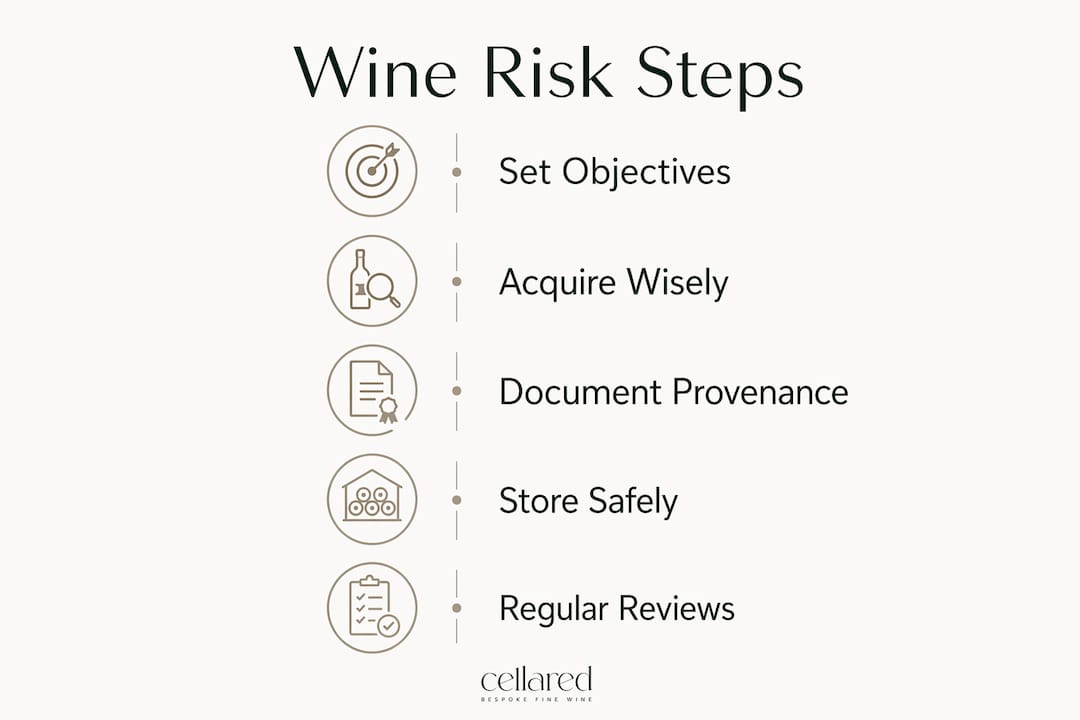
Step one is the most frequently skipped and the most consequential. Investors who enter the fine wine market without defined objectives tend to accumulate bottles based on personal taste rather than portfolio logic. That approach conflates collecting with investing, and the two disciplines demand different decisions. A goal-oriented approach that balances passion with discipline produces measurably better risk management outcomes.
Step five deserves particular attention. Regular portfolio review that tracks regional indices, auction performance, and vintage comparisons enables timely adjustments before underperforming positions erode overall returns. Storage costs and auction fees can consume 2–4% of gross returns annually, so rebalancing decisions must account for transaction costs as well as market movements.
What are the most common pitfalls in wine portfolio risk management?
The most damaging mistakes in fine wine investment share a common thread: they are all avoidable with prior planning.
- Purchasing from unverified sources. Buying outside certified channels to secure a lower price is the fastest route to counterfeit exposure. The short-term saving rarely compensates for the loss in value or the legal complexity that follows.
- Neglecting storage conditions. Wine stored outside optimal temperature and humidity ranges deteriorates in ways that are often invisible until a bottle is opened or inspected by an expert. Poor storage conditions destroy value that no subsequent care can restore.
- Over-concentration in a single region or producer. A portfolio built around one appellation or one celebrated producer is not a diversified asset. It is a concentrated bet. When that region or producer falls out of favour, the entire portfolio suffers.
- Ignoring exit planning. Fine wine is illiquid by nature. Investors who have not considered how and when they will sell face forced liquidation at unfavourable prices. Planning the exit before entering a position is a discipline that separates experienced collectors from reactive ones.
- Chasing market trends. Buying into a region or vintage because it is currently fashionable means paying peak prices for assets that may correct sharply. Diversifying wine collections across multiple dimensions is a more reliable path than trend-following.
- Underestimating ongoing costs. Operational costs including bonded storage, insurance, and professional management are not incidental. They are structural features of fine wine ownership that must be modelled into return expectations from day one.
Key takeaways
Effective wine portfolio risk management requires a multi-layered approach combining disciplined acquisition, bonded storage, provenance documentation, and regular rebalancing to protect capital and support long-term appreciation.
| Point | Details |
|---|---|
| Allocate within limits | Cap fine wine at 5–10% of investable assets to manage illiquidity and cost exposure. |
| Prioritise provenance | Buy only from certified sources and maintain a documented chain of custody for every bottle. |
| Use bonded storage | Bonded facilities provide climate control, tax efficiency, and provenance records that private cellaring cannot match. |
| Diversify across dimensions | Spread holdings across regions, vintages, and producers to reduce concentration risk. |
| Review every six months | Track performance against Liv-ex indices and rebalance before drift becomes a structural problem. |
The discipline behind the pleasure
Fine wine investment attracts people who love wine. That is both its greatest strength and its most persistent risk factor. I have worked with collectors who built genuinely impressive portfolios and others who assembled beautiful cellars that performed poorly as investments. The difference, almost without exception, came down to discipline.
The collectors who succeeded treated every acquisition decision as a portfolio decision first and a personal preference second. They set allocation limits before they felt the pull of a particular label. They reviewed their holdings on a schedule rather than when the mood struck. They asked hard questions about provenance before they asked about price.
What I find most instructive is that the best-performing portfolios were rarely the most exciting ones to look at. They were not built around a single celebrated producer or a single celebrated region. They were spread carefully, documented thoroughly, and reviewed consistently. The wines were exceptional. The process was methodical.
Passion and discipline are not opposites in fine wine investment. Passion drives the curiosity that leads to better acquisition decisions. Discipline ensures those decisions serve the portfolio rather than the moment. The investors who hold both qualities in balance are the ones who call me years later with something genuinely worth celebrating.
— David
How Cellared Fine Wine supports your portfolio risk management

Cellared Fine Wine works with collectors and investors across Australia to bring structure, clarity, and expertise to every stage of fine wine portfolio management. From bespoke wine buying that prioritises provenance and authenticity, to professional cellar management services that handle bonded storage and insurance, Cellared provides the specialist support that transforms a collection into a well-managed asset. Independent, market-led wine valuations give investors the accurate benchmarks needed for ongoing monitoring, insurance, and exit planning. For collectors who want to manage their holdings with greater confidence, Cellared offers the expertise and the personal service to make that possible.
FAQ
What percentage of assets should I allocate to fine wine?
Experts recommend allocating no more than 5–10% of total investable assets to fine wine, given its illiquidity and the ongoing costs of storage and insurance.
How do I reduce counterfeit risk in my wine portfolio?
Purchase exclusively from certified merchants and major auction houses with transparent, audited provenance. Counterfeit exposure is best addressed at the point of acquisition, not after the fact.
What are the main ongoing costs of a fine wine portfolio?
Storage, insurance, and professional management fees typically consume 2–4% of gross annual returns. These costs must be factored into total return expectations from the outset.
Why is bonded storage better than private cellaring for investors?
Bonded storage provides climate control, tax deferral, documented provenance, and easier resale conditions that private cellaring cannot reliably replicate.
How often should I review my wine portfolio?
A review every six months is the standard practice for serious investors. Tracking regional indices such as Liv-ex alongside auction results allows timely rebalancing before market drift affects overall performance.