
Fine wine occupies a curious position in the minds of high net worth investors across Australia and APAC. Many approach it with the assumption that a cellar of exceptional bottles functions as a straightforward safe haven, comparable to gold or government bonds. Yet leading asset managers are explicit that fine wine, like other alternative assets, can be speculative and illiquid, placing it in an altogether different category from traditional defensive holdings. Understanding this distinction is the foundation of any intelligent rare wine investment strategy.
Table of Contents
- Why rare wines are gaining appeal for investors
- How rare wine fits into a modern portfolio strategy
- Understanding the risks: illiquidity and speculation in rare wine
- Practical steps: access, valuation and ongoing management
- What most miss about the real role of rare wine
- Enhance your collection with expert guidance
- Frequently asked questions
Key Takeaways
| Point | Details |
|---|---|
| Diversification value | Rare wine can reduce overall portfolio risk but is not a cash-equivalent asset. |
| Consider illiquidity | Rare wine investments carry low liquidity, so plan allocations and exits carefully. |
| Professional guidance matters | Expert advice on sourcing, storage, and valuation is crucial to maximise returns. |
| Practical risk controls | Insurance and verified storage are essential to protect against loss. |
Why rare wines are gaining appeal for investors
The momentum behind fine wine in APAC portfolios is not accidental. A confluence of macro forces, from equity market turbulence and inflationary pressure to currency volatility and an expanding regional collector base, has pushed sophisticated investors to look beyond conventional asset classes. Rare wine sits at an intriguing intersection: it carries tangible, physical value, it benefits from a deep cultural history, and it commands genuine global market demand.
Consider the contrast with other alternatives. Cryptocurrency offers liquidity but extraordinary volatility. Contemporary art can appreciate dramatically, yet valuation lacks standardisation and markets can be opaque. Rare wine, by comparison, operates within well-established auction and trade networks, with pricing benchmarks provided by platforms such as Liv-ex and decades of transaction data. The market is not perfect, but it is not lawless either.
What gives fine wine particular resonance in APAC is the region's deep appreciation for provenance and prestige. The cultural cachet of a Grand Cru Burgundy or a Penfolds Grange is not lost on collectors from Singapore to Sydney. This cultural dimension elevates the asset beyond pure finance: a bottle of 1996 Giacomo Conterno Barolo is simultaneously an investment and a piece of living history.
"Alternative investments such as fine wine are gaining traction for diversification, but alternatives can be speculative and/or illiquid rather than equivalent to cash or treasuries-style safety."
The key drivers currently attracting APAC investors to fine wine include:
- Inflation resilience: Tangible assets with constrained supply have historically held value better than cash-denominated instruments during inflationary periods.
- Low equity correlation: Premium bottles from top producers tend not to move in lockstep with sharemarket indices, offering genuine portfolio breathing room.
- Scarcity and ageing dynamics: Unlike most assets, the investable supply of a specific vintage can only decrease over time as bottles are consumed.
- Currency diversification: Fine wine is traded globally in multiple currencies, offering indirect exposure to international markets.
For those considering diversifying with wine investments, the appeal is real. The discipline lies in approaching it with the same rigour you would apply to private equity or infrastructure, rather than treating it as a passion project that happens to appreciate. Those ready to explore investing in rare bottles will find that the learning curve rewards patience and meticulous selection.
How rare wine fits into a modern portfolio strategy
With the appeal established, let us examine how rare wine actually integrates into a broader investment strategy. The central function it serves is diversification, specifically the reduction of overall portfolio volatility through the inclusion of an asset with low or negative correlation to equities and fixed income. In practical terms, when sharemarkets correct sharply, a well-chosen fine wine allocation may remain relatively stable or even appreciate, providing a natural counterbalance.

The critical caveat, which asset managers emphasise clearly, is that allocation sizing and storage and transaction friction matter enormously for real portfolio outcomes. This is not a set-and-forget asset class.
Comparing rare wine to other alternative assets
| Asset class | Liquidity | Correlation to equities | Storage/transaction cost | Typical holding period |
|---|---|---|---|---|
| Rare wine | Low to medium | Low | Moderate to high | 5 to 15 years |
| Listed equities | High | High | Low | Variable |
| Physical gold | Medium | Low | Low to moderate | Variable |
| Private equity | Very low | Medium | Low | 7 to 10 years |
| Contemporary art | Very low | Very low | High | 5 to 20 years |
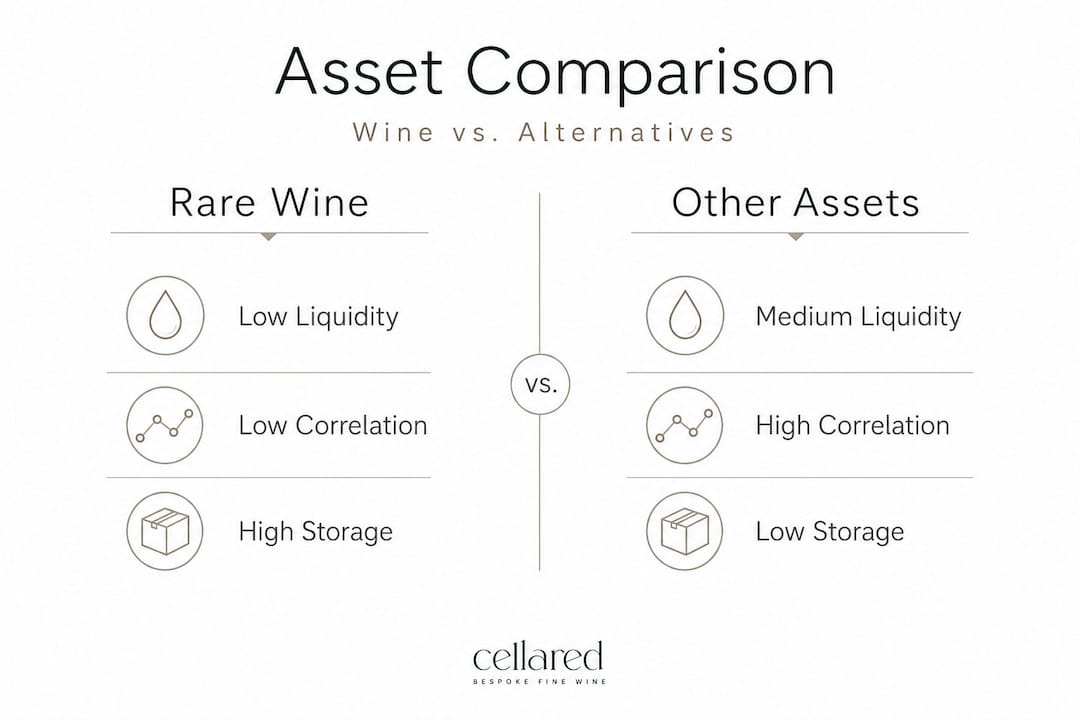
Most high net worth investors who allocate to fine wine treat it as a satellite position rather than a core holding. The broadly recommended range sits between 1% and 5% of total portfolio value, calibrated to the individual's liquidity needs, existing alternative exposure, and appetite for the operational demands the asset class brings.
When building a fine wine portfolio, a structured approach is essential. Consider the following practical checklist:
- Define your investment thesis: Are you seeking capital appreciation, inflation protection, or generational wealth transfer? Each objective influences which producers, regions, and vintages you prioritise.
- Establish storage infrastructure: Temperature-controlled, humidity-regulated, and security-compliant storage is non-negotiable. This applies whether you use a personal cellar or a professional bonded warehouse.
- Source from reputable channels: Auction houses, specialist merchants, and investment-grade wine advisers with documented provenance chains reduce the risk of counterfeit or compromised stock.
- Engage independent valuation: Establish a baseline valuation at acquisition, and schedule reassessments every two to three years or following significant market events.
- Integrate into your broader tax and estate structure: Fine wine's tax treatment varies significantly across APAC jurisdictions; early advice from a specialist is prudent.
Pro Tip: A 2% allocation to fine wine within a well-structured portfolio can meaningfully reduce overall volatility without materially sacrificing return potential, particularly when the selection focuses on producers with proven secondary market demand.
Understanding the risks: illiquidity and speculation in rare wine
Understanding the integration is only part of the story. Effective risk management is essential before any allocation is committed. The most significant risk in fine wine is one that is often underestimated by those approaching the asset class for the first time: illiquidity.
Unlike shares or bonds, you cannot exit a fine wine position at 9:30 on a Monday morning. Selling a collection of any meaningful size requires time, the right market conditions, and often specialist intermediaries. Costs associated with auction commissions, merchant fees, and shipping can erode returns substantially if not accounted for in the original acquisition strategy. As established asset managers note, fine wine can be speculative and/or illiquid, a reality that demands honest appraisal before commitment.
Key risks to assess before allocating
- Illiquidity risk: Realisable value may not be accessible quickly, and forced sales in a thin market can significantly reduce returns.
- Provenance risk: Bottles with unclear or broken provenance chains attract buyer scepticism and may command steep price discounts or fail to sell entirely.
- Storage risk: Suboptimal storage conditions, even temporarily, can permanently impair the quality and value of a bottle.
- Price volatility: While broad correlation to equities is low, fine wine is not immune to its own cycles of boom and correction, particularly for fashionable regions or producers.
- Regulatory and import risk: Cross-border transactions in APAC can encounter complex duty and import regulations, adding cost and delay.
- Counterfeit risk: The market for rare wine has attracted sophisticated fraudsters; due diligence on seller credentials and provenance documentation is essential.
Mitigation begins with specialist advice. Securing appropriate wine insurance guidance tailored to the APAC context is a foundational step that many collectors overlook until it is too late. Equally important is developing a working understanding of the wine market, including the key indices, the producers whose secondary market demand is most robust, and the seasonal rhythms of the major auction houses.
Pro Tip: Before purchasing any bottle above AUD 2,000, request a full provenance trail from the seller, including original purchase receipts, storage history, and import documentation where applicable. This single discipline eliminates the majority of counterfeit and quality-impairment risk.
Practical steps: access, valuation and ongoing management
With risks clearly on the table, the next priority is translating strategy into action through smart, secure execution. Rare wine investment is ultimately an operational discipline as much as a financial one, and the decisions made at acquisition, storage, and exit each have material consequences for the final return.
Fine wine, as alternative investments gaining traction demonstrate, requires a level of active stewardship that many first-time investors underestimate. The steps below outline a rigorous approach to building and managing a meaningful allocation.
A structured process for rare wine investment
- Source with purpose: Use specialist advisers or reputable auction platforms to access exclusive rare wine that meets your defined investment criteria. The open retail market is rarely the right entry point for serious collectors.
- Commission an independent valuation at acquisition: Establish the market value of each bottle or case at the point of purchase, referencing current secondary market data. This baseline is essential for insurance, tax, and future comparison. Adherence to wine valuation standards ensures your records will stand up to scrutiny in any formal context, from insurance claims to family law proceedings.
- Arrange specialist storage: Utilise a temperature-controlled, professionally managed cellar facility. Ensure the facility provides individual ownership records and is covered by comprehensive insurance.
- Review and revalue regularly: Schedule formal revaluations every two to three years, or following significant auction results for comparable bottles. This discipline keeps your portfolio data current and enables informed buy, hold, or sell decisions.
- Monitor the market actively: Track Liv-ex indices, major auction results from Christie's, Hart Davis Hart, and Langton's, and keep abreast of critical point scores and producer news that may affect demand.
- Plan your exit early: Identify your preferred disposition channels before you need them, whether auction, private sale, or trade. Early planning preserves your negotiating position and timing flexibility.
The full spectrum of private wine services available to serious collectors in APAC encompasses everything from bespoke sourcing through ongoing cellar management, and engaging these services proactively removes much of the operational burden from the investor.
Pro Tip: Commission a formal court-ready valuation for any collection exceeding AUD 50,000. This level of documentation is invaluable not only for insurance purposes but also for estate planning, gifting strategies, and potential family law scenarios.
What most miss about the real role of rare wine
There is a tendency in financial commentary to reduce rare wine to a simple diversification instrument, a useful non-correlated asset to be sized at 2% and largely forgotten. This framing, while not entirely wrong, misses something essential about what rare wine actually is.
The finest bottles carry a form of value that spreadsheets do not fully capture. A magnum of 1990 Romanée-Conti or a first-growth Bordeaux from a legendary vintage is not merely a financial instrument. It is a cultural object, a story, and in many APAC family contexts, a statement of generational intention. The collector who approaches rare wine purely through the lens of return on investment will frequently miss the moments that create the greatest value: the underpriced lot at a regional auction, the emerging producer whose critical recognition is about to inflect upwards, or the obscure vintage that a new generation of collectors suddenly discovers.
Illiquidity, so often framed as the primary risk, can also function as a discipline. Unlike liquid assets that tempt reactive selling during market dislocations, a cellar of fine wine demands patience. That enforced patience, aligned with the ageing dynamics of the wines themselves, means that the investor who holds a structured position in first-growth Bordeaux or top Burgundy through a market correction often emerges with a materially stronger position than the one who panicked and sold. The patience required to hold is precisely what many asset classes cannot enforce.
There is also the generational dimension, which we see particularly in APAC families with multigenerational wealth. Wine collections passed between generations carry emotional and cultural weight that amplifies their financial value. An estate wine collection, approached with the right advisory framework as part of estate-level wine investment, can serve as a vehicle for values, stories, and relationships as much as for capital. The conventional financial playbook has no framework for that, and it is precisely why rare wine rewards a more holistic perspective.
Enhance your collection with expert guidance
For investors who recognise that rare wine deserves a more considered approach than a simple allocation decision, Cellared Fine Wine offers the depth of expertise to match your ambition.

Whether you are commencing your first formal allocation or managing an established collection that has grown beyond its current framework, our team provides professional wine appraisals that meet the highest evidentiary standards, meticulous cellar management solutions tailored to your holdings, and bespoke acquisition services that reach beyond what open markets offer. From sourcing a single iconic bottle to conducting a full portfolio audit, Cellared works with collectors and investors across Australia and APAC to ensure every decision is informed, every bottle is protected, and every investment is positioned to realise its full potential.
Frequently asked questions
How much should I allocate to rare wine in my portfolio?
Most investors allocate between 1% and 5% to rare wine, calibrated to their liquidity needs and existing alternative exposure, given that allocation sizing and friction matter materially to real portfolio outcomes.
What is the main risk of investing in rare wine?
The primary risk is illiquidity, as rare wine can be speculative and selling may take considerable time and involve transaction costs that reduce net returns.
Do rare wines perform well during market volatility?
Rare wines often carry low correlation to equity markets, offering potential stability during sharp corrections, though fine wine's traction for diversification does not guarantee returns in all market conditions.
Can I easily access my rare wine investment if I need funds quickly?
Rare wine is a fundamentally illiquid asset, and alternatives lack cash-equivalent safety, meaning you should not rely on a wine allocation to meet short-term liquidity requirements.