
Selecting a bottle from a prestigious merchant's catalogue is one thing. Building a collection that performs beautifully across decades, from cellar to portfolio, is an entirely different discipline. Bespoke wine buying is the art and science of acquiring wines with meticulous precision, shaped by expert guidance, forensic provenance verification, and a deeply personal understanding of your objectives. For collectors and investors across Australia and the Asia-Pacific region, this approach represents not merely a preference but a strategic imperative, one that separates exceptional collections from expensive accumulations of bottles gathering dust.
Table of Contents
- What is bespoke wine buying?
- Key components of bespoke wine buying
- Balancing drinking pleasure and investment returns
- Navigating risks and opportunities in bespoke buying
- Why bespoke wine buying is the ultimate portfolio strategy
- Explore bespoke wine solutions for your collection
- Frequently asked questions
Key Takeaways
| Point | Details |
|---|---|
| Personalised buying matters | Bespoke wine buying delivers tailored enjoyment and stronger investment returns than generic purchases. |
| Verification is crucial | Careful provenance checks and expert validation protect against counterfeits and ensure quality. |
| Portfolio approach maximises value | Strategic collection management balances drinking pleasure with capital growth potential. |
| Australian wines offer unique advantages | Local blue-chip bottles provide strong appreciation and liquidity for investors and collectors. |
What is bespoke wine buying?
At its core, bespoke fine wine buying is a highly personalised acquisition process guided by expert knowledge rather than catalogue browsing. Think of it as the difference between a made-to-measure suit from a master tailor in Naples and an off-the-rack jacket from a department store. Both are garments, but only one is crafted to your precise measurements, preferences, and purpose.
Standard wine purchasing typically involves selecting from whatever is available on shelves or via an online merchant. Bespoke buying, by contrast, considers provenance (the documented history of a bottle's ownership and storage), critic scores from authoritative voices such as Robert Parker or Antonio Galloni, bottle rarity, and in some cases the creation of custom blends in limited quantities. It is a process designed to maximise your enjoyment, investment return, and the long-term integrity of your collection.
The complexity of this approach is worth appreciating fully. A fine wine buying guide built around bespoke principles must account for a range of nuanced scenarios:
- Allocations that require long-standing relationships with Burgundy domains, where availability is tightly controlled and waitlists span years
- Counterfeit risk that demands forensic examination of labels, capsules, fill levels, and cork markings for investment-grade bottles
- Mixed-vintage rotation structured around drinking windows, sorting bottles into "drink soon," "monitor," and "hold for investment" categories
- Custom blending from half-barrels in smaller quantities, offering unique lots unavailable on the open market
- En primeur futures, where wine is purchased before bottling, offering price advantages and access to sought-after vintages
As noted in expert cellar rotation guidance, these edge cases are not exceptions but the defining features of serious wine collection management. Managing them well is precisely what distinguishes bespoke buying from any other approach.
"Bespoke wine buying is not about spending more. It is about acquiring with purpose, verifying with rigour, and managing with the discipline of a seasoned portfolio manager."
This discipline extends naturally to private client wine services, where advisors work alongside collectors to map objectives before a single bottle is acquired. The relationship comes first; the wine follows.
Key components of bespoke wine buying
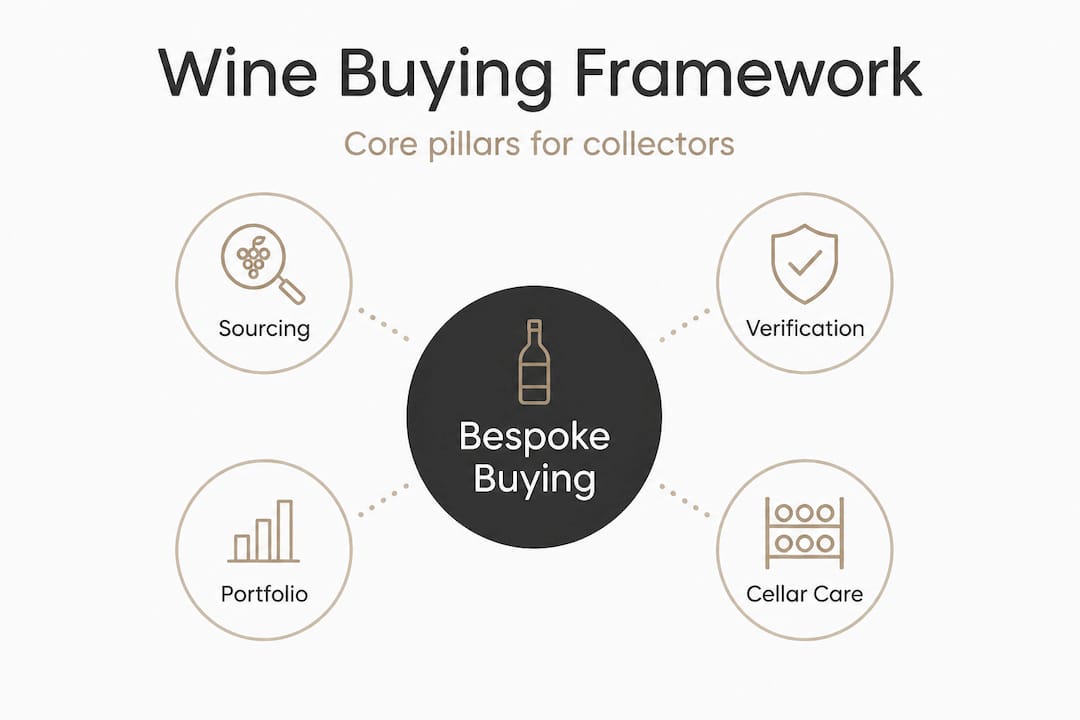
Understanding the pillars of bespoke acquisition allows collectors to evaluate any purchase opportunity with clarity and confidence. These components are not sequential steps but interconnected layers that reinforce one another throughout the collection lifecycle.
The core framework
| Component | What it involves | Why it matters |
|---|---|---|
| Sourcing | Direct allocations, specialist brokers, auction channels | Access to rare and limited bottles unavailable elsewhere |
| Verification | Provenance documentation, critic scores, forensic checks | Protects investment integrity and authenticity |
| Vintage strategy | Drinking windows, appreciation curves, mixed-vintage rotation | Balances enjoyment and long-term financial return |
| Collection management | Portfolio tracking, liquidity planning, custom blending | Ensures flexibility and strategic exit options |
| Market intelligence | Liv-ex indices, regional data, APAC demand trends | Informs buying decisions with real-time market signals |
Each component must operate in harmony. Exceptional sourcing without rigorous verification, for example, creates exposure to the counterfeit market, a risk that remains deeply underestimated by casual collectors.
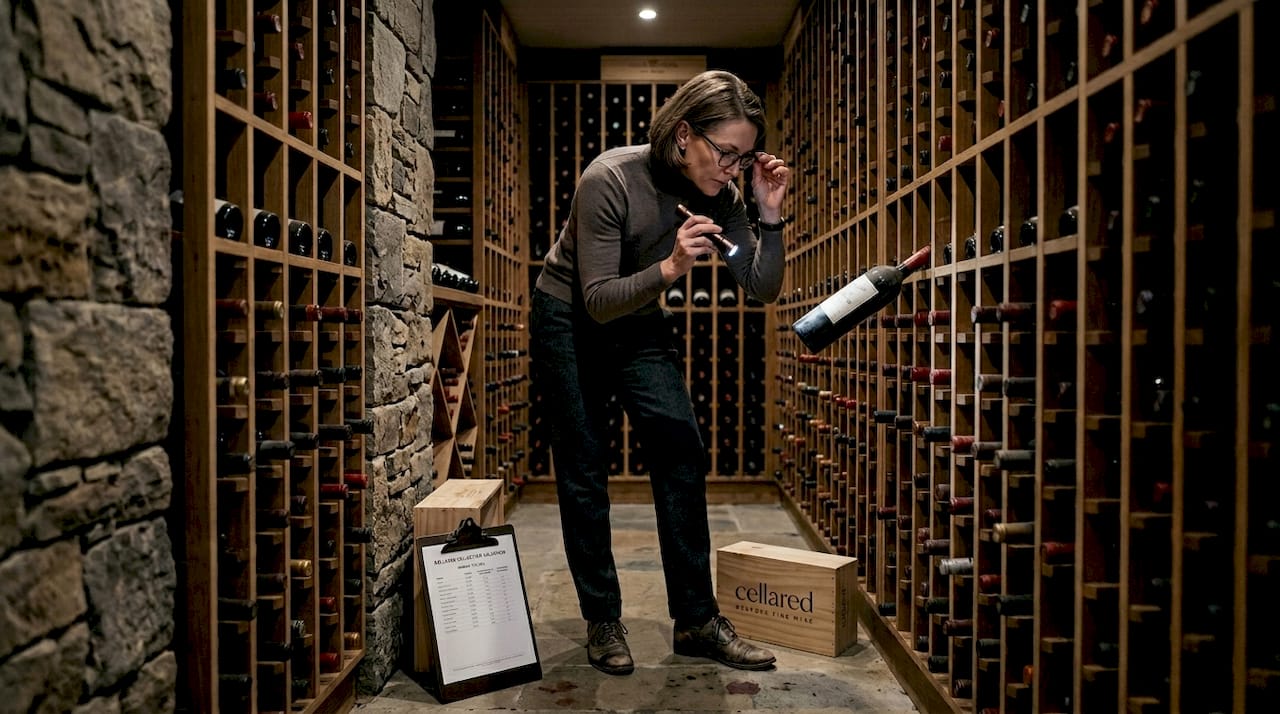
From an investment perspective, a sound fine wine portfolio strategy prioritises blue-chip wines with high critic scores and proven appreciation histories. According to wine finance data, investment-grade collections should focus on wines scoring 95 points or above, with strong Liv-ex liquidity and documented appreciation. Minimum collections for wine-backed loans typically start at £250,000, equivalent to approximately AUD $470,000, at lending ratios of 50 to 60 per cent of appraised value.
For Australian collectors specifically, the bespoke buying framework should incorporate:
- Penfolds Grange from the Barossa Valley, widely regarded as Australia's most internationally recognised icon wine, with critic scores consistently above 95 points
- Henschke Hill of Grace, a single-vineyard Shiraz of extraordinary rarity and provenance, sourced from vines planted in the 1860s
- Wynns Coonawarra Estate Black Label Cabernet Sauvignon, a collectible wine that has appreciated substantially from entry-level cases starting around $200, now commanding multiples of that figure at auction
- Torbreck RunRig and other small-production Barossa Shiraz expressions with international collector followings
- Cullen Diana Madeline from Margaret River, a benchmark biodynamic Cabernet blend with growing international prestige
Pro Tip: Before committing to any significant purchase, cross-reference the wine's current Liv-ex market price against its auction history over five and ten-year periods. This single habit separates investment-grade wine identification from speculative buying.
Balancing drinking pleasure and investment returns
One of the most nuanced challenges in building a bespoke collection is achieving the right tension between bottles you will open and enjoy and those you will hold for financial appreciation. The two objectives are not mutually exclusive, but they require deliberate structure.
A well-designed collection typically divides into three zones:
- Drink soon: Wines at or approaching their peak drinking window, selected for immediate enjoyment at the table. These may include younger vintages of accessible producers or older wines that have peaked and will not benefit from further cellaring.
- Monitor: Wines developing towards their peak, requiring periodic reassessment. These bottles benefit from professional cellar management to ensure storage conditions remain optimal and drinking windows are tracked accurately.
- Investment hold: Wines specifically selected for appreciation, liquidity, and potential resale or inclusion in asset-backed financing structures.
The data on Australian wine appreciation is compelling. Wine finance research confirms that Wynns Black Label cases acquired at entry-level pricing have appreciated significantly over holding periods, while Penfolds Grange consistently maintains secondary market liquidity that rivals first-growth Bordeaux. These are not incidental outcomes; they are the result of strategic, bespoke acquisition over time.
Mixed-vintage rotation, as detailed in cellar rotation guidance, is central to this balance. Rather than holding a uniform block of one vintage, sophisticated collectors build layered collections where bottles from different years mature at different rates, providing flexibility to drink or sell depending on market conditions, personal circumstances, or shifting investment objectives.
| Wine | Entry price (per case) | Current secondary market range | Appreciation profile |
|---|---|---|---|
| Penfolds Grange (strong vintages) | AUD $3,000+ | AUD $6,000 to $15,000+ | High, proven liquidity |
| Wynns Black Label | AUD $200 to $400 | AUD $600 to $1,200+ | Strong, underappreciated globally |
| Henschke Hill of Grace | AUD $5,000+ | AUD $9,000 to $18,000+ | Exceptional, very limited supply |
| Torbreck RunRig | AUD $1,500 to $2,500 | AUD $3,000 to $5,000+ | Solid, growing international profile |
Note: Figures are indicative and subject to vintage variation and market conditions.
Understanding wine cellar management tips that align with this three-zone framework allows collectors to extract maximum value from every bottle, whether that value is measured in pleasure or financial return. The key is intentionality at the point of purchase, knowing precisely why each bottle is being acquired and where it fits in the collection's overall architecture.
To invest and collect rare bottles successfully, you must resist the temptation to buy reactively. Every acquisition should serve the collection's strategic objectives.
Navigating risks and opportunities in bespoke buying
Fine wine investment is not without its hazards. For every story of extraordinary appreciation, there is a cautionary tale of counterfeit bottles, poorly stored collections, or allocation relationships that were never properly cultivated. Understanding these risks is not pessimism; it is the prerequisite for sound decision-making.
The principal risks in bespoke buying include:
- Counterfeit exposure: The fine wine market, particularly for high-value bottles, attracts sophisticated fraud. Labels, capsules, and even glass can be replicated with alarming precision. This is why forensic provenance checks are non-negotiable for investment-grade acquisitions, not an optional extra.
- Allocation scarcity: The most sought-after producers, particularly in Burgundy but increasingly in the Barossa and Coonawarra, release wine only to established clients. Building these relationships requires patience, consistent purchasing history, and often the guidance of an advisor with existing connections.
- Storage compromise: Even a perfectly authenticated bottle of Penfolds Grange loses significant value if its provenance includes periods of inadequate storage. Temperature fluctuations, vibration, and light exposure degrade wine chemically and destroy investment value.
- Market volatility: The Liv-ex Fine Wine 100 index, like any asset class, experiences cycles. A bespoke strategy accounts for this by diversifying across regions, vintages, and price points rather than concentrating in a single producer or appellation.
The opportunities, however, are equally significant:
- Early allocation access through long-term producer relationships provides pricing advantages unavailable on the secondary market
- Custom blending options for smaller quantities create unique, numbered lots that carry their own collectible status
- Australian wines remain undervalued relative to their quality and appreciation trajectory by international standards, representing a genuine opportunity for locally-based collectors
- Wine-backed lending against established collections at 50 to 60 per cent loan-to-value ratios provides liquidity without requiring the sale of prized bottles
Pro Tip: Always request a full provenance chain in writing before purchasing any bottle valued above AUD $500. If a seller cannot provide clear storage and ownership history, treat the acquisition as high-risk regardless of how appealing the label appears.
"Investment-grade wine demands forensic scrutiny. The most expensive mistake a collector can make is to assume that a prestigious label guarantees authenticity. Verification is not bureaucracy; it is the foundation of collection integrity."
When the time comes to realise value from your collection, understanding wine liquidation strategies ensures you exit with maximum return. Equally, selling your wine collection through experienced professionals protects against undervaluation in private sales or unsupported auction processes.
Why bespoke wine buying is the ultimate portfolio strategy
Here is a perspective that rarely appears in mainstream wine commentary: most high net worth individuals who invest in wine underperform not because they buy the wrong bottles, but because they buy without a framework.
The conventional approach to "serious" wine collecting still centres on selecting prestigious names from well-regarded vintages. That is a reasonable starting point, but it overlooks the relationship infrastructure that truly defines elite collections. The finest lots of Romanée-Conti, Screaming Eagle, or Penfolds Bin 95 Grange do not reach casual buyers. They flow through networks built over years, sometimes decades, of mutual trust and consistent engagement. Bespoke buying is, at its heart, a relationship-first discipline.
Australian wines present a particularly compelling case for this approach. Globally, Barossa Shiraz and Coonawarra Cabernet remain underrecognised relative to their quality, their aging potential, and their secondary market appreciation rates. Collectors who have built direct relationships with producers in these regions have accessed extraordinary bottles at prices that international buyers would consider almost implausibly low. That window of opportunity will not remain open indefinitely as APAC demand continues to mature.
What also tends to be overlooked is the flexibility that a well-structured bespoke collection provides. A portfolio built across drinking, monitoring, and investment-hold segments offers genuine liquidity options, portfolio building strategies that can adapt to life changes, tax planning needs, or simply the desire to share a magnificent bottle at the right moment. Casual buyers accumulate wine. Bespoke collectors build living, breathing portfolios.
The hard-won lesson, drawn from working with serious collectors across Australia and the broader APAC region, is this: the depth of your relationships with producers, advisors, and the market itself is what separates a collection of lasting value from one that simply fills a cellar. Bottle selection matters enormously, but it is the layer beneath the selection, the framework, the verification, the strategy, and the relationships, that determines whether your collection genuinely performs.
Explore bespoke wine solutions for your collection
Building a collection that balances pleasure and investment with genuine precision requires more than enthusiasm and a generous budget. It requires the kind of market knowledge, producer relationships, and analytical rigour that only comes from deep, sustained expertise in fine wine.
Cellared Fine Wine offers a complete suite of bespoke wine buying services tailored to collectors and investors across Australia and APAC, from sourcing rare and allocated bottles to structuring collections for both enjoyment and long-term appreciation. Our professional wine valuations are court-ready and market-led, covering insurance, probate, family law, and private advisory purposes with rigorous independence. For those seeking ongoing support, our wine cellar management services provide the oversight, rotation planning, and condition monitoring your collection deserves. Every engagement begins with a conversation about your objectives. The bottles follow from there.
Frequently asked questions
How do I verify the authenticity of investment-grade wines?
You should request full provenance documentation, critic score reports, and consider forensic counterfeit checks for high-value bottles, particularly those from Burgundy domains or limited-production Australian icons where fraud risk is elevated.
What are the main risks in bespoke wine buying?
The primary risks include counterfeit bottles, allocation scarcity challenges, inadequate storage compromising provenance, and market volatility; engaging an experienced specialist significantly reduces exposure to each of these.
Which wines are considered blue-chip for Australian collectors?
Blue-chip Australian wines include Penfolds Grange and Henschke Hill of Grace from the Barossa, along with Wynns Coonawarra Estate Black Label, all of which demonstrate strong critic scores, international demand, and documented secondary market appreciation.
How can I balance drinking and investment in my collection?
Structure your collection using a three-zone framework: bottles to drink now, those to monitor as they approach their peak, and investment-hold wines selected specifically for appreciation, liquidity, and potential inclusion in asset-backed financing arrangements.