
Choosing fine wine is not simply a matter of selecting what appeals in the moment. Beneath the surface of every significant acquisition lies a complex layer of provenance assessment, channel strategy, lifecycle management, and market intelligence that only genuine expertise can navigate with confidence. Whether you are building a cellar for personal pleasure, assembling a portfolio with investment intent, or managing a substantial inherited collection, the operational and strategic decisions that shape long-term value are rarely visible to the untrained eye. This guide reveals precisely what expert involvement looks like in practice, and why it matters more than most collectors initially realise.
Table of Contents
- Why expertise matters in fine wine acquisition
- Navigating buying channels: Retail versus auctions and secondary markets
- Expert-driven collection management: Operations, inspection, and documentation
- Tailoring expertise: Investment advisers versus sommeliers
- Frameworks for engaging wine experts: Practical steps for collectors
- Beyond conventional wisdom: What most collectors overlook about expert roles
- Connect with expert services for your fine wine journey
- Frequently asked questions
Key Takeaways
| Point | Details |
|---|---|
| Expert curation maximises value | Professional guidance ensures you acquire authentic, well-stored wines and enjoy confidence in every purchase. |
| Strategic channel selection | Experts leverage auctions and secondary markets for liquidity, transparent pricing, and access to desirable bottles. |
| Operational management drives longevity | Inspection, recorking, and proper documentation by experts support long-term value retention and traceability. |
| Tailored advice for diverse goals | Investment advisers and sommeliers address different objectives, from portfolio optimisation to personal enjoyment. |
| Adapt expert roles for the digital era | With greater transparency, experts now focus on market structure, timing, and risk management rather than classic scoring alone. |
Why expertise matters in fine wine acquisition
Fine wine is not a commodity, and treating it as one is the fastest route to regret. A bottle of first-growth Bordeaux or vertically-aged Burgundy carries with it a story of storage, handling, provenance, and chain of custody that directly determines its worth, both at the table and at auction. Experts do not merely point to what is fashionable; they diagnose authenticity, assess condition, and match bottles to the specific goals of each collector.
The transition from casual drinker to serious collector is a moment of considerable vulnerability. Labels become more prestigious, prices climb significantly, and the consequences of a poorly authenticated purchase grow proportionally. This is where expert-led curation earns its value. As noted in master sommelier retail strategies, leading wine advisers formalise expert-led curation and personalisation as a buying methodology, particularly for collectors moving from casual purchasing to genuinely managed cellars.
The practical benefits of expert involvement at the acquisition stage include:
- Provenance verification: Confirming the chain of custody and storage history of a wine before purchase, reducing the risk of counterfeit or compromised bottles.
- Condition assessment: Evaluating fill levels, capsule integrity, label condition, and cork performance to determine whether a wine is investment or drinking grade.
- Personalised curation: Matching selections to the collector's palate, investment horizon, and cellar capacity rather than defaulting to generic recommendations.
- Market intelligence: Understanding which appellations, producers, and vintages are gaining or losing favour, giving clients a structural advantage.
- Educational progression: Building a collector's knowledge alongside their cellar, so confidence grows in tandem with the collection.
"The most consequential decisions in fine wine are not about what to buy, but how to buy it. Provenance, channel, and timing are the real architecture of value."
Collectors who engage experts from the outset typically find that their wine cellar management tips translate into measurable returns over time, rather than costly lessons learned in hindsight. For those just beginning, a structured fine wine buying guide provides the essential framework for acquisition decisions that stand the test of time.
Navigating buying channels: Retail versus auctions and secondary markets
Not all fine wine is available through the same door, and the channel through which a bottle is acquired shapes its provenance certainty, pricing dynamics, and eventual resale potential. Experts understand these distinctions instinctively and structure purchases accordingly.
| Channel | Best suited for | Key advantages | Key considerations |
|---|---|---|---|
| Retail (specialist) | Curated collections, immediate availability | Personalised service, verified stock | Pricing may carry retail margin |
| Auctions | Rare, mature, or cellared bottles | Transparent bidding, secondary market access | Buyer's premiums, authentication due diligence |
| Secondary markets | Specific vintages, hard-to-find labels | Access to aged stock, sometimes competitive pricing | Provenance verification critical |
| Direct from producer | En primeur, futures, allocated releases | First access, producer certification | Requires long-term capital commitment |
Auction houses such as Langton's in Australia provide a transparent marketplace where historical pricing data informs bidding strategy. However, wine investment channel strategies confirms that experts build liquidity and value through deliberate channel selection, weighing market signals, buyer's premiums, and authentication risk rather than defaulting to direct-from-producer buying alone.
Secondary markets offer extraordinary access to wines that simply cannot be sourced elsewhere. A 1996 Penfolds Grange or a 2005 Domaine de la Romanée-Conti will not appear on any retailer's current price list; finding such bottles requires expert networks, relationships with private vendors, and the judgement to assess whether the price reflects genuine condition. Experts also analyse timing carefully, understanding that secondary market dynamics fluctuate with vintage releases, auction cycles, and collector sentiment.
Key factors experts assess when selecting a buying channel include:
- Liquidity profile: Whether the wine can be resold efficiently at a future date.
- Provenance certainty: The traceability of storage and ownership history.
- Commission and premium structures: Total acquisition cost beyond the hammer price or retail ticket.
- Authentication risk: The likelihood of encountering counterfeit or compromised stock.
For collectors aiming to build a fine wine portfolio with both enjoyment and asset growth in mind, understanding channel mechanics is as important as the selection itself. Detailed guidance on wine sourcing explained helps demystify the pathways through which exceptional bottles reach discerning cellars.
Expert-driven collection management: Operations, inspection, and documentation
Acquisition is only the opening chapter of a collection's story. What follows, the care, inspection, recorking, documentation, and periodic reassessment of every bottle, is where expert involvement becomes truly indispensable. Many collectors invest considerably at the point of purchase, then inadvertently erode that value through neglect of the operational layer.
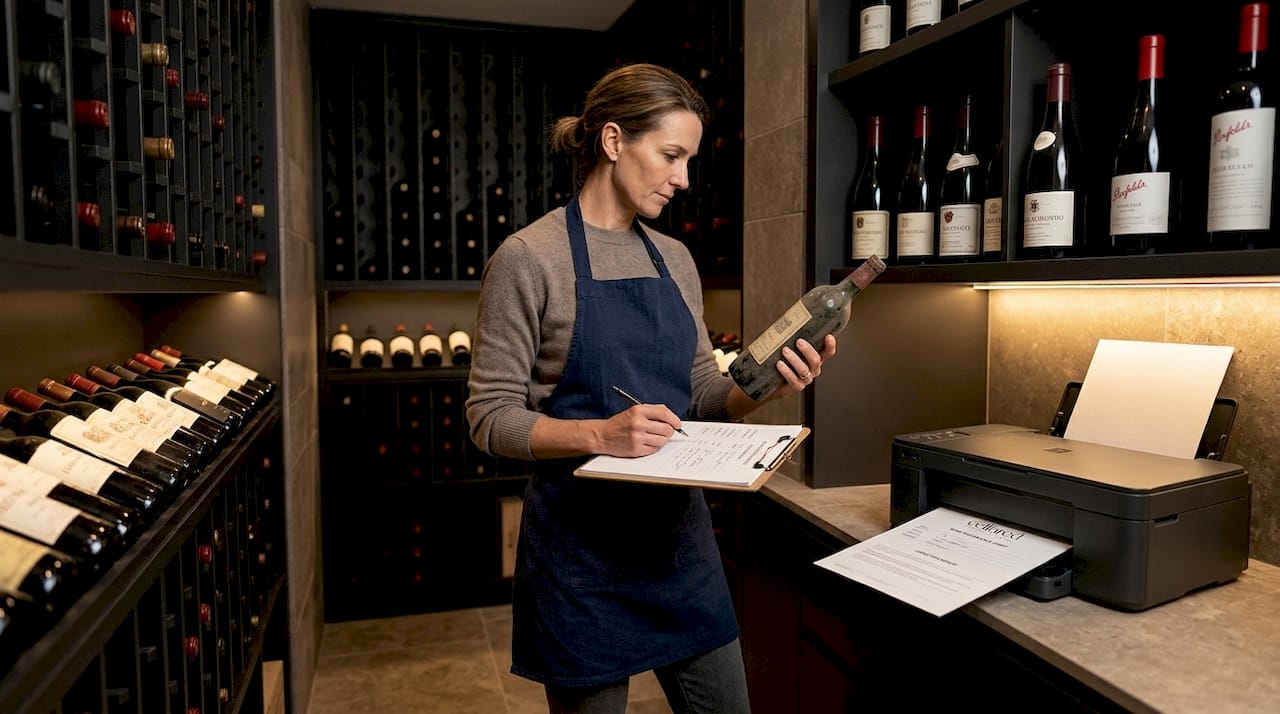
The Penfolds inspection clinics illustrate precisely what rigorous lifecycle management looks like in practice. At these events, bottles of Grange worth tens of thousands of dollars are opened, assessed, and recorked by technical specialists, with each decision documented and certified. This process directly supports value retention by confirming condition and providing a traceable record of treatment.
The operational steps experts typically coordinate include:
- Initial inspection: Assessing fill level, capsule condition, label integrity, and visual signs of seepage or oxidation upon acquisition.
- Temperature and humidity verification: Confirming that storage conditions meet the thresholds required for long-term cellaring.
- Periodic condition assessment: Scheduling regular reviews so that evolving bottles are consumed, sold, or treated at the optimal moment.
- Recorking and topping up: For extended-hold collections, managing cork integrity and, where appropriate, facilitating producer or specialist recorking programmes.
- Documentation and database entry: Recording treatment decisions, condition notes, and certification details so the collection has a verifiable, transferable history.
| Documentation element | Purpose | Impact on value |
|---|---|---|
| Provenance records | Chain of custody confirmation | Essential for auction and resale |
| Condition reports | Snapshot of wine health at each assessment | Supports insurance and liquidation |
| Recorking certificates | Proof of professional treatment | Premium realised at auction |
| Storage logs | Temperature, humidity, movement records | Underpins buyer confidence |
Pro Tip: Build a digital record for every significant bottle in your cellar. Photograph labels, capsules, and fill levels at acquisition and at each subsequent assessment. This archive becomes a powerful asset at the point of sale or estate settlement.
For practical guidance on organising your wine cellar to support this operational discipline, and for those exploring what a private wine cellar truly entails at a sophisticated level, expert guidance provides the structure that transforms a collection from a pleasant hobby into a well-managed asset.
Tailoring expertise: Investment advisers versus sommeliers
Not all wine experts bring the same orientation to the table, and understanding the distinction is crucial for high net worth collectors who want to extract maximum value from their advisory relationships. The two most common expert archetypes, investment advisers and sommeliers, approach the task through entirely different lenses.
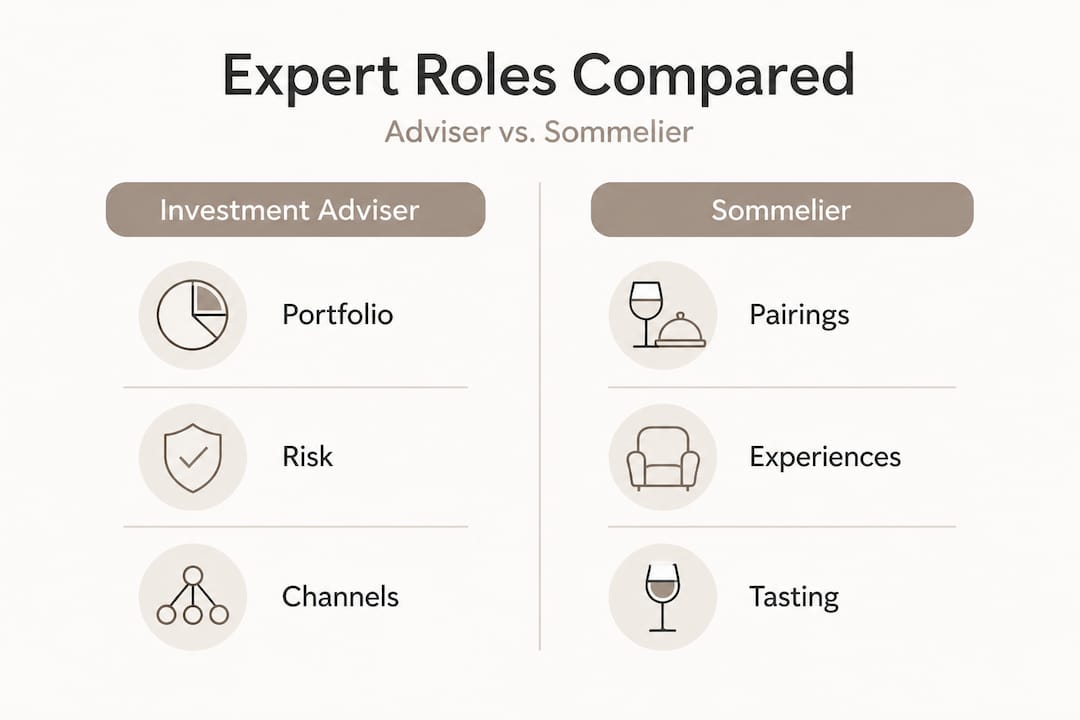
| Dimension | Investment adviser | Sommelier |
|---|---|---|
| Primary focus | Portfolio strategy, risk management, channel mechanics | Curation, pairing, discovery, personal enjoyment |
| Provenance approach | Formal verification, auction record analysis | Producer knowledge, retail relationship |
| Channel preference | Auctions, secondary markets, futures | Specialist retail, direct from producer |
| Client interaction | Strategic, periodic, data-driven | Regular, experiential, palate-led |
| Ideal for | Investors, estate planning, liquidation | Personal cellars, hospitality, gifting |
As expert investment strategies clarifies, sommelier expertise optimises for immediate pairing fit and personalised discovery, while investment advisers concentrate on channel mechanics, provenance verification, and portfolio benchmarks. Both are genuinely valuable, but they answer different questions.
The most sophisticated collectors typically engage both orientations at different stages of their collection's life. A sommelier might curate the drinking and gifting component of a cellar with elegance and precision, while an investment adviser manages the longer-hold, higher-value bottles with rigorous strategic oversight. Combining these perspectives, with clear communication between advisers about shared objectives, delivers an outcome that neither could achieve alone.
The key is knowing which expert to engage for which decision:
- Engaging a sommelier: When building a drinking cellar, selecting wines for a significant occasion, exploring a new region or style, or seeking education.
- Engaging an investment adviser: When acquiring at auction, managing a multi-vintage portfolio, planning estate or probate considerations, or assessing liquidation options.
For those seeking wine services for collectors that bridge both perspectives, or looking for ideas on wine collection curation at a refined level, clarity about your own objectives is the most important starting point.
Frameworks for engaging wine experts: Practical steps for collectors
Knowing that expertise matters is one thing; knowing how to harness it across the full lifecycle of a collection is another entirely. The following framework provides a structured approach to expert engagement that serves both newcomers and seasoned collectors.
- Define your objectives clearly. Are you building a drinking cellar, an investment portfolio, or a mixed-purpose collection? The answer shapes every subsequent decision, from channel selection to storage requirements.
- Select advisers with complementary skills. Match expert type to objective, whether that is a sommelier for curation and discovery, or an investment specialist for portfolio strategy.
- Establish a provenance standard. Before any purchase, agree with your adviser on the documentation and verification required. Do not compromise on chain of custody.
- Document everything at acquisition. Photograph, record condition notes, and retain receipts, catalogue entries, or auction records for every bottle of significance.
- Schedule periodic collection reviews. Engage your expert at least annually to assess maturing bottles, identify those approaching optimal drinking windows, and update condition records.
- Plan post-purchase treatment proactively. For long-hold bottles, coordinate recorking or inspection programmes before condition deteriorates rather than after.
- Prepare for liquidation from day one. The Penfolds certification clinics demonstrate that collections with traceable, documented treatment command meaningfully better outcomes at the point of sale.
Pro Tip: Treat your wine collection as you would any other significant asset class. Engage your adviser not only at the point of purchase but at every major lifecycle moment, acquisition, condition review, gifting, and eventual sale.
Cellar management services that integrate acquisition, documentation, and ongoing assessment provide the infrastructure for this kind of disciplined stewardship. For those considering their exit strategy, understanding wine liquidation from the outset shapes far better outcomes than approaching the question retrospectively.
Beyond conventional wisdom: What most collectors overlook about expert roles
Here is an uncomfortable truth most fine wine commentary sidesteps. The traditional model of expert value, built on critic scores, en primeur allocation faith, and the authority of famous names, is losing its structural dominance. Data transparency is accelerating this shift in ways that will reshape how collectors engage with advisers.
As the architecture of trust article by Greg Sherwood MW argues, expert advantage is migrating away from score-giving and toward underwriting strategy around market structure, timing, and risk. In plain terms: the experts worth engaging in 2026 are those who understand market mechanics, channel dynamics, and operational risk as fluently as they understand viticulture and vinification.
This matters enormously for high net worth collectors. The old model rewarded those who trusted the right critics and secured the right allocations. The emerging model rewards those whose advisers understand when to buy, through which channel, at what stage of the market cycle, and how to document the journey for maximum value retention. These are structural and strategic skills, not merely palate skills.
What does this mean practically? It means collectors who rely solely on scores and reputation are operating with an increasingly incomplete map. The wine sourcing confidence that distinguishes elite collectors from aspirational ones now derives from market intelligence, provenance rigour, and operational discipline rather than label prestige alone.
The most overlooked operational detail, consistently, is post-purchase documentation. Collections that are acquired with care but never formally assessed, recorked, or logged lose a disproportionate share of their potential value at the point of liquidation. This is not a nuanced point; it is a structural gap that costs collectors real money, and it is entirely preventable with the right expert involvement from the outset.
Connect with expert services for your fine wine journey
The difference between a collection that grows in value and one that quietly diminishes often comes down to one factor: the quality of expert support behind every key decision.
At Cellared Fine Wine, we provide bespoke wine buying services tailored to collectors, investors, and private clients across Australia and the broader APAC region. Whether you need independent wine appraisals and valuation for insurance, probate, or family law purposes, or you are seeking professional cellar management that brings rigour and accountability to your collection, our team combines deep market knowledge with a genuinely personal approach. The next step is a conversation.
Frequently asked questions
How do experts verify the provenance and condition of rare wines?
Experts verify provenance and condition through inspection, documentation, certification, and database entry after treatment, ensuring traceability and supporting value retention across the collection's lifecycle.
What is the benefit of buying through auctions and secondary markets?
Auctions and secondary markets provide access to well-stored, mature wines with transparent pricing, and building liquidity through channel selection allows buyers to leverage market signals and secure bottles unavailable through retail channels.
How do expert advisers differ from sommeliers in wine buying?
Expert advisers concentrate on channel mechanics, verification, and risk management, while sommeliers optimise for pairing fit and personalised discovery, making each approach valuable for different collector objectives.
Can experts help maintain the value and longevity of my collection?
Yes, experts coordinate regular inspection, recorking, and post-purchase documentation that supports both condition preservation and smoother liquidation outcomes when the time comes to sell.
What changes are happening for expert roles as data transparency improves?
As information becomes more accessible, expert advantage is shifting toward market structure and strategic risk management, rather than relying on critic scores or the faith-based allocation model of previous generations.